Counter-Strike Skills You Can Improve Without Playing Matches
You don’t need to spend every hour in Premier or Faceit to become a better Counter-Strike player. Discover the skills you can train away from live matches, from map recognition and economy knowledge to prediction, pattern recognition, and game sense.

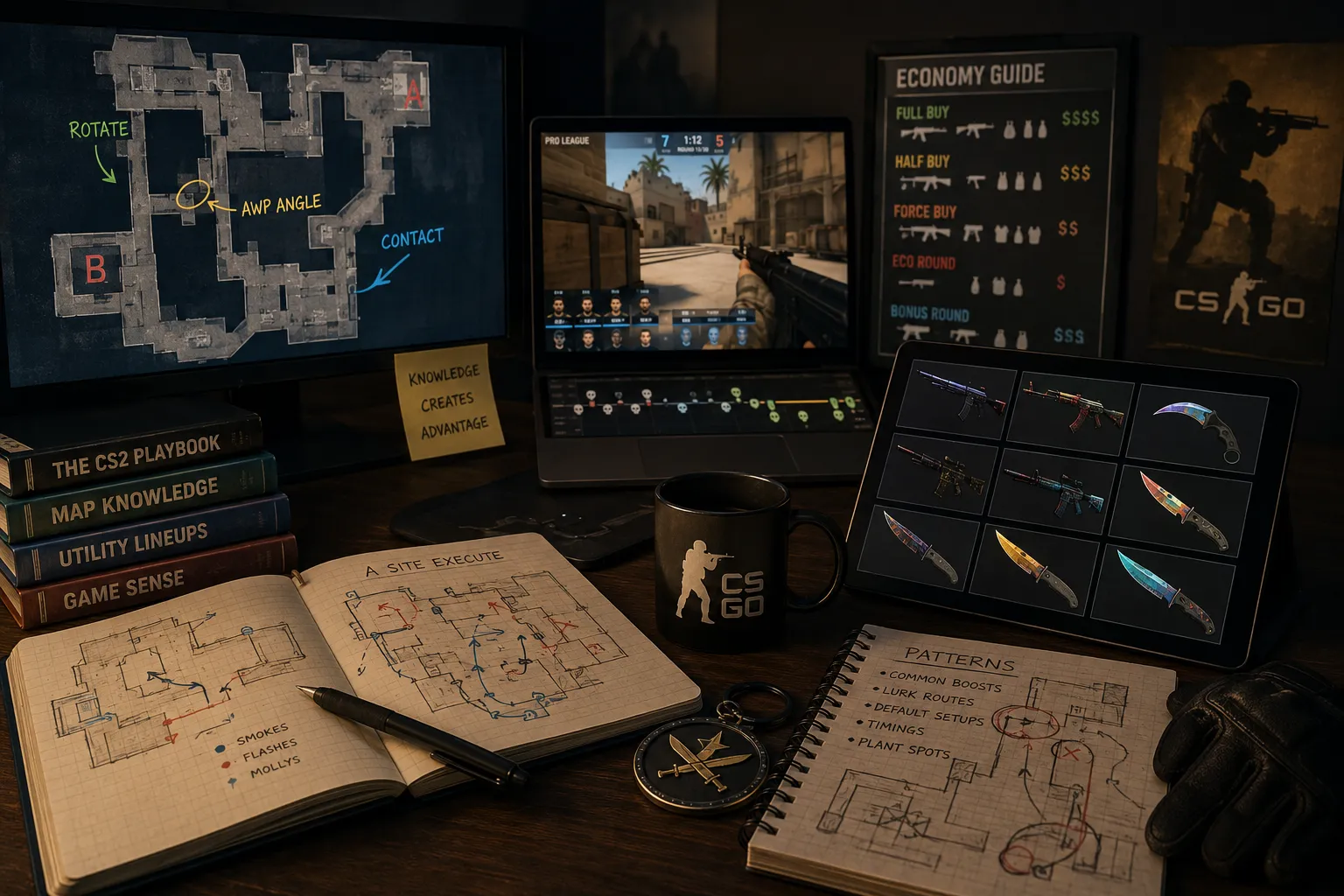
Introduction
Many Counter-Strike players believe improvement only happens inside a live match.
They queue Premier, jump into Faceit, practice aim, and repeat the same cycle — hoping that more hours played will automatically turn into better results.
While playing matches is one of the most important parts of improving at Counter-Strike, it is not the only way to become a smarter and more effective player.
Some of the biggest improvements happen away from the server.
Professional players, analysts, and experienced competitors spend countless hours studying the game outside of active matches. They review demos, analyze strategies, learn maps, study opponents, and develop their understanding of Counter-Strike fundamentals.
These activities improve the skills that separate average players from great ones:
- Better decision-making
- Faster reactions
- Stronger game sense
- Improved map awareness
- Smarter economy choices
- More accurate predictions
The best part? Many of these skills can be trained anywhere — even when you are not launching CS2.
1. Improve Your Map Recognition
Learn landmarks, layouts, and important positions
Map knowledge is one of the most valuable skills in Counter-Strike.
A player with strong map recognition does not just know where Bombsite A or B is located. They understand the entire environment.
They recognize:
- Common player positions
- Important angles
- Rotation paths
- Choke points
- Common hiding spots
- Popular utility locations
A skilled player can look at a small section of a map and immediately understand where they are.
They know if they are near:
- A bombsite entrance
- A connector area
- A rotation route
- A dangerous engagement position
This knowledge allows players to make faster decisions during high-pressure moments.
Why map recognition improves gameplay
Imagine you are defending a site and hear footsteps somewhere nearby.
A player with limited map awareness might panic.
A player with strong recognition immediately understands:
- Where enemies can come from
- How long rotations will take
- Which angles need attention
- When to reposition
Good map knowledge creates confidence.
You spend less time thinking about where you are and more time thinking about what your opponent might do.
Challenge yourself with map recognition
Map recognition is one of the fastest Counter-Strike skills to train because it relies heavily on pattern recognition.
You can test your knowledge by identifying locations from screenshots, unusual angles, or small visual clues.
A great way to practice is through Guess the Map on CSGuess, where players can challenge their knowledge of Counter-Strike environments in a fun and competitive way.
2. Improve Your Skin Recognition
Understanding skins is more than collecting cosmetics
At first glance, Counter-Strike skins might seem purely cosmetic.
However, the skin economy has become one of the biggest parts of the Counter-Strike community.
Many casual players recognize famous skins like:
- AK-47 | Redline
- AWP | Dragon Lore
- M4A4 | Howl
But experienced players and collectors can identify much more.
They understand:
- Float values
- Wear conditions
- Collections
- Rare finishes
- Doppler phases
- Case Hardened patterns
- Market differences
This knowledge creates a deeper connection with the game.
How skin recognition helps players
Learning skins improves your understanding of:
- The Counter-Strike economy
- Trading culture
- Item rarity
- Market trends
- Community history
It also develops visual memory.
Recognizing small differences between skins requires the same type of observation skills that help players identify enemy positions, weapon choices, and game situations.
3. Master Counter-Strike Economy Management
Winning rounds starts before the round begins
Many players focus entirely on aim.
However, economy decisions often decide matches before a single bullet is fired.
A team that understands economy management can create advantages even without having better mechanical skill.
Important economy concepts include:
Full Buy
A full buy means having enough money for:
- Rifles
- Armor
- Utility
- Defuse kits when needed
Knowing when to full buy is essential for creating strong rounds.
Half Buy
A half buy balances spending and saving.
Teams may purchase limited equipment while preparing for future rounds.
Force Buy
A force buy means spending money even when resources are limited.
Sometimes teams choose to force because winning one unexpected round can completely change the match.
Eco Round
An eco round focuses on saving money for future rounds.
Good players understand that losing one round strategically can create a stronger position later.
Bonus Rounds
Bonus rounds happen after a team wins with surviving weapons and continues using them.
Understanding when to protect weapons and when to upgrade is part of advanced decision-making.
Why economy knowledge matters
A player with average aim but excellent economy awareness can consistently outperform someone with better mechanics but poor decisions.
Counter-Strike is not only a shooting game.
It is a resource management game.
4. Analyze Professional Counter-Strike Matches
Watching pros is only useful if you study them
Many players watch professional matches for entertainment.
They enjoy incredible clutches, amazing aim, and highlight plays.
But the biggest learning opportunities are often hidden between those moments.
Instead of simply watching, analyze.
Pause rounds and ask:
- Why did they rotate?
- Why did they save?
- Why did they push?
- Why did they choose this buy?
- Why did they use this utility?
- Why did they slow down?
These questions develop game sense.
Learn how professionals think
Elite players are not successful only because they aim better.
They understand:
- Timing
- Positioning
- Team communication
- Risk management
- Opponent behavior
Studying professional gameplay helps you understand the decisions behind the action.
5. Study Utility Knowledge
Learn before you practice
Utility is one of the most important parts of modern Counter-Strike.
Smokes, flashes, and Molotovs can completely change how rounds are played.
Even without opening CS2, you can study:
- Smoke lineups
- Flash timings
- Molotov locations
- Pop flashes
- Common executes
Learning the theory first makes practical training much faster.
When you finally enter a server, you are not starting from zero.
You already understand:
- Why the grenade is used
- Where it lands
- What advantage it creates
Knowledge reduces wasted practice time.
6. Develop Pattern Recognition
Counter-Strike is a game of repeated behaviors
One of the hidden skills behind elite players is their ability to recognize patterns.
Every match contains repeated situations.
Players often use:
- Similar boosts
- Common lurk routes
- Popular timings
- Familiar bomb plant positions
- Repeated defensive setups
Experienced players notice these patterns quickly.
Why pattern recognition matters
The faster you identify a situation, the faster you can respond.
A player who recognizes a common attack setup can prepare before the enemy fully commits.
This creates an advantage that has nothing to do with reaction speed.
It comes from experience and understanding.
7. Improve Your Prediction Skills
The connection between knowledge and prediction
Prediction is one of the most underrated Counter-Strike skills.
Great players are constantly predicting:
- Enemy positions
- Opponent strategies
- Map choices
- Economy decisions
- Future rounds
They are not randomly guessing.
They are using information.
This is where skill-based prediction games naturally fit into Counter-Strike training.
Platforms like CSGuess allow players to test their knowledge by predicting:
- Maps
- Skins
- Weapons
- Match outcomes
- Player performances
Prediction games keep your Counter-Strike knowledge active even when you are away from competitive matches.
They challenge your memory, awareness, and understanding of the game.
How to Improve at CS2 Without Playing Every Day
Improvement does not require endless hours of matchmaking.
A smarter training approach combines gameplay with learning.
You can improve by:
- Studying maps
- Watching professional demos
- Learning economy concepts
- Understanding utility
- Testing your knowledge
- Reviewing strategies
- Practicing prediction
The strongest players are students of the game.
They do not only play Counter-Strike.
They study Counter-Strike.
Conclusion
Becoming better at Counter-Strike is about more than winning gunfights.
Aim is important, but knowledge creates consistency.
The players who continue improving are the ones who develop every part of their skill set — including the parts that happen away from the server.
Whether you are learning map recognition, studying professional matches, understanding economy, or testing your prediction abilities, every activity builds your understanding of the game.
You can improve at CS2 without firing a single bullet.
The next time you close the game, remember: your progress does not stop.
There is always another skill to learn, another pattern to recognize, and another way to become a smarter Counter-Strike player.