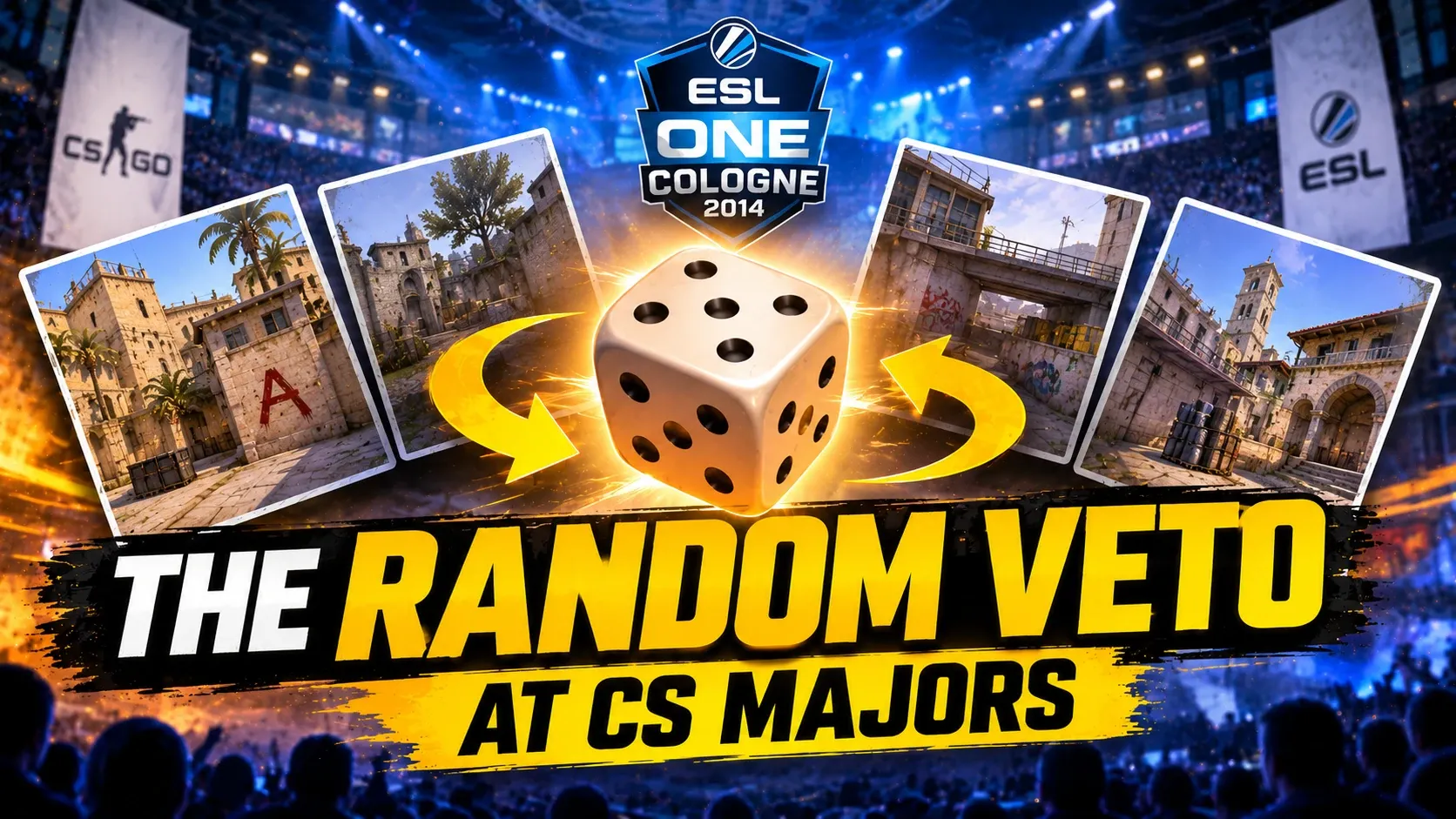
When Valve changed Premier's map selection in September 2026, one detail stood out: the system ends in a random draw. According to Dot Esports, as we noted in our article on the change, it resembles a format used at the ESL One Cologne 2014 Major.
That earlier format has a history. It was used at Valve's Majors for about three years, and the pros who played under it were not fans. The details below come mainly from HLTV's history of the competitive map pool.
How Majors Picked Maps Before
The first Major, DreamHack Winter 2013, used a pool of Dust2, Mirage, Train, Nuke, and Inferno. In the group stage, played as best-of-ones, each team banned two maps and the last one left became the battlefield. In best-of-three playoffs, each team banned one map and picked one, and the last remaining map was the decider.
Inferno was by far the most played map at that Major. It was played 19 times, ten more than second-placed Dust2.
The Update That Forced a Change
The trigger was Operation Breakout, in July 2014. It removed Train and added Cache, Cobblestone, and Overpass, which made the Active Duty group seven maps for the first time. HLTV, writing in 2023, called it the most impactful change to the pool up to that point.
It caused controversy on two fronts. It arrived only one month before ESL One Cologne 2014, so teams could not prepare properly for the new pool. And seven maps meant the old veto no longer fit.
The Random Veto
Six days after the update, ESL announced that Cologne would use the new Active Duty group and a new veto.
In best-of-ones, each team banned two maps, and the map to play was chosen at random from the last three available. In the playoffs, each team banned one map and picked one, and then a randomizer chose the decider. No knife rounds were played, so the team that vetoed first got to choose its side.
The Reaction
Pros disliked it. According to HLTV, NBK described the random selection as fit only for matchmaking, and device said it was too biased toward the higher-seeded team.
Valve's Majors were the only ones using it. Other organizers, including ESL, DreamHack, and FACEIT, ran vetoes controlled entirely by the two teams. Devilwalk, who played and coached through that era, told HLTV that no one else used the system.
The practical problem was preparation. Devilwalk said a team using the random format would always leave most of its prep unused, and that it was demotivating to prepare for things you would not play. HLTV adds that a couple of unfavorable random picks could end a team's whole run at a Major.
It Stayed
Despite the criticism, the randomizer stayed at Majors for three years, with few changes.
At DreamHack Winter Cluj-Napoca 2015, Valve tweaked the best-of-one format. Teams alternated bans until two maps were left, and then the randomizer chose between the pair. The same structure was used at MLG Columbus 2016.
How It Ended
The randomizer was removed at PGL Kraków in July 2017, the second Major of that year. The tournament adopted the standard veto used elsewhere, which gives teams full control over map selection. HLTV says Valve adopted the usual ban, ban, pick, pick sequence at that event.
The Echo in 2026
This is interpretation. Premier's 2026 system is not the same. It has no bans: one team picks a map, the other picks two, the first picks a fourth, and the game draws one at random. In 2014, the randomizer chose from the maps left after bans.
The reaction to the old system also may not predict anything about the new one. The old format was used in the biggest tournaments of the year, where preparation is everything. Premier is matchmaking, and ironically that is where NBK said a random pick belonged. Whether players accept it is something we will only learn from how they use it.
What We Do Not Know
HLTV's history does not include a statement from Valve on why it chose the random veto in 2014. There are no published figures on how often a team was knocked out by an unlucky draw, and the sources do not say whether Valve plans any changes to Premier's draw.
Keep Learning the Format
Knowing why Valve moved away from random selection once helps you read every new map system. The mini games on CS Guess test your knowledge of Counter-Strike, covering skins, cases, music kits, and the history behind this game, with free perks for playing well.
Head over to CS Guess and see how much of this game you know.