Valve Made Almost $900 Million From CS2 Armory Since Launch — Here's Where That Money Actually Goes
Valve doesn't publish revenue figures for CS2, and it never has. But a community of dedicated analysts has spent the past two years reverse-engineering the numbers anyway, using publicly available market data, and the picture that's emerged is staggering: Valve's Armory system alone appears to have generated somewhere close to $900 million since it launched, on pace to cross a billion dollars right around its second anniversary. Here's the full breakdown of where that number comes from, and where the money actually goes once it's in Valve's hands.

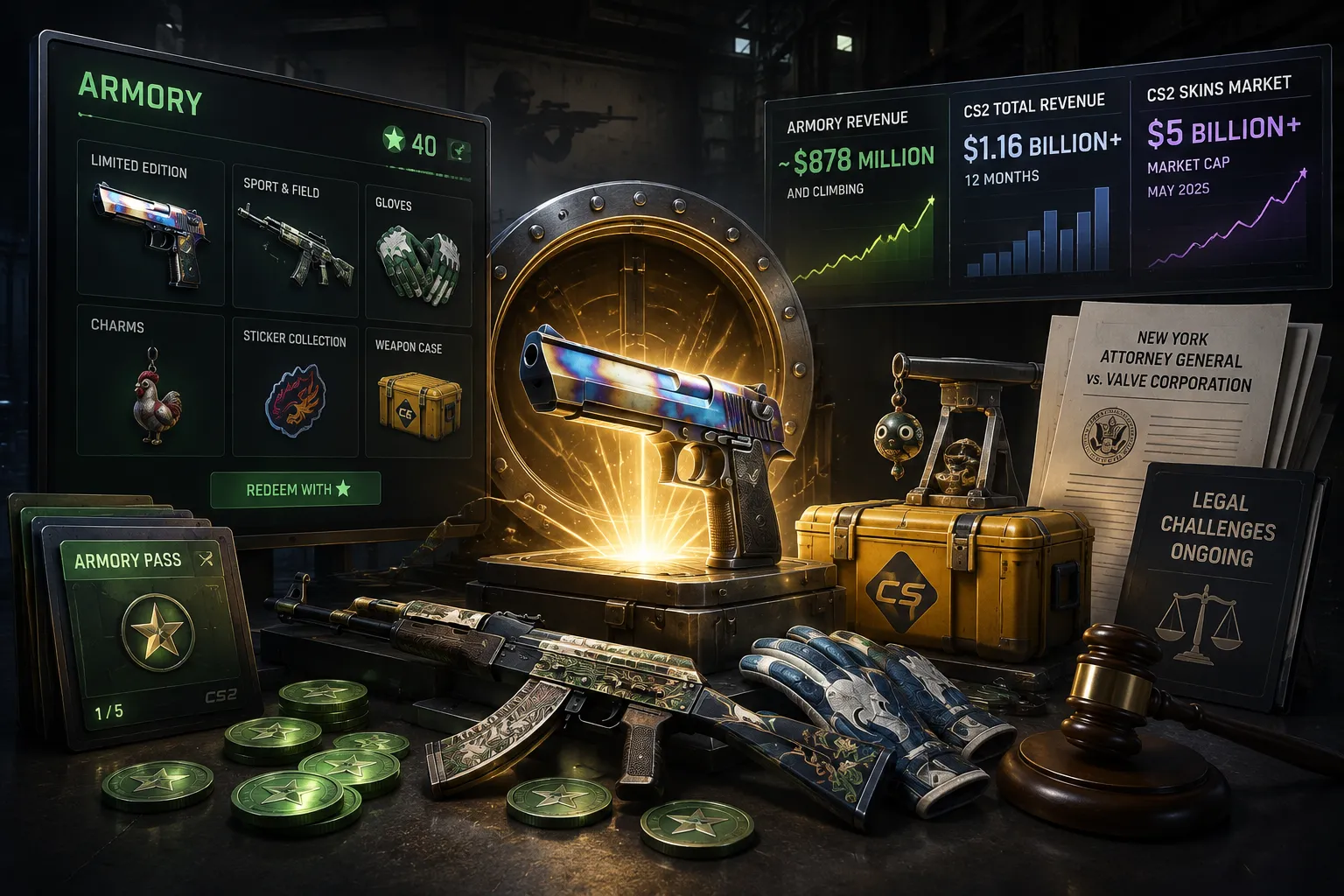
A quick note on sourcing before the numbers: Valve is privately held and has never published official revenue figures broken out by individual game or system. Every number in this article comes from independent community analysts working from publicly available market data, primarily sites like CSFloat, CSGOSkins, CS2StickerTracker, and CSROI, reverse-engineering totals from case-opening statistics and marketplace transaction data. These are informed estimates from people who've built genuinely sophisticated tracking tools, not official disclosures, and the analysts themselves are consistently upfront that their own numbers are likely conservative rather than inflated.
What Armory Actually Is
The Armory launched on October 2, 2024, as a permanent addition to CS2's monetization, sitting alongside the older case-and-key system rather than replacing it. It requires Prime Status to access, costs $15.99 per Armory Pass, and can be stacked up to five passes at once for players willing to spend $79.95 upfront. Each pass earns up to 40 Armory Credits, commonly called stars, which players redeem for specific collections, Limited Edition skins, gloves, charms, and case keys rather than relying purely on random drops the way the older case system does.
The Number: Nearly $900 Million and Climbing
Community analyst SigaTbh has tracked Armory revenue estimates since shortly after launch, and the trajectory tells its own story. Back in February 2026, the estimate sat at roughly $355 million from Armory items specifically, plus another $280 million from Gallery and Fever case key sales, a combined total around $635 million at that point. By July 2026, the same analyst's updated calculation put total Armory-attributable revenue at approximately $878 million, and the trend line suggests Valve is on pace to cross the billion-dollar mark right around October 2026, which would mark exactly two years since Armory's launch.
Individual items within that total tell their own stories. The Desert Eagle Heat Treated, the very first Limited Edition skin sold through Armory, reportedly generated $12.3 million on its own and remains one of the most sought-after items in the entire system. The Sport & Field Collection has been cited as the single most popular collection released through Armory, reportedly bringing in around $86 million.
The Bigger Picture: CS2's Total Revenue
Armory is only one piece of a much larger financial picture. A separate, widely cited analysis from YouTuber ZestyJesus, built using a custom-scraped dataset covering the Steam Community Market alongside public case-opening statistics, estimated that Valve generated more than $1.16 billion from CS2 in total across the twelve months from November 2024 to November 2025. That figure breaks down into more than $1 billion in gross key sales alone, based on over 400 million cases opened at $2.50 per key, plus roughly $166 million from Valve's 15% cut on the more than $1.22 billion in Steam Community Market transaction volume tracked over that same period. Passes, stickers, and music kits add further revenue on top of that, though there's no reliable public data to size that slice precisely, and ZestyJesus's own estimate treated it as a conservative placeholder rather than a confident figure.
For context on how large the surrounding economy has actually gotten, the total value of the CS2 skins market itself, meaning the combined market value of everything already in player inventories rather than Valve's revenue specifically, was tracked by Price Empire crossing $5 billion in market cap by May 2025, having taken just three months to climb from $4 billion to $5 billion after a full year to go from $3 billion to $4 billion.
Where the Money Actually Goes
This is the part that's generated real friction within the community. Content creator ArrowCS highlighted the gap directly: Armory had generated at least $636 million in under two years at the time of that comparison, while an individual creator who gets their community-submitted skin design accepted into the game receives a flat $35,000 payment. Valve's newer "Call to Arms-ory" creator program, which invites Workshop submissions around specific themes, offers creators a choice between that same flat one-time payment structure, $35,000 for an accepted weapon finish, $6,000 for a sticker, or $6,000 for a charm, or an alternative revenue-share arrangement tied to how well that specific item actually sells over time. It's a genuine trade-off between guaranteed cash upfront and a smaller, uncertain slice of a system that's demonstrably capable of generating hundreds of millions of dollars.
The Legal Question Hanging Over All of This
The sheer scale of this revenue has attracted regulatory attention, and it's worth being clear-eyed about where that stands rather than picking a side. In February 2026, the New York Attorney General filed suit against Valve, arguing that CS2's loot box mechanics, cases requiring a paid key with a random chance-based outcome that can carry real market value afterward, amount to illegal gambling. Valve responded publicly in March 2026, denying the claims and stating it had spent years engaging with the AG's office on this exact question since first contact in early 2023. In May 2026, Valve filed a motion to dismiss, arguing that treating its case system as gambling under this reasoning would logically extend to things like baseball cards or Happy Meal toys, physical products that also involve randomized rewards with resale value. Separately, an Austrian court had already ruled in favor of a player in a smaller refund dispute over case mechanics, and countries including Belgium and the Netherlands have imposed their own loot box restrictions for years already. Germany introduced a mandatory odds-preview tool for local players in March 2026, and the EU's broader Digital Fairness Act discussions continue to keep loot boxes in the conversation at a policy level. None of this is resolved, and it's presented here as an active, unsettled legal and regulatory question rather than a verdict on whether Valve's systems are or aren't gambling.
What This Means If You're Playing the System
Whether or not you have strong feelings about the legal debate, the practical math around Armory is worth understanding on its own terms. Community-built ROI trackers following specific collections have shown real variance, some redemptions landing close to or above breakeven on the credits spent, others sitting well below the cost of the pass required to earn them. That variance is the entire point of the system from Valve's side, and it's exactly why the hundreds of millions in estimated revenue and the individual player experience of "is this actually worth it" can both be true at the same time.
Test Your Read on Value Without Spending a Cent
If reading through these numbers makes you want to sharpen your own sense of what's actually worth chasing in this economy versus what just looks appealing, that instinct is exactly what the mini games on CS Guess are built to develop. You get tested on real prices, real rarity, and real market patterns, and you build up free perks just for playing well, without a single Armory Credit or dollar changing hands to find out if your read was right.
Head over to CS Guess, sharpen your instincts for what's actually worth something, and get a clearer picture of value before you ever open your wallet.