CS2 Just Reworked Bomb Damage for the First Time in 26 Years — Here's Everything That Changed
For as long as Counter-Strike has existed, the bomb has worked the same simple way: a circle expands from wherever it's planted, and if you're inside it when it goes off, you take damage based purely on distance, walls or no walls. That's no longer true. Valve shipped a complete rework of bomb damage alongside CS2's Premier Season 5 update, and it's being described as the first change of its kind in the franchise's 26-year history. Here's exactly what changed, and why it's already reshaping how rounds actually end.

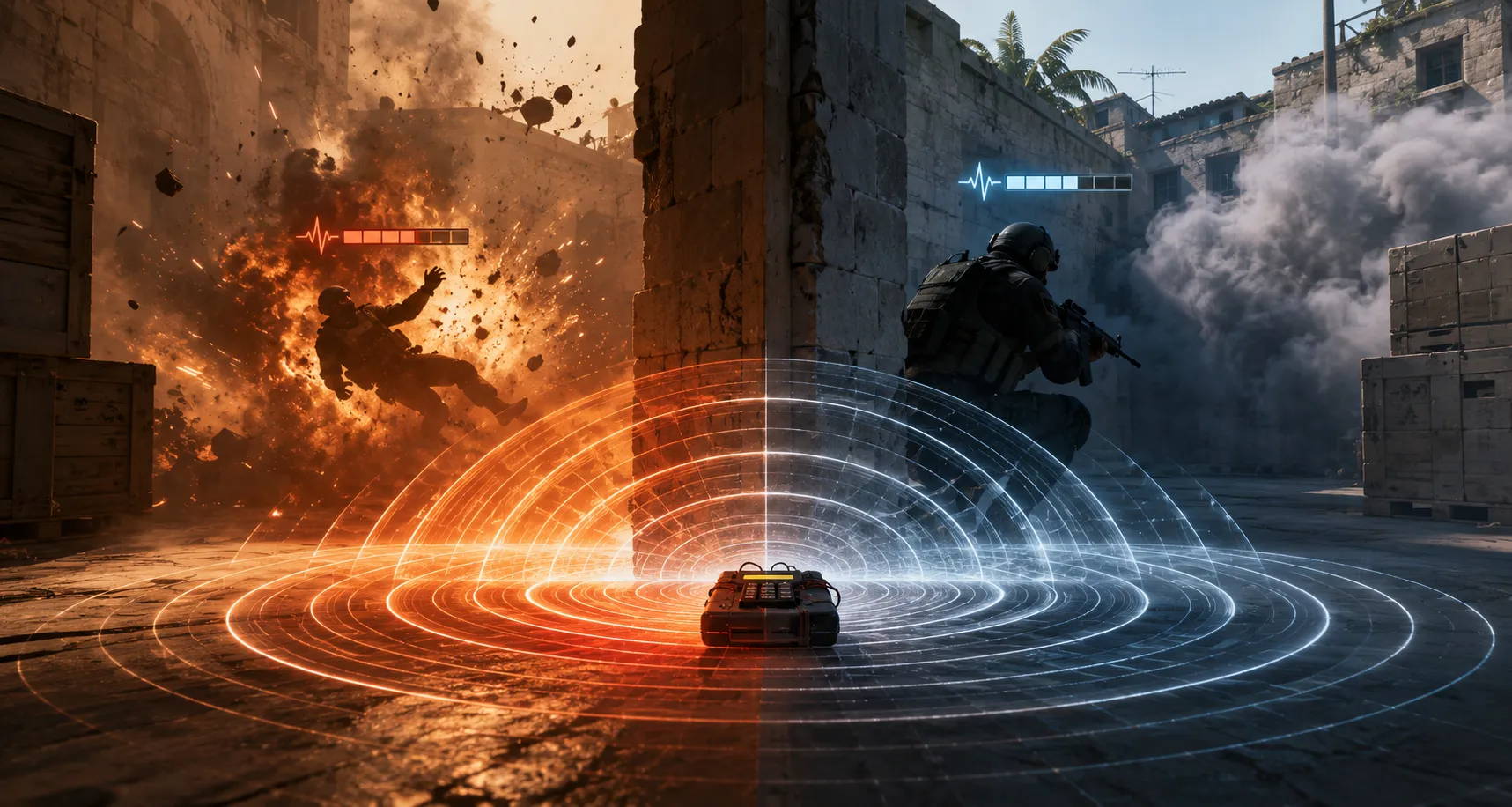
Some updates tweak numbers. This one rewrote a piece of Counter-Strike's core physics that had gone essentially untouched since the original game shipped in 1999. Valve released the change on July 8, 2026, bundled into the same patch that brought Cache back into the Active Duty map pool and kicked off Premier Season 5, but the bomb rework is the part that's actually going to decide rounds.
How the Bomb Used to Work
For over two and a half decades, bomb damage in Counter-Strike was calculated with a simple invisible sphere. Wherever the bomb was planted became ground zero, and damage was applied instantly the moment the timer hit zero, based purely on straight-line distance from that point. Walls, corners, and any other map geometry were completely irrelevant to the calculation. If you were close enough to the bomb in raw distance, you took damage, even if there were three concrete walls physically between you and the explosion. Generations of players learned specific safe spots on every map purely through trial, error, and word of mouth, since the underlying math never actually cared what was between you and the blast.
How It Works Now
The new system replaces that instant, distance-only sphere with an expanding shockwave that actually interacts with the map around it. When the bomb detonates, damage now spreads outward from the plant location over roughly a couple of seconds rather than applying all at once, and it genuinely respects the environment as it travels. Corners dissipate the force of the blast, and standing behind a sufficiently thick wall can block it almost entirely, though being close enough to a wall that's in the blast's path doesn't guarantee full safety, since the shockwave can still catch you if you're not far enough away. Valve also added a genuinely useful piece of new information: once the bomb becomes audible, players now get a health bar preview showing roughly how much damage they're about to take from their current position, giving you a real-time read on whether your spot is actually safe before the explosion happens.
A few smaller wrinkles came with the initial rollout and got adjusted quickly afterward. Valve briefly introduced a rule guaranteeing every player on the map took at least one point of damage from any bomb explosion regardless of position or distance, then walked that specific rule back in a follow-up patch after community feedback, removing the map-wide minimum entirely. The health bar preview's timing also got tightened in a later update, so the warning window before detonation is shorter than it was at launch, putting more pressure on split-second decisions rather than giving defenders a generous, relaxed window to plan their retreat.
Technically, the new bomb radius isn't calculated live during the match at all. It's precomputed and baked directly into each compiled map ahead of time, meaning the exact damage pattern for any given plant spot is a fixed, repeatable formula rather than something simulated fresh every round. Valve even added a console command, bake_bomb_damage_render_visualization, that lets players actually see the baked damage zones for any map, which several outlets have already used to map out exactly where is and isn't safe across the current map pool.
What Changed on Specific Maps
The practical map-by-map effects have been dramatic in some cases and barely noticeable in others. Nuke saw one of the most significant shifts: players can now survive on A site when the bomb goes off on B, and vice versa, something that was simply not survivable under the old distance-only system. That specifically undercuts the old "ninja defuse" playstyle, where defenders were forced to expose themselves to near-certain death just to have any chance at a legitimate defuse attempt on a bomb planted far from their position. Ancient, which was previously one of the more punishing maps for bomb damage, saw a genuine improvement in survivability in several spots. Anubis, by contrast, was already one of the more forgiving maps under the old system, so the practical difference there has been smaller. On Inferno, a specific corner near the far end of Pit on A site, sometimes referred to by the community as Dosia, got noticeably worse rather than better, since it sits wide open to the new shockwave with essentially nothing blocking it. Cache, freshly returned to the Active Duty pool in the very same patch, is still being actively mapped out by the community for its new safe and unsafe zones, since nobody has an established playbook for how the new bomb system interacts with a map this unfamiliar in its current form.
The Follow-Up Change That Rewrote Post-Plant Situations
Less than two weeks after the initial rework, Valve shipped a second, smaller update on July 20, 2026, that added another layer entirely: the bomb explosion itself now physically disperses any active smoke grenade clouds within its blast radius and extinguishes molotov or incendiary fire in the same area. That sounds minor on paper, but it fundamentally changes one of the most common post-plant patterns in the game. Attackers have long used a smoke thrown directly onto the planted bomb to obscure defenders' vision during a retake, forcing the defending side to either push in blind, burn a grenade clearing the smoke, or guess the timing entirely. With the bomb detonation now clearing that smoke and fire automatically, defenders retaking a site get a cleaner read on the situation in the final seconds, which shifts a meta that had been built up over years on maps like Inferno and Mirage where smoke-covered retakes were especially common.
How the Community Has Reacted
The reception has been genuinely split. A number of players and analysts have welcomed the change as a more realistic, more rewarding system, one that actually punishes standing in the open while rewarding players who use real cover intelligently, rather than relying on a purely arbitrary distance number. Others in the community have pushed back, framing the shift toward shockwave physics and environmental interaction as one more step toward CS2 playing more like other tactical shooters that have leaned into that kind of system already, a comparison that tends to come up whenever Valve changes something this foundational. Pro player reaction has leaned toward curiosity and even enthusiasm in some cases, with players testing out the new mechanic on maps like Cache and generally describing the redesigned explosion as a genuinely different feeling experience compared to the old system.
What This Means If You're Still Playing on Old Habits
If you learned your safe spots on any Active Duty map before July 2026, some of that knowledge is now simply wrong, and the maps where the change mattered most, Nuke in particular, are worth relearning from scratch rather than assuming your old instincts still hold. The baked, precomputed nature of the new system at least means the underlying math is consistent and learnable once you've actually tested it, which is a meaningfully different task from memorizing old distance-based safe spots, but it does mean a genuine relearning period for anyone who's been playing this game for years.
Keep Your Read on the Game Just as Sharp
Following changes like this is part of what makes staying current with CS2 genuinely interesting, the game keeps evolving in ways that reward players who actually pay attention. If you enjoy that kind of close following of the game, testing your knowledge of its skins, prices, and history is a different, equally engaging way to stay sharp on the culture surrounding it, and that's exactly what the mini games on CS Guess are built for.
Head over to CS Guess, put your CS2 knowledge to the test, and stay just as current on the game's economy as you are on its mechanics.