The Different Types of CS2 Cheats Explained (And How Anti-Cheat Actually Catches Them)
If you've ever died to something that felt physically impossible and wondered exactly what kind of cheat you just ran into, you're not alone. Cheating in CS2 comes in several distinct categories, each with its own telltale signs, and understanding the difference actually matters, both for recognizing what you're seeing and for reporting it effectively. Here's what each major cheat type actually does, and how anti-cheat systems work to catch them.

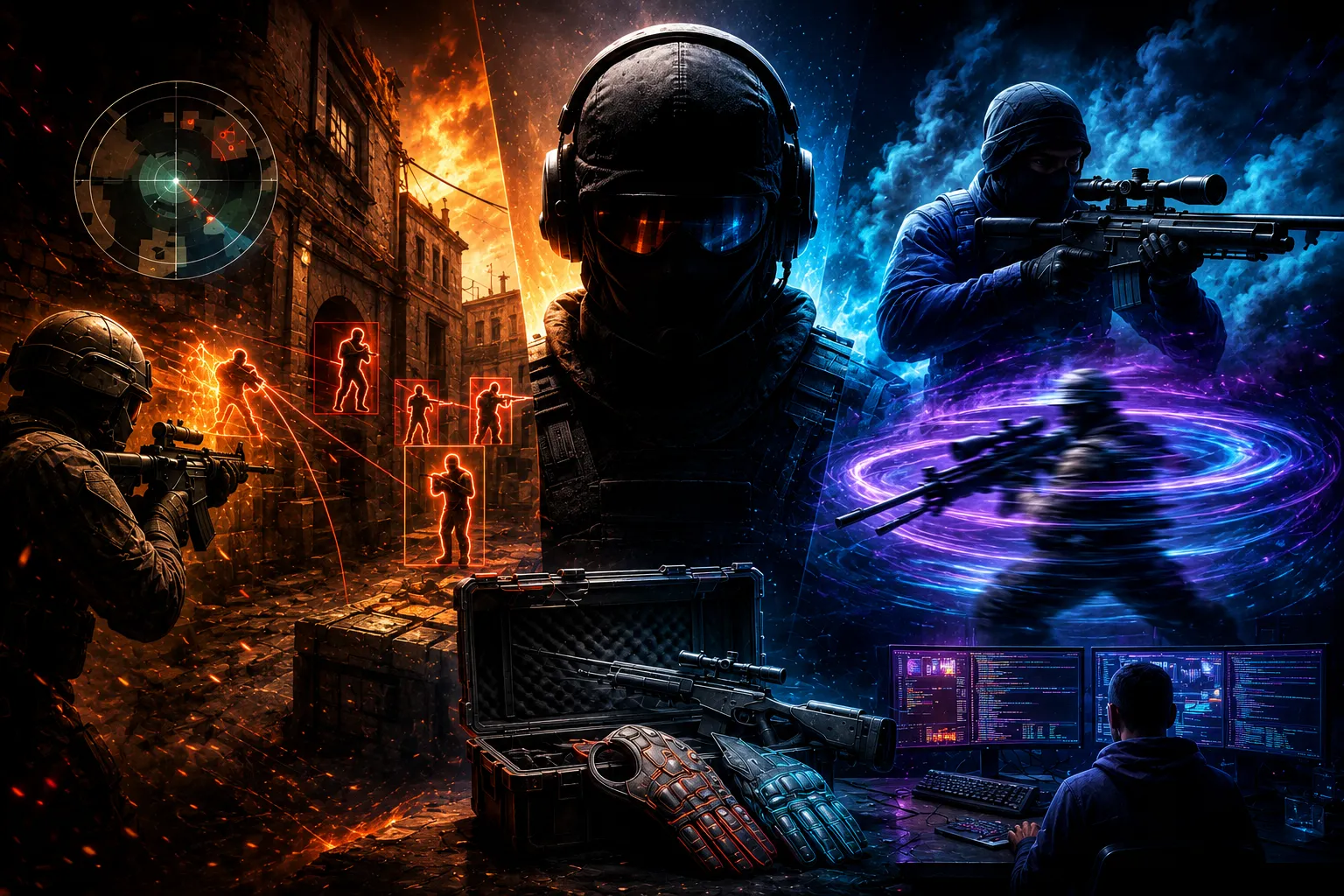
Competitive integrity is something the CS2 community cares about deeply, and part of protecting it is simply understanding what you're looking at when something feels off. This is a purely informational breakdown of cheat categories and detection concepts, not a guide to obtaining or using any of them.
Aimbot
An aimbot automatically assists or takes over a player's aim, snapping onto opponents with a precision no human reaction time could naturally replicate. The telltale sign is usually unnatural crosshair movement, sudden snaps directly onto a head or body with no visible tracking or adjustment beforehand, especially through smoke or from positions where a legitimate player would have no clear visual read on the target.
Wallhack and ESP
Wallhack, often bundled with what's generally called ESP, gives a player information they have no legitimate way of seeing, most commonly the positions of opponents through walls and other solid geometry. The giveaway here tends to be positioning rather than aim: a player consistently pre-aiming exact angles with no possible intel, or reacting to an opponent's rotation before there was any legitimate way to know it happened.
Triggerbot
A triggerbot automatically fires the instant a player's crosshair crosses an opponent's hitbox, removing human reaction time from the equation entirely. This tends to show up as shots landing with zero visible delay the moment a crosshair happens to cross a target, even in situations where the player wasn't visibly tracking or anticipating an angle.
Spinbot
Spinbot is generally the most visually obvious form of cheating, associated with what the community calls "rage" cheating rather than more subtle setups. It typically involves a player's view spinning rapidly while still landing shots with inhuman consistency, a style that prioritizes chaos and results over looking like legitimate play.
Radar Hacks and Movement Scripts
Radar hacks reveal opponent positions on the minimap without legitimate information like recent gunfire or teammate callouts to justify it. Movement-related scripts, most commonly associated with automated jump timing, remove a mechanical skill element from movement entirely. Both tend to be more subtle than an aimbot or spinbot, but still produce patterns that look mechanically inhuman on close review.
The Categories That Are Hardest to Catch
Not all cheating methods work the same way from a detection standpoint. Two categories are genuinely harder for software-based anti-cheat to identify because they don't necessarily involve any code running inside the game's own process at all. One relies on a separate physical device reading a computer's memory through a hardware connection rather than software running on the same machine as the game. The other uses a completely separate piece of hardware that visually observes the screen and feeds inputs back, again without any code touching the game process itself. Both categories are considered significantly more difficult for conventional detection methods, since there's no cheat software running inside CS2 to actually flag in the first place.
How VAC Actually Works
Valve Anti-Cheat operates largely in the background, scanning running processes and loaded system modules for known cheat signatures, and monitoring for suspicious system calls or memory modifications tied to the game's process. A distinctive feature of VAC is that bans are frequently delayed, sometimes by weeks, specifically so Valve can collect broader data before issuing bans in coordinated waves rather than banning individual accounts the moment something is flagged. That's part of why a cheat can appear to work without consequence for a period of time before a ban wave removes a large batch of accounts at once.
How FACEIT's Anti-Cheat Differs
FACEIT runs its own separate anti-cheat client that's widely considered significantly more aggressive than standard VAC, operating at a kernel level and running as a mandatory requirement before a player can even queue for a match. Cheats built around bypassing standard VAC detection don't necessarily work against FACEIT's system at all, which is part of why FACEIT has built a reputation as a comparatively cleaner competitive environment than open matchmaking, even though no anti-cheat system catches everything.
The Human Layer: Overwatch and Community Reports
Software detection isn't the only layer working against cheaters. Valve's Overwatch system relies on experienced players reviewing suspicious demos submitted through the reporting system, which is specifically useful for catching more subtle, so-called "legit" cheating that's deliberately tuned to avoid triggering automated detection while still giving a real, if smaller, advantage. This is exactly why identifying the specific type of cheat you think you witnessed, rather than just reporting someone as a generic "hacker," genuinely helps: a report citing suspected aimbot behavior in specific rounds gives a human reviewer a much clearer starting point than a vague complaint, and specific reports have consistently been shown to get faster, more accurate action than generic ones.
Why Understanding This Actually Matters
None of this is about learning to spot cheaters so you can accuse every good player you lose to of hacking, most unusual-looking plays in CS2 have a perfectly legitimate explanation. It's about being able to tell the difference between a genuinely great read and a pattern that's mechanically impossible for a human, and being able to report the latter in a way that actually gets acted on rather than dismissed as noise.
Enjoy a Part of This Game Where None of This Applies
If reading through all of this makes competitive CS2 sound like a constant arms race, that reaction is fair, but it's also worth remembering there are parts of this hobby completely untouched by any of it. Testing your knowledge of the game's skins, prices, and history has nothing to do with aim, reaction time, or anti-cheat, just genuine knowledge, and that's exactly what the mini games on CS Guess are built to test, with free perks for playing well.
Head over to CS Guess, put your CS2 knowledge to the test, and enjoy a corner of this game where the only thing that matters is what you actually know.