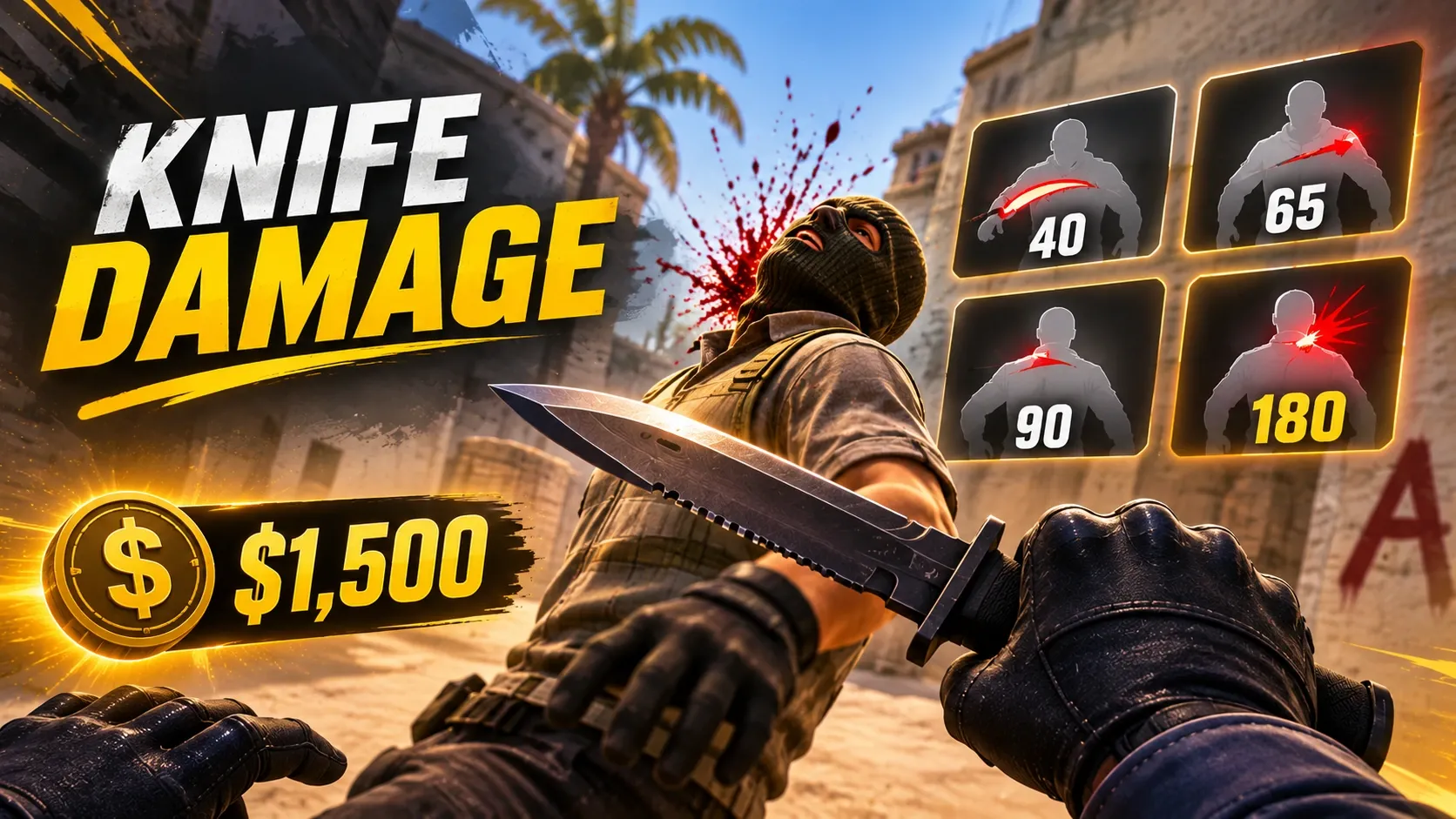
The knife costs nothing, and you carry it every round. It also pays the biggest kill award in the game, $1,500. Yet most players could not tell you how much damage each swing does, and that is where the interesting part starts.
Valve does not publish a damage table, so the damage figures below are community measured, from the Counter-Strike Wiki. The 2026 changes come from Valve's own notes.
The Four Attacks
The knife has a primary attack, a secondary attack, and each can land from the front or from behind. According to the wiki, that makes four different damage values.
- Front, primary: 40 damage, or 34 against an armored target
- Front, secondary: 65 damage, or 55 armored
- Back, primary: 90 damage, or 76 armored
- Back, secondary: 180 damage, or 153 armored
The armored numbers fit the knife's 85 percent armor penetration, which the same wiki lists. Forty at 85 percent is 34, and 180 at 85 percent is 153. That is my own arithmetic check, and it suggests the figures are consistent.
How Many Hits Each One Needs
This is my arithmetic from those figures, against a full-health player with 100 health.
A front primary attack needs three hits, because two do 80 and three do 120. Armor does not change that, since three armored hits still do 102.
A front secondary attack needs two hits, at 130 unarmored or 110 armored.
A back primary attack also needs two hits. One does 90, which is not quite enough.
A back secondary attack needs one. At 180, or 153 through armor, it kills a full-health player in a single swing.
That last number is why the knife has its reputation. A rear secondary attack is the only knife hit that ends a life on its own.
The $1,500 Question
The knife pays $1,500 per kill, according to the same wiki. A rifle pays $300, so a knife kill is worth five rifle kills. The AWP pays $100, so a knife kill is worth fifteen of those.
This is analysis, not something Valve has said, but the size of the award explains why knife kills stand out. They are rare, they are risky to attempt, and they pay far more than any gun.
What Valve Changed in January 2026
In January 2026, Valve changed how knives sound. The notes say the new impact sounds are unique depending on whether the swing is a primary or an alternate attack, and whether it hits from the front or the rear. Valve said this reflects the different damage amounts each attack deals. A later January note mentioned various further knife sound adjustments.
Valve did not state any damage change in those notes.
What the Sound Change Suggests
This is interpretation. If every attack has its own sound, then the sound tells you which attack just hit you. A heavy rear stab and a light front slash used to be hard to tell apart by ear, and now they are not. That is useful information, and it is the kind of detail Valve tends to fix quietly.
Animations
In April 2026, Valve moved CS2 to a new animation system called Animgraph 2 and said all third-person animations were re-authored. One outlet lists knife animations and attack transitions among the affected areas, and an update tracker says a later spring update fixed knife-attack transition animations. Valve's own notes are less specific, so treat those details as reported and not confirmed.
What We Do Not Know
Valve has not published the damage values, the swing speeds, the reach, or the exact angle that counts as behind a player. The figures above could change without Valve saying so, though the January notes did not describe a damage change. And the rounding in the armored case is the wiki's, not Valve's.
Keep Learning the Arsenal
Knowing the numbers behind every weapon makes every fight easier to read. The mini games on CS Guess test your knowledge of Counter-Strike, covering skins, cases, music kits, and the history behind this game, with free perks for playing well.
Head over to CS Guess and see how much of this game you know.