How CS2 Teams Actually Qualify for a Major: The VRS System Explained
Watch enough CS2 Majors and you'll hear commentators mention a team's standing or ranking as the reason they got invited, without much explanation of what that actually means. The qualification system behind that sentence has changed dramatically over the years, and understanding where it landed says a lot about how Valve runs its biggest events today.

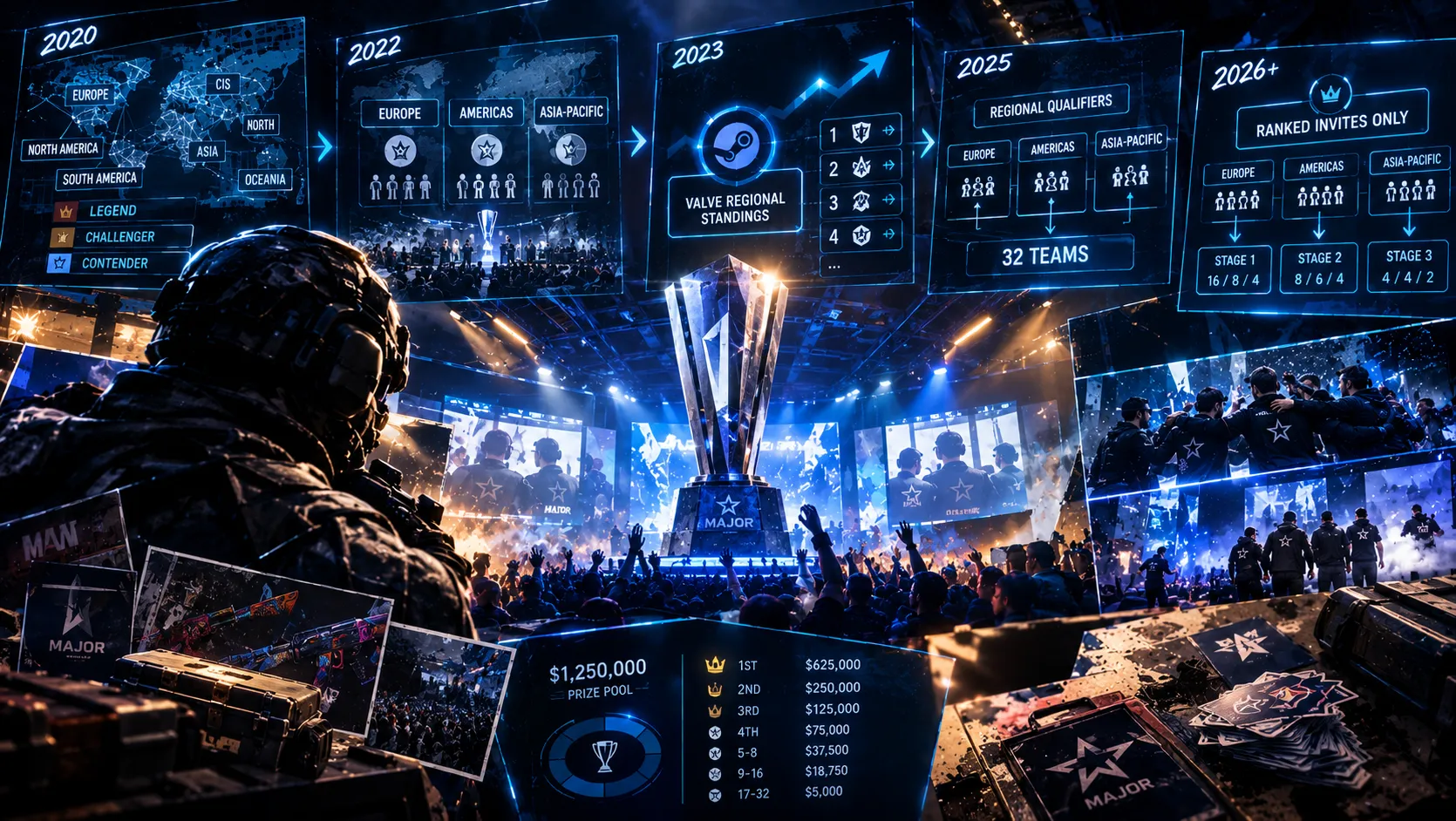
Getting into a CS2 Major hasn't always worked the same way, and the version currently in place is genuinely different from how things worked even a couple of years ago.
Where the System Started
Following the disruption of the COVID era, Valve introduced Regional Major Rankings as the qualification backbone for Majors, built around a points system where teams competed across six separate regions, Europe, CIS, North America, South America, Asia, and Oceania, earning points through a series of events in each. The top performing teams in each region secured a spot, along with a status label carried over from the old system, Legend, Challenger, or Contender, depending on where they landed.
The Shift Away From Points
By 2022, Valve simplified the regional structure and moved away from an ongoing points accumulation model entirely. Instead of scoring points across a series of smaller events, three consolidated regions, Europe, Americas, and Asia-Pacific, each held a single standalone qualifying event whose results directly decided who advanced. Team status labels stuck around, but the deciding mechanism itself had shifted from a season long points race to one decisive qualifying tournament per region.
Valve Builds Its Own Ranking
2023 marked the real turning point. Valve introduced its own team ranking system, generally referred to as the Valve Regional Standings, functioning essentially as an ELO style rating built from match results specifically within Valve sanctioned tournaments. Win more matches at Valve sanctioned events, gain more points. Starting with PGL Copenhagen 2024, this ranking system began directly shaping seeding and, increasingly, actual invites to the Major itself, gradually replacing the older status labels as the thing that actually mattered.
The Expansion to 32 Teams Changes Things Again
When the Major expanded to a 32 team field starting at BLAST.tv Austin 2025, Valve introduced Major Regional Qualifiers to handle the qualification process at this larger scale, again organized across the same three consolidated regions, with the option to split further into sub-regions specifically to manage fairness around ping differences between teams playing from different parts of a large region. All sixteen teams who made it through these regional qualifiers started the Major at its first stage, while direct invites based on Valve's Regional Standings filled out the higher stages for teams who'd already proven themselves.
Where Things Stand Today
Later in the same rulebook cycle, Valve removed the Major Regional Qualifiers entirely and pushed the system fully toward direct ranking based invites. As of the current format, the only path into a Major is ranking high enough on the Valve Regional Standings within your region when invites go out. There's no separate qualifying tournament left to grind through. Your results in Valve sanctioned events over time, translated into your regional ranking position, are what actually get you a seat at the table.
Invites themselves follow a specific logic tied to how a region performed at the previous Major. The number of slots a region receives at each stage depends on how many of that region's teams advanced at the prior event. A region that sent zero teams past the first stage last time around can lose a slot at that next stage going forward, while a region that overperformed can gain one. Invite cutoff dates are typically set six to eight weeks before a tournament actually begins, which locks in the field well ahead of the event itself.
What Teams Are Actually Playing For
The standard Major prize pool sits at $1,250,000 across the 32 team field, with the eventual champion taking close to half of that total, while a team eliminated in the very first stage can walk away with as little as $5,000 in prize money alone. That gap looks stark on paper, but it understates the real financial picture for most participating teams, since sticker sales tied to a Major, with a share of revenue going directly to players and organizations, frequently add up to considerably more money than tournament prize winnings themselves.
Why This System Keeps Changing
Every version of this qualification structure has been trying to solve the same underlying tension: how do you fairly and efficiently decide which of hundreds of competing teams worldwide deserve one of a limited number of Major slots, without dragging the process out into something unmanageable. A pure ranking system like the current one is efficient and continuous, rewarding consistent performance over time rather than a single high pressure qualifying event, but it also means a team's entire path to a Major now runs through months of accumulated results rather than one clear, dramatic qualifier weekend. Whether that trade favors the sport's biggest stars or its rising underdogs more is a genuinely open question, and it's very likely why this system has already changed multiple times and probably isn't finished evolving yet.
Test Your Own Read on This Competitive Scene
Understanding the actual mechanics behind how a scene crowns its biggest events is exactly the kind of detail that separates a casual fan from someone who really knows this game inside and out, and that same depth of knowledge is what the mini games on CS Guess are built to test, covering prices, rarity, and history, with free perks for playing well.
Head over to CS Guess and see how deep your own knowledge of this scene really goes.