CS2 Just Had Its Worst Stretch Ever, and the Community Has Theories Why
A single chart posted to social media in early August set off one of the year's biggest CS2 discussions. Six consecutive months of falling average player numbers, the longest such streak since the final days of CS:GO. The community's instant read was cheating and Valve's failure to fix it. The full picture turns out to be more complicated, and more interesting, than that.

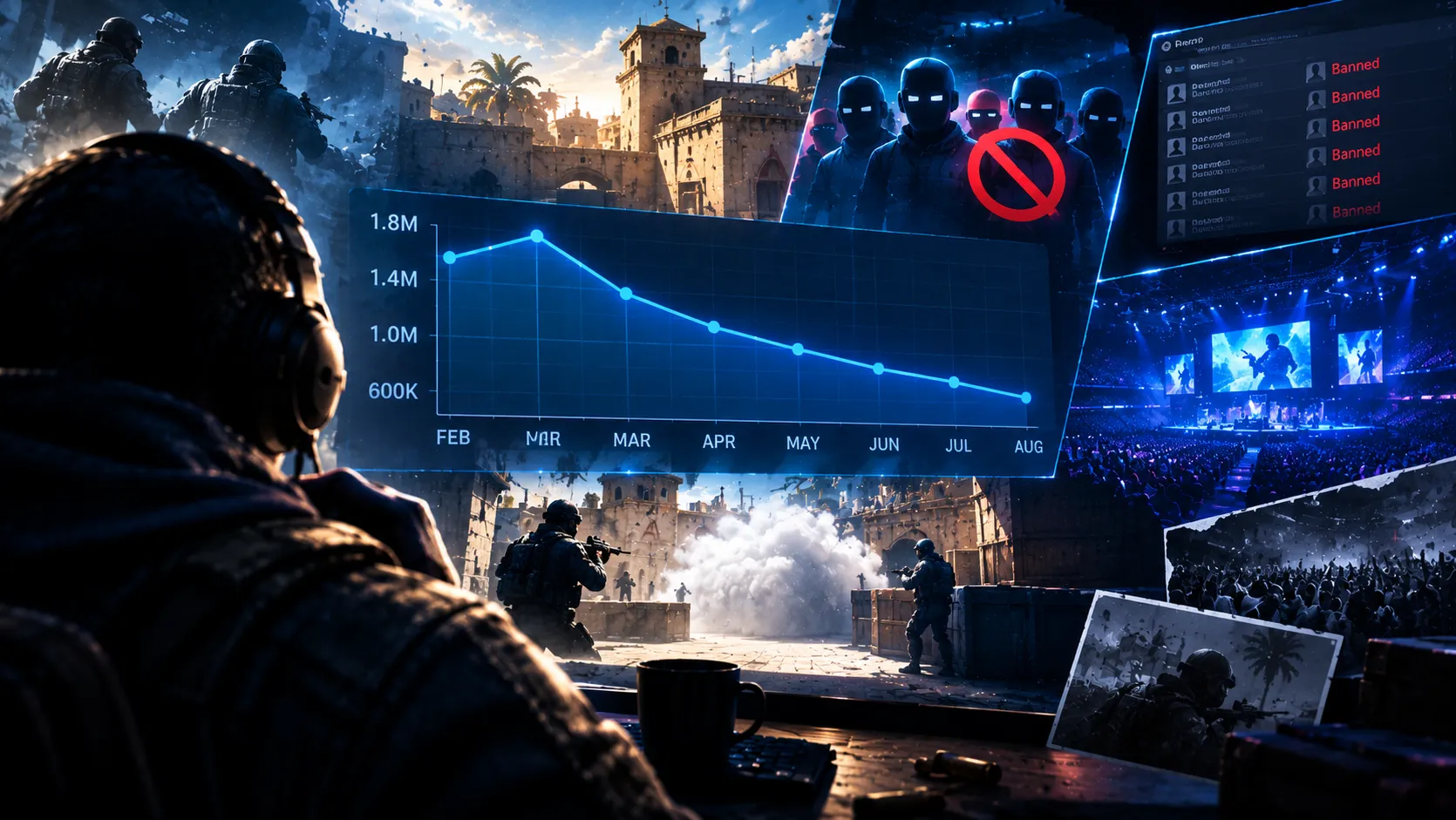
Numbers alone rarely tell a complete story, and this one is a genuinely good example of why context matters just as much as the raw data itself.
What the Chart Actually Showed
CS2 opened 2026 strong, averaging over 1.08 million concurrent players in February and hitting a yearly peak of 1.72 million at the March high point. From there, every single month came in lower than the one before it. By July, the average had fallen to roughly 853,000. By the end of August, it had slipped further still to around 825,000, with that month's peak concurrent number landing at its lowest point in two years. Six straight months of decline hadn't happened to this franchise since 2021, during the last stretch of CS:GO before CS2 was even announced, which is exactly the kind of historical comparison that made this chart spread as fast as it did once a community account posted it publicly.
The Explanation Almost Everyone Reached For First
The dominant theory across Reddit and social media settled quickly on anti-cheat frustration, and it's not a theory that came out of nowhere. Complaints about cheating at the mid-tier ranks where most of the actual playerbase competes, rather than just the highest visible ranks, have been building steadily since CS2 launched. The argument goes that patience has a limit, and that a chart like this one is what it looks like when years of frustration finally start translating into people quietly logging off rather than continuing to grind through a matchmaking experience they no longer trust.
The Detail That Complicates the Simple Story
Here's where the picture genuinely shifts. On March 26, 2026, Valve removed 960,000 accounts in a single enforcement action, the largest single ban wave in the game's history, larger even than the roughly 609,000 bans issued across CS:GO's entire record-setting month back in December 2018. CS2's project lead publicly confirmed the number the following day and credited player reports with helping identify the networks behind it. Crucially, these weren't cheaters in the traditional sense. They were scripted bot accounts idling in Deathmatch and Wingman lobbies specifically to farm weekly item drops for resale on the Steam Market and elsewhere, and every single one of them had been counted as an active concurrent player right up until the moment it got banned.
That timing lines up in a genuinely striking way. April 2026, the single steepest month of decline in the entire dataset at nearly nine percent, comes directly on the heels of that late March purge. A chart that looks like a mass exodus of frustrated real players partly reflects something else entirely: Valve successfully cleaning out a huge population of fake accounts that had been artificially inflating the numbers for who knows how long beforehand.
Why Neither Explanation Fully Wins on Its Own
The honest read here isn't that the bot purge explains the whole decline, or that anti-cheat frustration explains none of it. Both things are almost certainly true at once. A meaningful chunk of the drop is very likely a statistical correction rather than genuine player loss, but the underlying frustration with cheating at the ranks most people actually play in is well documented independently of this specific chart, stretching back well before this particular decline began. A normal seasonal summer dip, which affects most online games to some degree, and a stretch with fewer major content updates than players wanted almost certainly contributed something on top of both of those factors as well.
The Numbers Worth Holding Onto for Perspective
Despite six months of decline, CS2 remained comfortably the most played game on Steam through this entire stretch, still sitting well ahead of titles like Dota 2 and PUBG by a wide margin. The esports side of the picture looked even healthier by contrast. IEM Cologne 2026's grand final alone pulled in more than 2.7 million concurrent viewers, a number that shows the audience actively following this game as a spectator sport is enormous even during a stretch where the number of people personally queuing into matches was shrinking. Playing and watching turned out to be two genuinely different measures of a game's health, and only one of them was actually falling.
Read the Data Before You Read the Panic
A viral chart and a full explanation are two different things, and this particular story is a solid reminder that the first theory a community reaches for isn't always the whole picture, even when it's a real and legitimate concern in its own right. If you want to sharpen that same instinct for separating a compelling headline from the fuller story behind it, the mini games on CS Guess test your knowledge of this game's prices, rarity, and history in exactly that spirit, with free perks for playing well.
Head over to CS Guess and see how well your own read on this game holds up.