CS2 Premier Rank Distribution 2026: What % of Players Are Actually in Each Rank
If you've ever climbed to 15,000 CS Rating and felt like you were still just an average player, there's a good reason for that feeling, and it has nothing to do with your actual skill. Matchmaking shows you people near your own rating all day long, which quietly convinces almost everyone that wherever they sit is the middle of the pack. It usually isn't. Here's what the real distribution looks like across every Premier color tier, and where you actually land once you step outside your own lobby's bubble.

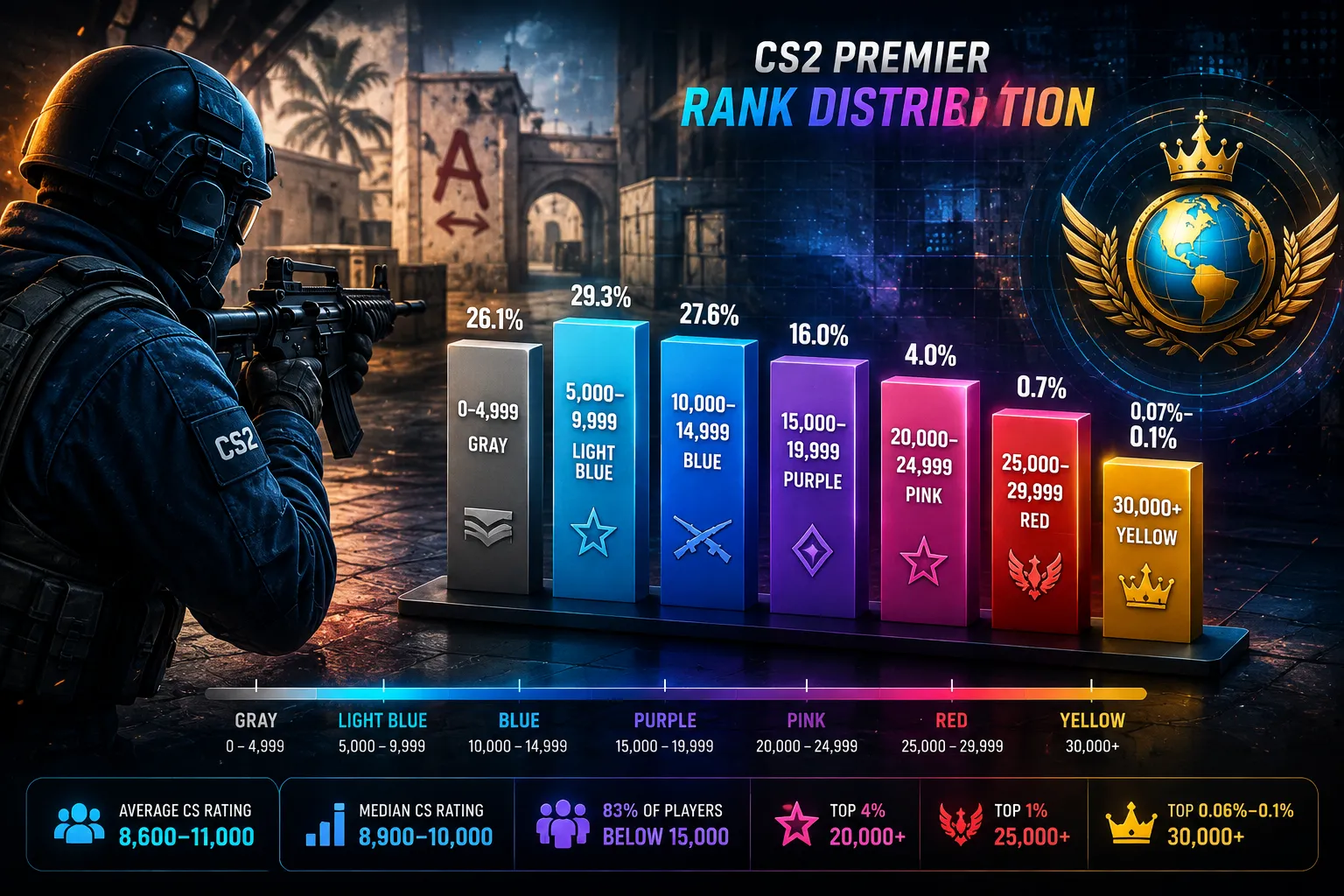
A quick note before the numbers: Valve doesn't publish official rank distribution data for CS2. Every figure below comes from large-scale third-party tracking, primarily Leetify match data aggregated and republished by outlets like Esports Tales across several snapshots taken through 2026. Different snapshots and different sample sizes produce slightly different exact percentages, so treat the numbers here as a reliable, well-corroborated picture of the overall shape of the ladder rather than an exact permanent count.
The Seven Color Tiers
CS2 Premier uses a numerical CS Rating system running from 0 upward, with no hard ceiling, grouped into seven color-coded tiers in 5,000-point bands: Gray from 0 to 4,999, Light Blue from 5,000 to 9,999, Blue from 10,000 to 14,999, Purple from 15,000 to 19,999, Pink from 20,000 to 24,999, Red from 25,000 to 29,999, and Yellow at 30,000 and above. In practice, the rating stabilizes for almost everyone somewhere in the 30,000 to 35,000 range even among the very best players, since there's no meaningful population pushing meaningfully higher than that.
Where the Average Player Actually Sits
Here's the number that surprises most people: reported averages across recent 2026 snapshots land somewhere between roughly 8,600 and 11,000 CS Rating, depending on exactly when the data was pulled, with the median generally coming in a bit lower than the mean, somewhere around 8,900 to 10,000. That gap between average and median exists because a relatively small number of very high-rated accounts pull the mean upward, while the actual midpoint of the population, the point where half the ladder sits above and half below, lands closer to the top of Light Blue or the bottom of Blue.
That single fact reframes a lot of what people assume about their own rank. Lobby culture treats something like 15,000 as a vague middle-of-the-road number, but based on the available distribution data, 15,000 actually places you somewhere around the top 16% of the ranked population, not anywhere close to average. The distortion happens because matchmaking constantly shows you opponents near your own rating, which makes your own tier feel like "normal" even when it's genuinely well above the median.
The Full Shape of the Ladder
Putting the bands together, the picture that emerges consistently across sources looks roughly like this: somewhere around 83% of the active Premier population sits below 15,000 CS Rating, meaning the overwhelming majority of players never leave Gray, Light Blue, or Blue. Purple, from 15,000 to 19,999, is where things start thinning out fast, roughly the range separating the top 16% from everyone else. Pink, 20,000 and up, is where it gets genuinely rare, cited consistently at around the top 4% of the population, or roughly 1 in 25 players. Red, at 25,000 and above, drops off sharply from there, generally cited at under 1% of the population. And Yellow, 30,000 and above, is where the numbers stop looking like a normal ladder at all, with most estimates landing somewhere between 0.06% and 0.1% of players, territory that overlaps heavily with the semi-professional and professional player pool.
Worth sitting with for a second: if you've ever hit 20,000 CS Rating, the data suggests you're rarer at that point than Legendary Eagle Master was on the old CS:GO matchmaking ladder, a rank that carried real bragging rights for years.
Why Competitive Mode Tells a Completely Different, Wilder Story
If Premier's distribution feels skewed, CS2's separate Competitive mode, which still runs the classic 18-rank system from Silver through Global Elite, is skewed to an almost absurd degree. Because Competitive tracks rank separately per map rather than as one global number, and because Valve reduced the calibration requirement on that mode from 10 wins down to just 2 relatively recently, the system saw a dramatic compression effect. Tracked data suggests over 97% of players sit below Master Guardian across tracked map ranks, meaning the higher legacy ranks, Legendary Eagle, Supreme Master First Class, Global Elite, are close to statistically nonexistent in current tracked play. If Premier is a normal-looking bell curve with a long tail, Competitive right now looks more like almost the entire population crammed into the bottom third of an 18-step ladder.
The practical takeaway is that Premier's CS Rating and Competitive's legacy ranks aren't really measuring the same thing anymore, or at least not with anything close to equivalent scaling, which is part of why comparing "what rank are you" across the two modes has become a genuinely confusing question rather than a simple conversion.
FACEIT Is a Different Population Entirely
If you split time between Premier and FACEIT, it's worth being clear that the two aren't directly comparable either, for a different reason than the Competitive mismatch. FACEIT's level system draws from a self-selected population of players who specifically chose to play on a third-party platform that's historically attracted a more dedicated, competitive-minded player base than the average Premier queue. A given FACEIT level doesn't map cleanly onto a specific CS Rating, since the underlying pools of players being measured aren't the same group to begin with.
What This Actually Means for You
If you're sitting somewhere in the 10,000 to 14,000 range, the data suggests that's the single most crowded stretch of the entire ladder, the true center of mass where a huge share of the active population lives, which also makes it one of the most volatile bands to climb out of, since you're constantly matched against players with a genuinely wide spread of underlying skill despite similar ratings. Crossing into Purple at 15,000 already separates you from the large majority of the player base, even if it doesn't feel that way when everyone in your own lobby looks roughly like you. And if you're anywhere in Pink or above, the numbers say you're operating in territory that most of the community will never see, regardless of how it feels from inside your own bracket.
Test Your Read on the Game Beyond Just Rank
Knowing exactly where you sit on the ladder is one kind of CS2 knowledge. Knowing the game's skins, prices, and history well enough to spot real value at a glance is a completely different one, and it's exactly what the mini games on CS Guess are built to sharpen. You don't need a 20,000 CS Rating to have a genuinely sharp eye for what's actually valuable in this game, and playing the rounds well earns you free perks regardless of what color your rank happens to be.
Head over to CS Guess, put your skins knowledge to the test, and build up something worth bragging about outside the Premier ladder too.