CS2 Prime Status Explained: What It Actually Does and Whether It's Worth It
New players usually run into the same wall within their first few hours. You try to queue for ranked, and the game tells you that you need Prime status first. What that purchase actually buys you, and whether it's worth the money, depends on what you're actually trying to get out of this game.

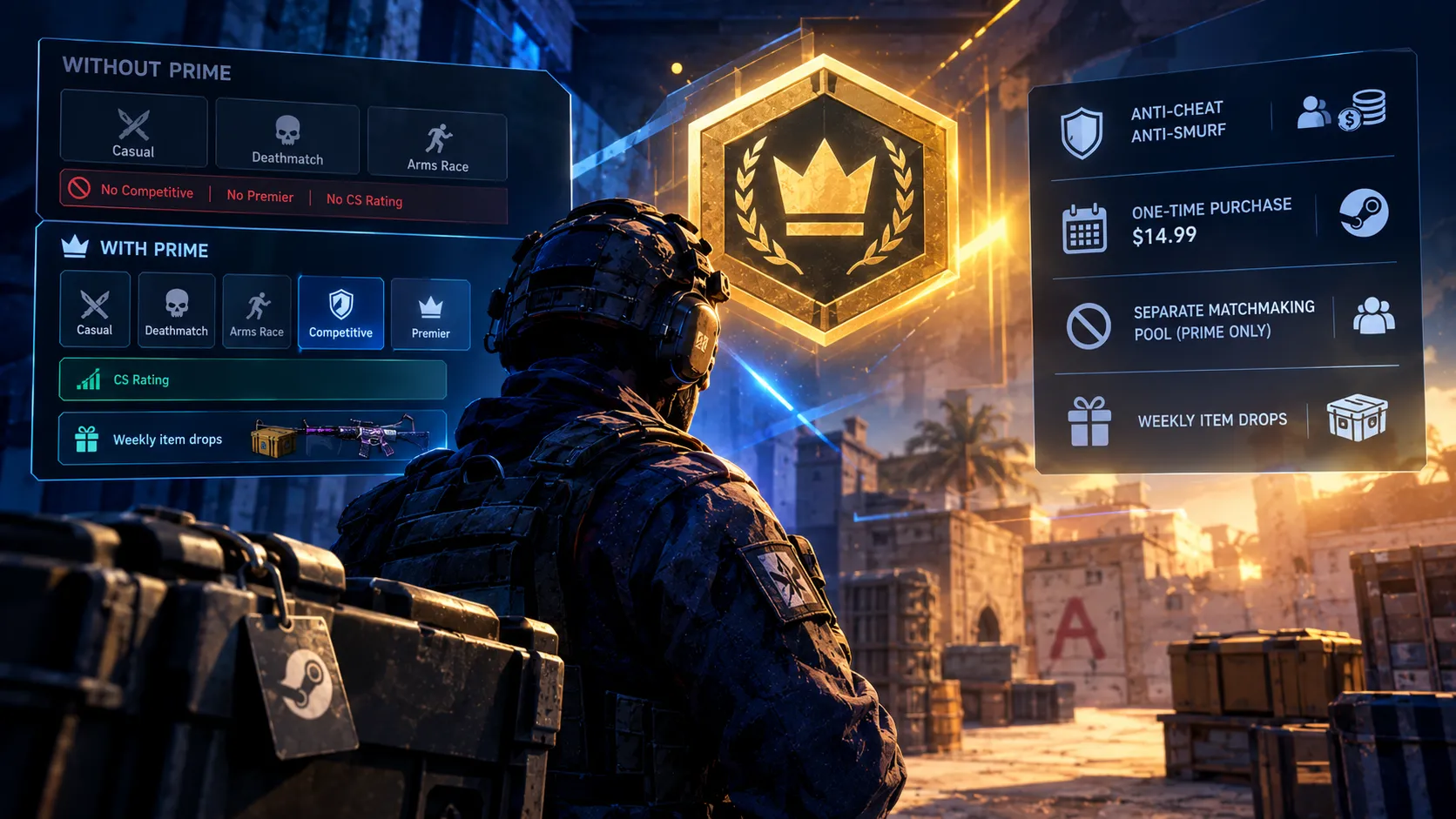
Prime status has been part of Counter-Strike's structure for so long that a lot of longtime players forget new players even have to ask about it, but the question comes up constantly, and it deserves an honest answer rather than a reflexive yes.
What Prime Actually Unlocks
Prime status is a one-time purchase of $14.99 on Steam, tied permanently to whichever Steam account buys it. There's no subscription and nothing to renew. Without it, CS2 restricts you to unranked modes like Casual, Deathmatch, and Arms Race, with no access to Competitive or Premier and no CS Rating attached to your account at all. With it, you're placed into a separate matchmaking pool made up specifically of other Prime accounts, and you start receiving weekly item drops that non-Prime accounts don't get.
The Real Reason It Exists
Prime started life in CS:GO specifically as an anti-cheat and anti-smurf measure, not as a monetization scheme first and a quality filter second. The logic is straightforward. Requiring a real purchase attached to a Steam account raises the cost of running throwaway accounts, whether that's for smurfing on a fresh account well below your actual skill level or for cheating and burning through bans on accounts with nothing invested in them. That original purpose carried over unchanged when CS2 launched in 2023, and it's still the honest reason the system exists today rather than an afterthought justification for charging money.
The History Behind the Current Paywall
Prime wasn't always purely a paid feature. Back in December 2018, once CS:GO went free to play, Valve let players unlock Prime for free by grinding their account to Lieutenant rank 21, a genuine time investment that community tracking generally estimated somewhere around forty to seventy hours depending on how your matches went. That free path disappeared in June 2021, when Valve made Prime purchase-only going forward. A later, more specific cutoff followed in May 2024. Anyone who had unlocked Prime for free back in the CS:GO days lost that status permanently if they hadn't actually launched CS2 before May 10 of that year, a detail that caught a number of returning players off guard when they came back to the game expecting their old status to still be attached.
What Prime Genuinely Improves
The matchmaking separation is the actual product here, and it's worth being specific about why it matters. Cheaters and smurfs who get banned lose the fifteen dollars they spent every single time it happens, which raises the real cost of repeat offending in a way that a fully free account never could. That friction doesn't eliminate the problem, but it meaningfully thins it out, and for most players who plan to stick with ranked modes for more than a handful of sessions, that thinner pool of bad actors is the entire value proposition. The weekly drops are a real secondary benefit too, though a modest one on their own. Individual drops are rarely worth much, but accumulated over months of regular play, and occasionally boosted by a souvenir drop during a Major event, they genuinely chip away at that original fifteen dollar cost over time.
What Prime Does Not Fix
It's worth being honest about the limits here rather than treating Prime as a cure. Community discussion around top ranked leaderboards has repeatedly pointed out that cheating still shows up even among Prime accounts, and Prime was never designed to be a perfect filter, only a meaningfully better one than the alternative of no barrier at all. It also doesn't do anything for an account that's already been VAC banned. Buying Prime on a banned account doesn't restore matchmaking access in any way, since VAC bans are permanent by design and completely separate from whether an account holds Prime status.
Who Can Reasonably Skip It
If you're opening CS2 a few times a year to mess around in casual modes with friends, there's genuinely no urgency here, and holding off costs you nothing. The calculation changes the moment ranked play, Premier specifically, or any kind of long-term account investment enters the picture. Compared to what a monthly subscription to a service like FACEIT Premium costs over the same stretch of time, somewhere around seven to thirteen dollars every single month depending on region, a single fifteen dollar purchase that never expires is genuinely one of the cheaper entry points into serious competitive play that this hobby offers.
Get the Full Picture Before You Spend Anything
Understanding exactly what you're paying for, and what you're specifically not paying for, is worth five minutes before you spend money on anything in this game's ecosystem, and that same instinct for reading the fine print applies just as well to skins and market decisions. If you want to sharpen that same instinct in a completely different context, testing your knowledge of this game's prices, rarity, and history is exactly what the mini games on CS Guess are built for, with free perks for playing well.
Head over to CS Guess and put what you actually know to the test.