CS2 Just Killed Random Sticker Capsules for the First Time Ever — Here's How the New System Actually Works
If you read our breakdown of Major sticker investing, you already know the entire category was built on random capsule drops and the scarcity that comes with them. That foundation just cracked. IEM Cologne 2026 was the first Major in Counter-Strike history to skip sticker capsules entirely, replaced by a direct-purchase shop that Valve itself admitted didn't work as planned, followed by a fix called the Ranked Series. Here's exactly what changed, why it changed, and what it means if you're still thinking about stickers as an investment.

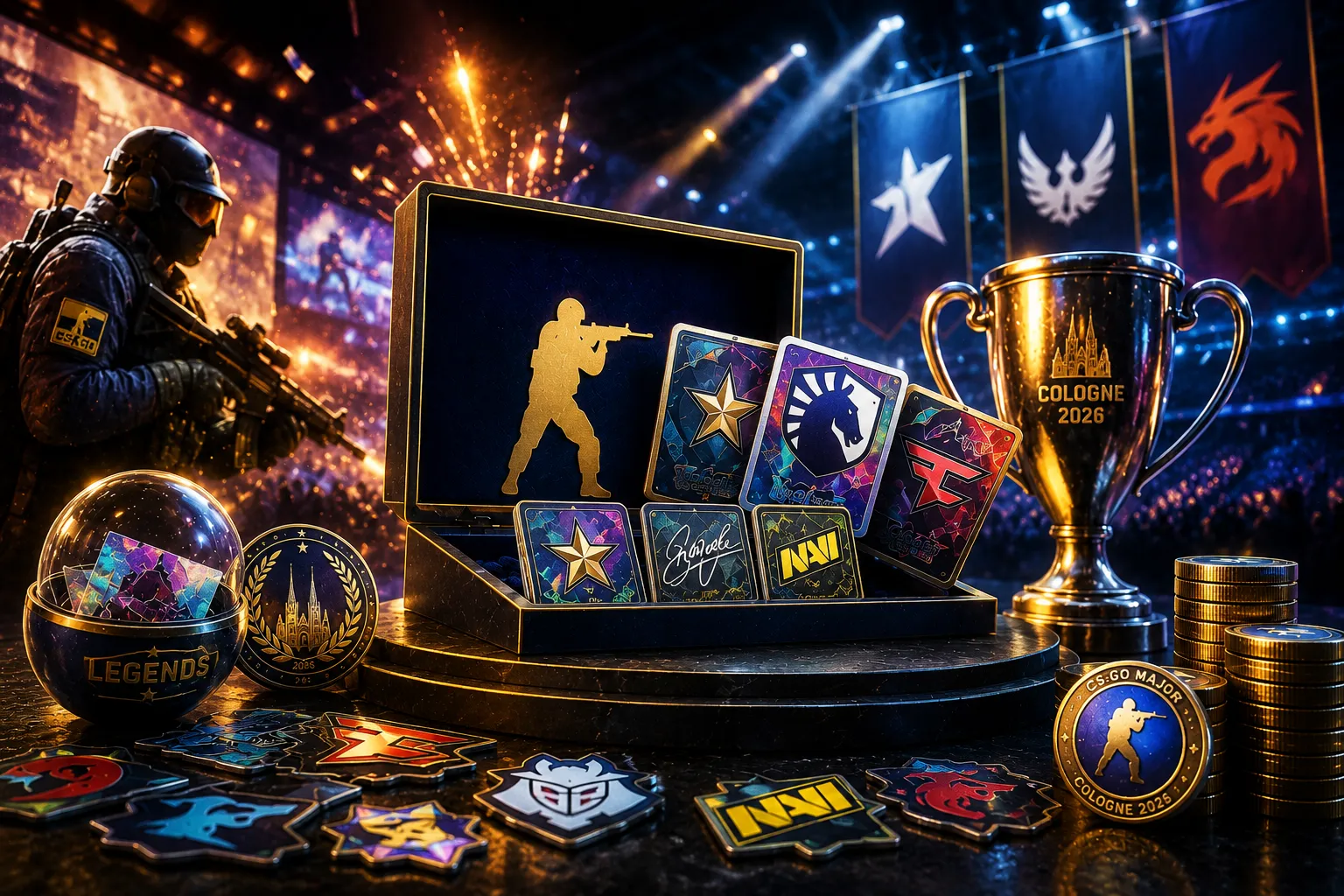
Every Major since sticker capsules were introduced has worked the same basic way: buy a capsule, get a random sticker from a pool tied to that event, and let scarcity plus luck do the rest. IEM Cologne 2026 broke that pattern completely, and the fallout from breaking it is a genuinely interesting story on its own.
No More Capsules, No More Random Drops
For the first time in Counter-Strike history, IEM Cologne 2026 shipped with no sticker capsules at all. Every tournament sticker, team logos, player autographs, holo, foil, and gold finishes, went straight into a direct-purchase shop inside the in-game Major Hub instead. You didn't open anything to get a sticker. You just bought the specific one you wanted, using a new in-game currency called Tokens, priced at roughly 100 Tokens to the dollar.
The idea behind cutting capsules made sense on paper: let the specific stickers people actually want be purchased directly, instead of forcing everyone through a random-chance wrapper just to get the exact team or player sticker they were after in the first place.
Why Valve Had to Walk It Back Within Weeks
The direct-purchase system used dynamic pricing, meaning prices adjusted based on how much relative interest a given player or team was generating. Valve's own admission afterward was blunt: the system determined relative interest reasonably well, but it didn't produce reasonable prices. In practice, that meant stickers for the most popular players and teams climbed past $1,000 apiece, and in a few cases actually exceeded the $2,000 balance limit Steam allows in a single transaction, meaning some stickers briefly became literally impossible to buy in one purchase through the official store. At the same time, stickers for smaller organizations and lesser-known players sat at close to zero value, since dynamic pricing based purely on demand meant low-demand items had essentially nothing propping up their price at all.
That combination turned out to be bad for almost everyone involved. Fans chasing stickers for top players got hit with prices that felt more like an auction than a purchase, while smaller organizations, the ones who arguably needed sticker revenue the most, ended up with stickers nobody was willing to pay meaningful money for. Valve's own language described the result as having severely lowered the value of Major stickers to organizations overall, which is a fairly direct admission that the experiment didn't work as intended.
The Fix: Ranked Series Stickers
Roughly a month after Cologne wrapped, Valve introduced the Ranked Series as a corrective. These are a genuinely new sticker type, 579 individual stickers spanning 193 unique team and player designs, each available in Holo, Foil, and Gold finishes. Rather than a team logo or player photo alone, each Ranked sticker's design incorporates the team's final placement at the tournament, turning it into a specific commemorative object tied to exactly how that team or player finished, not just that they participated.
Crucially, Ranked stickers use fixed pricing instead of the dynamic model that caused the original mess, set at a lower price point than the existing Event Series stickers, while preserving the same relative pricing relationship between different players and teams that dynamic pricing was originally trying to capture. In the shop itself, the two sticker types live in separate tabs, Event and Ranked, so you can shop each category on its own terms. Team Falcons, as the eventual Cologne 2026 champions, get an additional Champion banner treatment, but only within the Event Series tab. The Ranked Series doesn't include that particular flourish.
The entire Cologne 2026 Shop, both sticker types included, stays open until September 29, 2026, giving the new system roughly the same two-month sales window that Major stickers have historically gotten.
The Money Question: Where 50% Actually Goes
Here's the part that matters if you care about the competitive side of this as much as the collecting side. Valve has been consistent and explicit that 50% of royalties from every item in the Cologne 2026 Shop, across both Event and Ranked Series, go directly to the participating teams, players, and the tournament organizer. That revenue-sharing structure isn't a brand-new concept for Counter-Strike, tournament sticker economics tied to team and player royalties go back years, but with capsules gone and everything now a direct, transparent purchase, the connection between your specific purchase and where that money actually lands is more visible than it's ever been. Buying a specific player's sticker now reads much more directly as supporting that specific player, rather than buying a randomized capsule and hoping the contents happened to include someone you cared about.
What This Means If You Read Our Sticker Investing Piece
If you read our earlier breakdown of Major sticker capsules as an investment category, this update genuinely changes some of the underlying mechanics that piece was built around. The entire Katowice 2014 story, a $0.25 capsule turning into a five-figure sticker, depended on a low-cost, random-chance entry point where nobody knew what they were getting until after they'd already paid. That specific mechanic doesn't exist anymore, at least not for Cologne 2026 and whatever follows its model. When you can see the exact sticker and its exact price before buying, you've eliminated the lottery-ticket dynamic that made the extreme outlier outcomes possible in the first place.
That doesn't necessarily make stickers a worse category to pay attention to, arguably fixed, transparent pricing is a healthier system for buyers and for the organizations depending on that revenue. But it does mean the specific kind of investment story where a lucky community member turns pocket change into a life-changing sum on a single random pull is a much harder thing for this new system to produce. Scarcity now comes from finite total supply and whatever happens after the September 29 shop closes, rather than from the randomness of a capsule pull.
Whether PGL Major Singapore 2026 uses this same direct-purchase Ranked Series model, sticks with traditional capsules, or does something else entirely hasn't been confirmed as of this writing, so treat any assumption about Singapore's sticker format as exactly that, an assumption, until Valve actually announces it.
Test Your Read on What's Actually Worth Buying
Whichever system ends up in place for Singapore, telling a genuinely good pickup from an overpriced one is still the same underlying skill, reading rarity, demand, and pricing correctly. That's exactly what the mini games on CS Guess are built to sharpen. You get tested on real prices and real market patterns, build up free perks just for playing well, and get a clearer read on value without needing to spend a single Token or dollar to practice.
Head over to CS Guess, sharpen your read on the sticker and skins economy, and head into Singapore already ahead of whatever format Valve ends up choosing.