CS2's Reload Overhaul Explained: The Biggest Weapons Change in 27 Years
For as long as Counter-Strike has existed, reloading was a completely free action: whatever bullets were left in your magazine went back into a shared pool, no downside, no decision to make. That changed in March 2026, in what's being called the biggest mechanical shift to hit the series since it was first built on the Half-Life engine in 1998. Here's exactly what Valve changed, which weapons came out ahead, and why it's already moving the skins market.

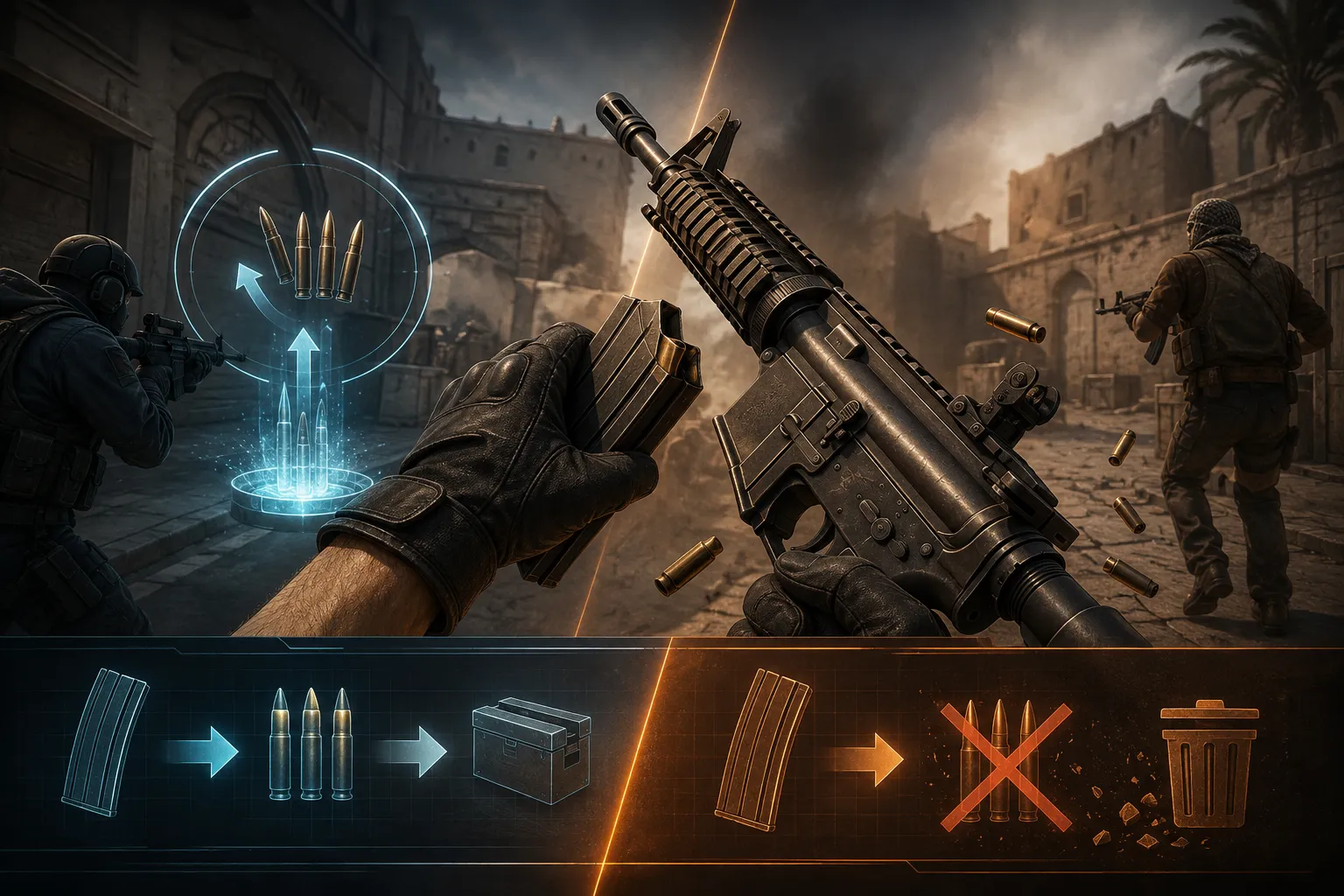
Some updates tweak numbers around the edges. This one rewrote a piece of Counter-Strike's DNA that had gone untouched for 27 years, and the community's reaction to it has been anything but quiet.
How Reloading Used to Work
Since the earliest versions of Counter-Strike, reloading had essentially no real cost attached to it. Whatever rounds remained in your current magazine simply returned to a shared reserve ammo pool the moment you reloaded, meaning players could top off their gun at any point in a round with zero penalty. It was one of the few mechanics in the game that had genuinely never changed, carried forward from the original Half-Life engine the series was built on back in 1998.
What Changed on March 18, 2026
Valve's "Guns, Guides, and Games" update replaced that entire system with what's now being called hard magazine depletion. Reload now, and whatever bullets remain in your current magazine are gone for good, discarded rather than returned to reserve. Ammo tracking itself changed to match, with weapons now displaying their ammo as distinct magazines, shells, or individual rounds depending on the weapon type, plus a new visual indicator showing exactly how full your current magazine is in the middle of a fight. Reserve ammo itself is now tied directly to a fixed number of magazines per weapon rather than one flexible shared pool, reinforcing the new logic throughout.
Not every weapon was touched the same way. Shotguns, the MAG-7, Nova, XM1014, and Sawed-Off, along with the R8 Revolver, were left out of the new system entirely and continue to reload shells and rounds individually exactly as they did before.
The Winners and Losers
Across the roughly 35 weapons affected by the broader rebalance bundled into this update, 16 received ammo nerfs, 7 received buffs, and the rest were left unchanged. On the rifle side, the Galil AR came out as the single biggest winner, gaining a full 50 extra bullets for a 40% jump in total ammo, while the M4A4 picked up 30 additional bullets, a 25% increase, effectively earning itself an extra magazine's worth of staying power. The FAMAS received a smaller but real buff as well.
Pistols saw some of the sharpest swings in both directions. The CZ75-A and R8 Revolver each gained a full 50% more total ammo, and the P250 picked up a meaningful 33% boost, all three becoming notably stronger eco-round options as a result. On the losing end, the Five-SeveN had its ammo cut in half, the Glock-18 lost 43%, and Dual Berettas dropped 40%, alongside additional cuts to popular picks like the MP9 and Desert Eagle.
No weapon felt the new system more than the AWP. It now carries just 15 total rounds across an entire round, five in the magazine plus two reserve magazines, a dramatic cut that fundamentally changes how AWPers have to think about positioning and ammo conservation. The SSG 08 Scout took an even steeper cut on paper, though in practice it's barely noticeable, since most players were never reloading a bolt-action sniper mid-round to begin with. The M4A1-S also lost meaningful ammo capacity, rounding out a rough update for two of the most iconic, and most expensive, weapon categories in the entire skins economy. The SG 553 and AUG were left completely unchanged.
Why Valve Made the Change
Valve's own stated reasoning was that reloading needed to become a genuine tactical decision carrying real risk, rather than a habitual, cost-free action players performed on autopilot after every exchange. Under the old system, there was essentially never a reason not to top off your magazine the instant you had a spare second, since nothing was lost by doing so. The new system forces an actual trade-off: reload early and you're discarding potentially valuable rounds, wait too long and you risk getting caught with an empty gun at the worst possible moment.
A Genuinely Split Reaction
The response from the community has been about as divided as a CS2 update gets. A wave of negative Steam reviews followed the patch, and some pro players publicly called the change misguided in the days after release. At the same time, a meaningful chunk of analysts and longtime community voices praised it as one of the more thoughtful balance changes the game has seen in years, drawing comparisons to the original CS 1.6, where actually managing your ammo purchases was a real part of force-round strategy rather than an afterthought. Adapting has reportedly been more about breaking old habits than understanding new rules, with plenty of players describing the instinct to reload after every single kill as a decades-old reflex that now actively works against them.
The real stage test came weeks later, at IEM Rio 2026 in April, where professional teams played with the new system live on broadcast for the first time, giving the wider community its first real look at how the change holds up under actual competitive pressure.
How It's Already Moving the Skins Market
Meta shifts in CS2 tend to ripple into skin prices eventually, and this one moved faster than most. With the M4A4 buffed and trending back into favor, related skins saw a noticeable uptick in listings and buyer interest almost immediately. On the other side, early market data pointed to a softening in demand for M4A1-S skins specifically, one of the most historically valuable skin categories in the game, as the weapon's practical standing took a real hit alongside its ammo pool. If competitive play continues drifting toward the M4A4 and away from the M4A1-S as a result of this update, that kind of pro-level weapon preference has historically been one of the strongest signals for where skin demand heads next.
Adjusting to the New Reality
If you're still catching yourself reloading out of pure habit after every engagement, you're not alone, and it's reportedly the single hardest part of adjusting to this update for most players. The practical fix suggested across the community is straightforward even if it takes real repetition to stick: get comfortable fighting with partial magazines, track your remaining ammo deliberately instead of assuming it doesn't matter, and treat every reload as a real decision rather than a reflex.
Stay Just as Sharp on the Economy Side
Following how a mechanical change like this ripples all the way into skin prices is part of what makes CS2's economy genuinely interesting to track. If you want to sharpen that same kind of instinct for value, rarity, and market movement without spending a cent to test it, that's exactly what the mini games on CS Guess are built for, with free perks for playing well along the way.
Head over to CS Guess, put your knowledge to the test, and see how sharp your read on this economy really is.