If You Invested $1,000 in CS2 Skins a Year Ago, Here's What You'd Have Now
"If you'd invested $1,000 in this a year ago" is one of the most common hooks in finance content, usually reserved for stocks or crypto. It turns out CS2 skins make for a genuinely wild version of that story, one with a market crash, a partial recovery, and a real answer that depends enormously on exactly what you bought and exactly when. Here's what actually happened, backed by real market data rather than the confident-sounding numbers most skin investing guides throw around.

A quick note before anything else: this is not financial advice, and nothing here should be read as a recommendation to buy or sell anything. CS2 skins are digital collectibles in an unregulated, third-party-driven market, and the numbers below are here to inform, not to sell you a strategy.
The Honest Starting Point
Before getting into hypothetical scenarios, it's worth grounding this in the most credible data available rather than the promotional-sounding claims that dominate most "skin investing" content. Steam Dashboard, a market tracking outlet, compared snapshots of the broader market from April 12 to June 29, 2026, and found that among 16,428 tracked items worth at least a dollar and listed across ten or more marketplaces, the median item actually fell 9.1% over that stretch, with 12,132 items dropping in value against just 4,285 that rose. That's a real, recent, unglamorous baseline: over a roughly two-and-a-half-month window in the middle of the year you're asking about, the typical tracked skin lost value, not gained it.
The Event That Actually Defines This Year
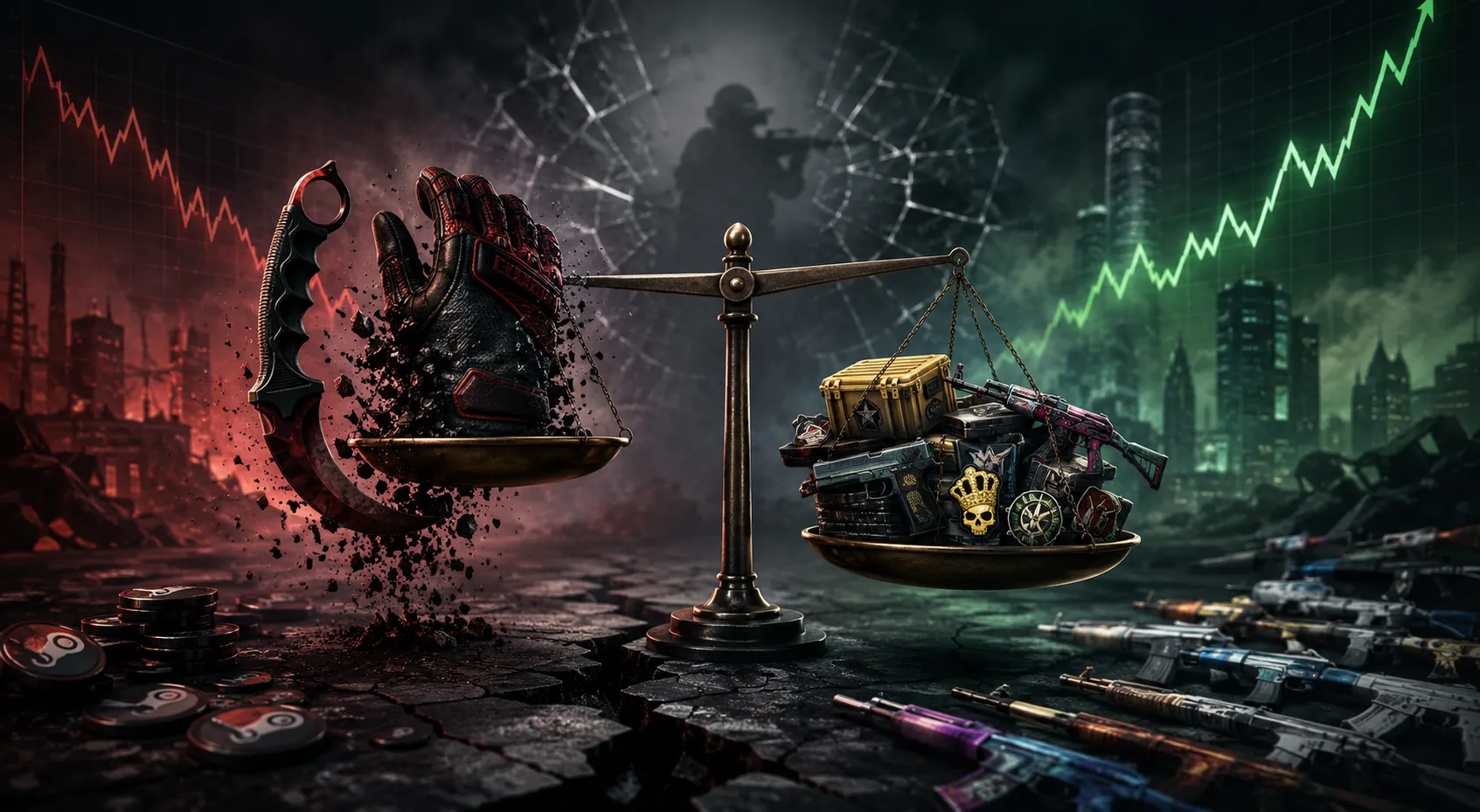
Any honest answer to "what would $1,000 be worth now" has to start with October 2025, when Valve expanded its Trade-Up Contract system to let players convert five Covert-rarity weapon skins directly into a guaranteed knife or pair of gloves. The change gutted the scarcity that had propped up knife and glove prices for years, and the market responded accordingly. Price Empire recorded the total CS2 skin market cap falling from roughly $6 billion to about $4.27 billion in under 24 hours, a nearly $2 billion overnight loss, with individual knife and glove prices reported down 40% to 60% almost immediately. Some trackers describe the broader correction as reaching 20% to 30% within the first two weeks as panic selling spread beyond just the directly affected categories.
Recovery followed, but slowly and only partially. By around April 2026, six months after the crash, several trackers reported the market had clawed back somewhere in the range of 15% to 18% off its lows, not a full recovery to pre-crash levels, but a genuine rebound for anyone who held rather than sold during the panic.
Scenario One: $1,000 in a Popular Knife or Glove Skin
If you'd put your full $1,000 into a knife or glove skin last August, right before the October crash, the paper reality would have been brutal in the short term. A 40% to 60% drop means your $1,000 position could have shown as low as $400 to $600 on paper within days of the update. The partial recovery since then would have clawed back a real chunk of that, but depending on the exact item, you'd likely still be sitting somewhere below your original $1,000 mark today, a paper loss overall, even after months of recovery. This is exactly the scenario RiskySkins, a skin-investing content site, points to when arguing that panic sellers who dumped during the crash locked in permanent losses while patient holders eventually broke even or came out slightly ahead, though it's worth noting that site has a financial interest in encouraging continued participation in this market.
Scenario Two: $1,000 Spread Across a Diversified Basket
If instead you'd split that $1,000 across a range of items, some cheaper StatTrak weapon skins, a case or two, maybe a sticker capsule, your exposure to the October crash would have been smaller in absolute terms, but so would any upside. Given the median item in mid-2026 was still down 9.1% over just a few months mid-year, a diversified basket bought a year ago likely sits close to flat to modestly down today, better than a concentrated bet on knives and gloves specifically, but still nowhere near the double-digit annual returns that promotional skin-investing guides tend to advertise.
Scenario Three: $1,000 in a Cheap, High-Volume Skin
Here's where the story gets genuinely more interesting. Some lower-priced, high-volume skins have shown real, if modest, appreciation over longer stretches. One frequently cited example is the MP9 Mount Fuji, which reportedly traded for $2 to $4 back in 2021 and has since climbed to around $9 for the Factory New version, with the StatTrak variant reportedly surpassing $16. That's the kind of skin where $1,000 could have bought you a genuinely large quantity of copies rather than one or two expensive items, spreading your risk across volume rather than concentration. It's a real example of appreciation, but the magnitude matters: this kind of gain plays out over years, not the single 12-month window this article is framing, and cherry-picked winners like this get repeated across investing content precisely because they're the exception rather than the rule.
What the Contrast Actually Tells You
Line these scenarios up and the honest picture is this: a concentrated bet on the exact category Valve blindsided with a rule change in October likely still shows a loss today. A diversified spread of cheaper items likely sits close to breakeven, tracking that unglamorous market-wide median rather than beating it. And the standout individual success stories that skin-investing content loves to lead with are real, but they're outliers highlighted after the fact, not a realistic default outcome for a random $1,000 a year ago.
Why This Market Behaves Differently From Stocks
Part of what makes this comparison genuinely different from a stock market retrospective is that Valve itself can single-handedly reshape the value of an entire category overnight through a single game update, something no company can do to its own publicly traded shares. That's not a knock on the hobby, it's just a structural reality worth understanding before treating skin prices like a stable long-term asset class the way some guides frame them.
Sharpen Your Read on Value Without Risking a Dollar
If working through these scenarios made you want to get better at reading which items are genuinely well-priced versus which ones are just riding hype, that instinct is exactly what the mini games on CS Guess are built to develop. You get tested on real prices, real rarity, and real market patterns, and you build up free perks for playing well, without a single dollar or skin changing hands to find out if your read was right.
Head over to CS Guess, put your knowledge of this economy to the test, and sharpen your eye for value the safest way there is: for free.