CS2 Smurfing: The Silent Epidemic Ruining Premier Rank
You queue into a fresh Premier placement match expecting a coin flip, and instead run into an opponent moving like they've got thousands of hours logged on an account that's barely a week old. That's not a glitch, and it's not a cheater in the traditional sense - it's a smurf. The frustrating part is that nothing about what they're doing actually breaks Valve's rules.

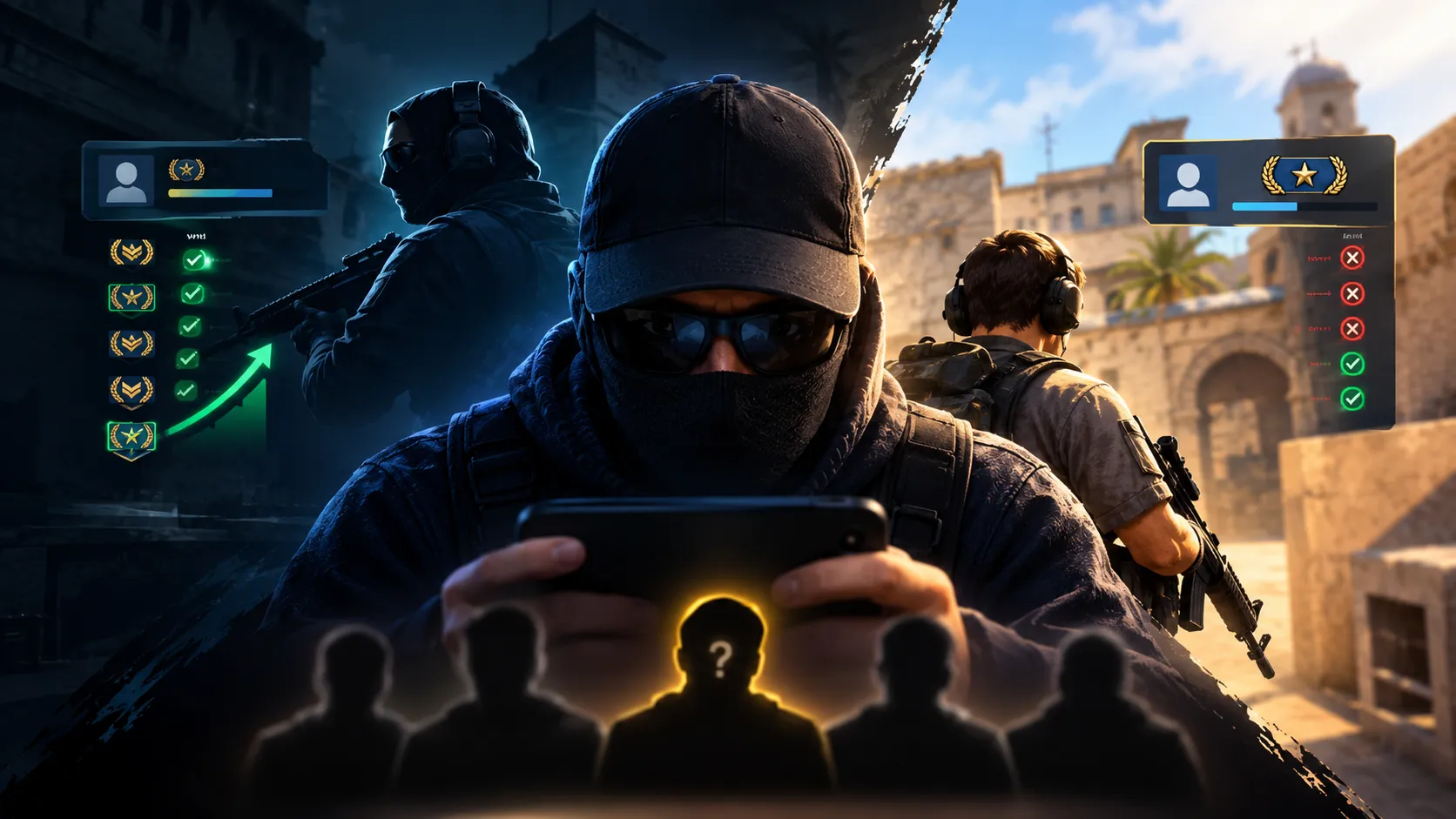
Ask almost anyone grinding Premier rank in 2026 what's actually ruining their climb, and cheating usually comes up first. Smurfing tends to come up right after it. Depending on who you ask, some players will tell you it's the worse of the two problems.
What a Smurf Actually Is
A smurf is an experienced, high-skill player competing on a secondary account that sits well below their true skill level - usually a fresh account with little to no match history. Unlike an aimbot or a wallhack, there's no software involved and no rule technically being broken. Someone is simply playing the game they're good at, just under a different identity than the one that reflects their real rank. That single distinction is what makes smurfing such a persistent, controversial problem. Cheating gets you banned. Smurfing, as far as Valve's terms of service are concerned, is just playing Counter-Strike.
Where They Tend to Show Up
Smurfs concentrate in specific places rather than spreading evenly across the rank distribution. Brand new accounts working through their first ten Premier placement matches will occasionally run into an opponent whose skill looks nothing like a first-time player - sometimes rated thousands of points above what a genuine newcomer would show. Beyond placements, smurfs tend to settle into the middle of the ladder rather than the very bottom, parking themselves at a rank comfortably below their real skill so they can dominate lobbies without immediately climbing back out of them. That middle band happens to be exactly where a huge number of genuinely improving players are trying to learn the game, which is part of why the frustration around smurfing runs so deep in that specific range.
Why Detection Is So Hard
Community-built smurf detection tools have gotten fairly sophisticated at flagging likely smurf accounts, and the methodology is worth understanding even if you're not running one yourself. Detection generally looks at a combination of signals rather than any single red flag. Account credibility factors include things like a low Steam level, a private profile, a recently created account, and a thin inventory. Performance analysis looks at whether a player's kill to death ratio, headshot percentage, and damage numbers look wildly out of place for how few hours they've logged. Progression patterns matter too - a smurf tends to gain rating unusually fast and rack up long win streaks that don't look like normal ranked variance. None of these signals alone proves anything. Plenty of legitimate new players have great instincts from other games, or simply run hot for a session. But when several of these factors line up at once, the odds of genuine smurfing rise sharply.
Valve's own system does something similar internally. It watches for performance that looks inconsistent with an account's current rating and adjusts how much that account's wins and losses actually move its number. That's a rating stabilization mechanism more than a punishment, and it does very little for the players stuck losing lobby after lobby while an account works through that adjustment period.
Why This Isn't Just a Ranked Ladder Annoyance
Smurfing lands at a particularly bad moment for CS2's broader trust problem. The game has already been dealing with a well-documented wave of concern around cheating and rank credibility in 2026, and smurfing compounds that same underlying issue from a completely different angle. A new or returning player queueing into Premier for the first time has no easy way to tell whether a brutal loss came from a cheater, a smurf, or someone who's simply better than expected - and all three outcomes feel identical from inside the losing team's perspective. That erosion of trust in what a rank actually means is arguably smurfing's biggest real cost, bigger even than any single lopsided scoreline.
Why Valve Hasn't Solved This
Part of the honest answer is that there's no clean way to punish something that isn't against the rules without also punishing legitimate behavior Valve has no interest in restricting. Plenty of players create secondary accounts for entirely reasonable reasons: wanting to practice a new role without risking their main rating, playing casually with friends who are far below their skill level, or simply starting fresh after years away from the game. Any system aggressive enough to reliably catch smurfs would almost certainly catch a meaningful number of those legitimate cases too. Valve has generally chosen to accept a smurfing problem rather than risk locking out its own player base over false positives.
What You Can Actually Do About It
If you suspect you're facing a smurf, the practical options are limited but real. Reporting suspicious accounts through the normal in-game system does feed into Valve's broader trust and detection signals over time, even if it doesn't produce an instant, visible result. Beyond that, the most useful shift is mental rather than mechanical: a brutal loss in a low-rank lobby is frequently not a reflection of your own skill or your teammates' skill at all, and recognizing that for what it is tends to make the whole experience considerably less demoralizing.
Enjoy a Ladder Where Nobody's Hiding Their Skill
If a leaderboard that actually reflects who knows this game sounds appealing, that's exactly the kind of clean, honest competition the mini games on CS Guess are built around. You're tested purely on your knowledge of prices, rarity, and the game's history, with free perks for playing well - no account to hide behind and nothing to fake.
Head over to CS Guess, put your CS2 knowledge to the test, and enjoy a leaderboard where skill is the only thing that matters.