Souvenir Skins Explained: The CS2 Item Type Tied to Major Tournaments
Scroll through the Steam Market and you'll occasionally spot a skin with gold stickers baked directly into its name and appearance, selling for a price that looks completely disconnected from every other copy of that same weapon. That's a souvenir, a category of item that works nothing like a regular skin, and the system behind it just changed in a genuinely significant way.

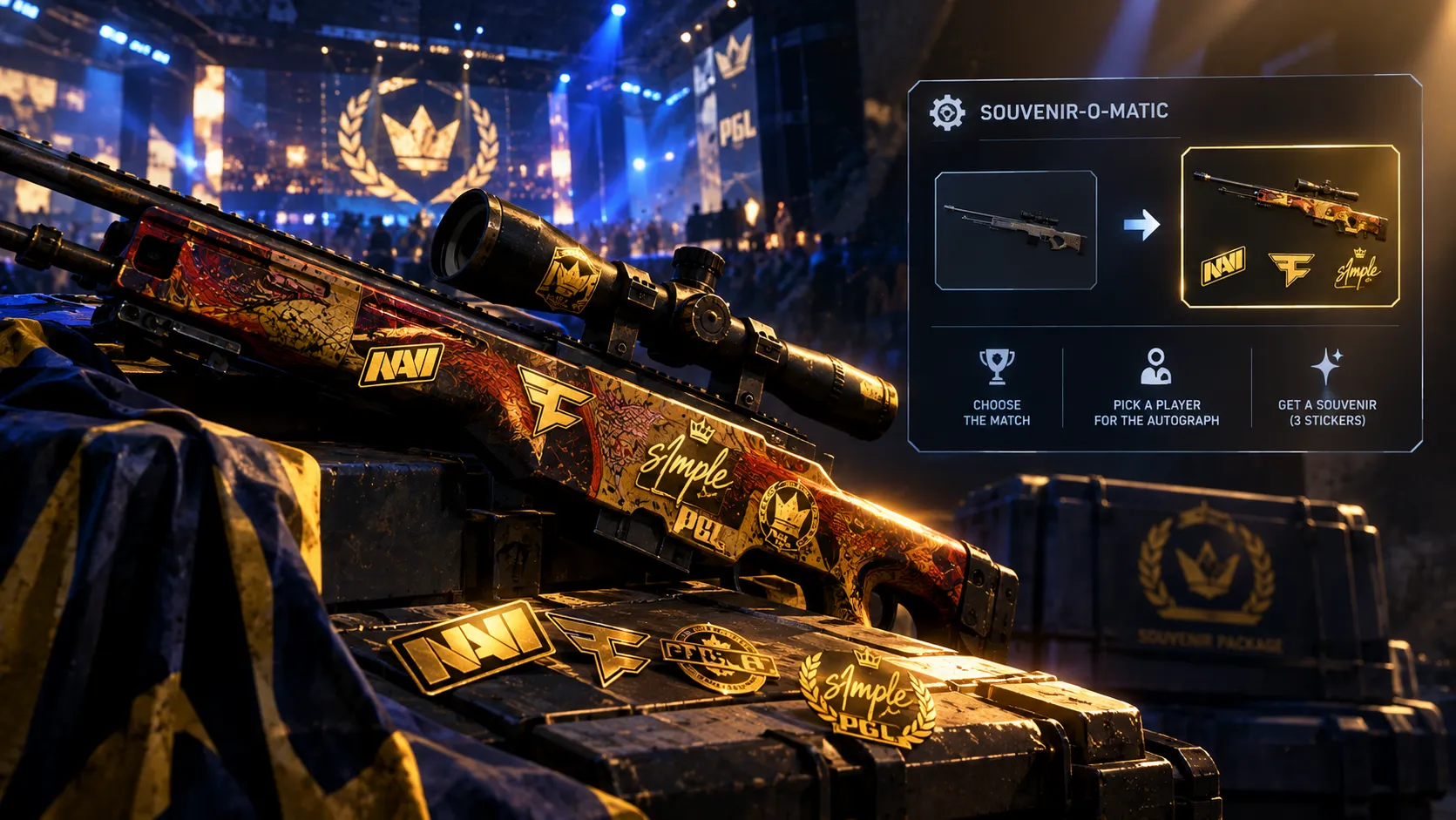
Most skins in this game are interchangeable copies of each other, separated only by wear and pattern. Souvenirs are the exception, and understanding why takes explaining a system most players have never had a direct reason to look into.
What Actually Makes a Souvenir Different
A souvenir skin is a weapon finish permanently tied to a specific match from a Major tournament. Every one carries a set of gold stickers applied at the moment of creation, and those stickers are locked in for good. They can't be removed, scraped off, or swapped out the way stickers on a normal weapon can. Souvenirs also can't be StatTrak, and for a long time couldn't be fed into trade-up contracts at all. A recent update changed that last part specifically, letting souvenirs go into trade-ups now, but only by stripping every souvenir attribute first. Whatever comes out the other end is always a single ordinary item, never a souvenir, so the trade-up door opened without actually creating a way to manufacture new souvenirs through crafting contracts.
How the System Traditionally Worked
For most of Counter-Strike's history, the only way to get a souvenir was to watch a Major live through a linked Steam and Twitch account and get lucky. Souvenir Packages dropped randomly to viewers during a match, and each package was tied to the specific map and match being played at that exact moment. Opening one gave you a random skin from that map's associated collection, arriving with four gold stickers already applied: both competing teams, the tournament itself, and an autograph from a player involved in that match. Because the packages only existed for the exact duration of a live, ongoing Major, the supply of souvenirs from any past tournament became permanently fixed the moment that event ended. Nobody can manufacture a new Boston Major souvenir today no matter how much money they're willing to spend, because the specific mechanism that created it stopped existing years ago.
The Change That Just Happened
In May 2026, Valve introduced something called the Souvenir-O-Matic, and it genuinely restructured how new souvenirs get created going forward. Instead of relying purely on random live drops, players can now take an eligible non-StatTrak skin they already own and convert it into a souvenir tied to a completed match from the current Major. You choose the match, and you choose which player from that match gets featured on the autograph sticker. The new system applies three stickers instead of the legacy four, dropping the separate tournament logo sticker while keeping both team logos and the player autograph. This crafting option only works for matches from whichever Major is currently active, so it doesn't reach back and let anyone create souvenirs from tournaments that already ended, but it does mean the pure luck-of-the-drop bottleneck that defined this system for years no longer applies to current events.
Why the Player Sticker Is Almost Everything
Two souvenirs of the exact same base skin, same wear, same everything else, can sell for wildly different prices, and the entire gap almost always comes down to whose autograph is on it and how significant the specific match was. A souvenir featuring a player nobody particularly remembers from an unremarkable group stage match trades close to whatever the base skin would sell for on its own, cosmetic premium included but nothing dramatic. A souvenir carrying a legendary player's autograph from a genuinely historic match is an entirely different asset. The most famous example in the game's history is a Dragon Lore AWP carrying stickers from a legendary player's standout performance at a Major years ago, a trade that's been cited as one of the most expensive single item sales in the game's history, reaching into six figures. That's an extreme outlier rather than a typical outcome, but it illustrates exactly how much of a souvenir's value sits in the story attached to it rather than the weapon skin underneath.
What This Means If You're Actually Holding One
If you've got a souvenir sitting in your inventory, the base skin's normal market value is your floor, and everything above that depends entirely on the specific stickers attached to it and how much the community cares about that particular match or player. A quick way to sanity check what you're holding is looking up the specific match the stickers reference and gauging whether it was genuinely memorable or just another round in a long tournament. The gap between those two outcomes is where all the real variance in souvenir pricing actually lives.
Test Your Read on What Actually Drives Value
Understanding why one item with an identical base skin can be worth a hundred times more than another is exactly the kind of pattern recognition the mini games on CS Guess are built to test, covering prices, rarity, and the history behind this entire economy, with free perks for playing well along the way.
Head over to CS Guess and see how sharp your read on this economy really is.