CS2 Trade-Up Contracts: The Complete 2026 Guide
If you learned how Trade-Up Contracts work from an old guide, some of what you know is now wrong. Two separate updates since October 2025 changed the rules around souvenir skins and introduced an entirely new way to trade directly into knives and gloves. Here's the complete, current picture of how the system actually works in 2026.

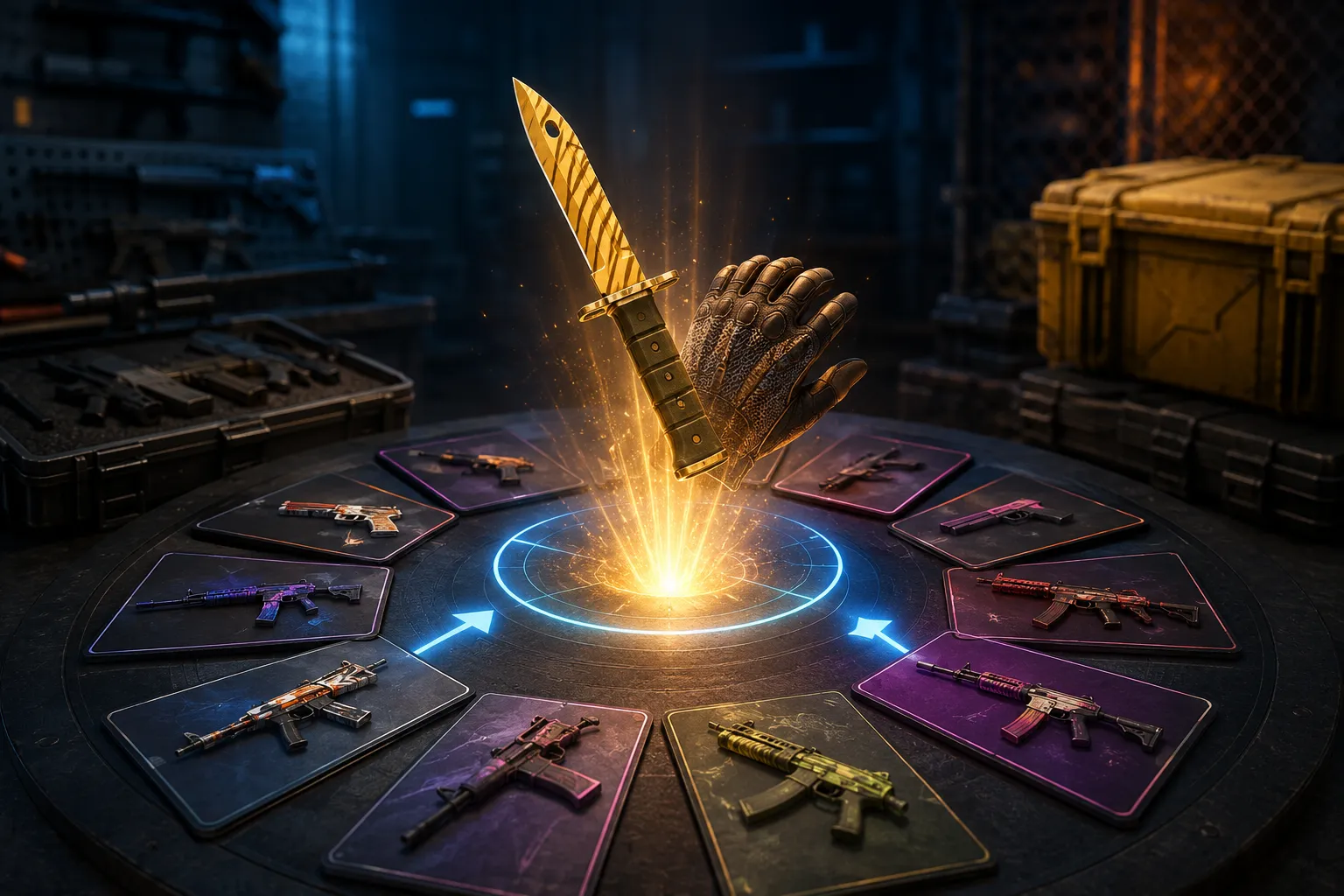
Trade-Up Contracts are one of the oldest features in Counter-Strike's economy, dating back over a decade to the original Arms Deal update. The core idea has stayed simple the whole time: combine lower-tier skins to get a shot at something better. What's changed is everything around that core idea, and if you haven't checked the rules since last year, it's worth a full refresher.
The Basic Mechanic
A standard Trade-Up Contract takes ten skins of the same rarity tier, Mil-Spec, Restricted, Classified, and so on, and produces one skin from the next tier up. All ten inputs need to match in quality, and StatTrak and non-StatTrak items can't be mixed in the same contract: ten StatTrak inputs are required to guarantee a StatTrak output. You don't need every input to come from the same collection either, skins from different collections at the same rarity tier can be combined in a single contract.
The math behind which skin you actually get is collection-weighted rather than purely random across every possible outcome. Each of your ten inputs carries an equal 10% share of the contract's total probability. The system effectively picks one of your inputs first, then selects an eligible output from that specific input's collection. In practice, that means loading a contract with more skins from one collection meaningfully increases your odds of pulling from that collection's outcome pool, since Valve doesn't publish official odds and this behavior has been established through extensive community testing rather than official documentation.
The float value of your output isn't random either. It's calculated from the average float of your ten inputs, mapped into the specific float range of whichever output skin you land on. Lower input floats produce cleaner, lower-float outputs, while the pattern ID itself is randomized regardless of what you put in. If you need to check exactly which skins belong to which collection before building a contract, reference sites like csgo.info maintain full collection breakdowns that are worth checking against before you commit anything.
The Souvenir Rule Change That Catches People Out
For a long time, Souvenir-quality skins were banned from Trade-Up Contracts entirely. That changed with the May 22, 2026 update. Souvenir items can now be used as valid inputs alongside normal skins, but with two important catches: the souvenir attributes themselves, meaning the gold nametag and any tournament sticker details, are stripped away entirely, and the item counts as one rarity tier higher than the rest of the inputs in the contract for probability purposes. The output of any trade-up is always a normal-quality skin. A contract can never produce a Souvenir item, regardless of what goes into it. This is exactly the kind of detail that makes older guides actively misleading if they haven't been updated since spring 2026.
The Knife and Glove System
The other major change traces back to October 22, 2025, when Valve introduced a separate, higher-stakes version of the mechanic specifically for knives and gloves. This contract only requires five Covert-rarity (red) skins rather than ten, and produces one guaranteed Exceedingly Rare item, a knife or a pair of gloves, from the collection of one of your five inputs. Five StatTrak Covert skins return a guaranteed StatTrak knife. Because only five inputs are involved instead of ten, each one carries a larger 20% share of the total probability rather than 10%.
This specific update is worth understanding in its full context, because it didn't just add a new feature, it reshaped the entire knife and glove market overnight. Removing the scarcity that had propped up knife and glove prices for years caused the total CS2 skin market cap to fall from roughly $6 billion to about $4.27 billion in under 24 hours, with individual knife and glove prices dropping 40% to 60% almost immediately. If you're trading up specifically for a knife or glove today, it's worth knowing you're operating inside a market that's still adjusting to that structural shift rather than the scarcity-driven pricing that existed before late 2025.
Is It Actually Worth Doing?
This is where a lot of guides get overly optimistic, often because they have a financial interest in you trading actively on their platform. The honest answer is that profitability depends entirely on running real numbers before you commit anything: the live market prices of your specific inputs, the actual collection-weighted odds for that specific combination, and the current prices of every possible output, not just the one you're hoping for. Community trackers following the broader skins market through 2026 have consistently found the median tracked item's value moving sideways to down over multi-month stretches, which is the honest backdrop against which any specific trade-up needs to be evaluated rather than assumed profitable by default. A contract that looked good against last year's prices can be a clear loser against this year's, and the only way to know is to check current prices for every input and every possible output before you commit, not after.
It's also worth remembering that a Trade-Up Contract cannot be reversed once executed. There's no undo button if the math didn't work out the way you expected, which makes checking the numbers beforehand considerably more important than it might seem.
The Practical Takeaway
If you're going to use Trade-Up Contracts at all, treat every contract as a calculation rather than a gamble dressed up as one. Confirm which collections your inputs actually belong to, work out the realistic odds for your specific combination rather than assuming even odds across every possible output, check the current float ranges and market prices for every plausible result, and go in accepting that the most likely outcome for most contracts, based on the broader market data available, is landing close to breakeven at best.
Sharpen Your Read on This Economy Without Spending Anything
Understanding collections, rarities, and how value actually moves through this system is exactly the kind of knowledge the mini games on CS Guess are built to test. You get to sharpen your read on prices, rarity, and market patterns, and build up free perks for playing well, without a single skin or dollar changing hands to find out if your read was right.
Head over to CS Guess, put your knowledge of the skins economy to the test, and get sharper before you ever open a Trade-Up Contract.