Big Head Mode made headlines in 2026 because it felt like Valve having fun with Counter-Strike. It was not the first time. In 2017, CS:GO had a whole collection of odd game modes, and most players have forgotten them.
The details below come mostly from the Counter-Strike Wiki, with dates cross-checked against Liquipedia.
What War Games Were
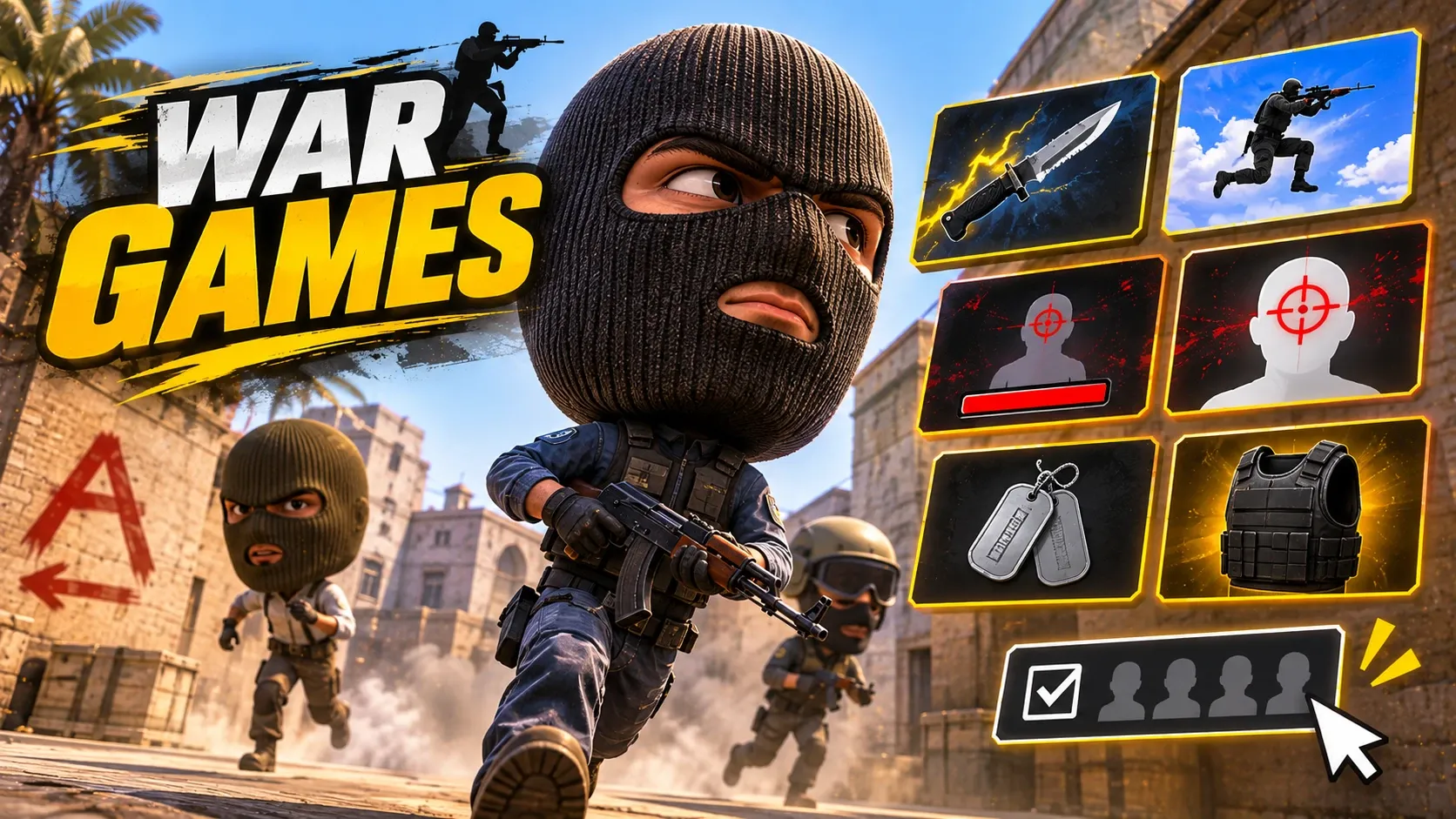
War Games were a collection of twists on the classic game, released with Operation Hydra on May 23, 2017. They were one of three Hydra events, alongside Wingman and Weapons Expert.
At the end of a match, players voted on the next War Game to play. The maps rotated daily, with three maps per mode each week. A picker menu arrived in the June 13, 2017 update, and before a June 6 update the feature was called Skirmish on Steam.
The Six Modes
Stab Stab Zap was based on Casual and Demolition. The only weapons were the knife and a rechargeable Zeus x27, and grenades were the only things you could buy. A developer comment in the files says it originally also started players with a flashbang.
Flying Scoutsman was based on Casual. Players got only the SSG 08 and the knife, gravity was reduced, midair acceleration was increased, and the accuracy penalty for shooting in the air was removed completely.
Trigger Discipline was also based on Casual. Players lost health for every missed shot, with the amount depending on the weapon, until they reached 1 health.
Boom! Headshot! was based on Deathmatch. Only headshot and backstab damage counted, and shots anywhere else did nothing. Players spawned with armor but no helmet.
Hunters-Gatherers was another Deathmatch variant. Kills dropped dog tags, and the goal was to collect the most before the match ended. The wiki notes it closely resembles Kill Confirmed from the Call of Duty series.
Heavy Assault Suit was based on Casual. A $6,000 Heavy Assault Suit replaced the normal Kevlar and helmet, and the mode ran only on bomb defusal maps.
The Three That Were Cut
Three more modes were found in the game files but were not part of the Hydra event.
Team Deathmatch awarded victory points for kills, and a later version arrived with Operation Riptide. Bloodletter healed players by the damage they dealt, up to 200, while also dealing non-lethal damage over time. Bounty Hunter made everyone an enemy, with kills dropping dog tags that anyone could pick up.
What Survived
On November 13, 2017, Flying Scoutsman became a permanent part of the game because of its popularity. The same update moved Arms Race and Demolition into the War Games category, replacing their old Arsenal grouping. Wingman, which had also debuted with Hydra, became permanent that day.
Later modes followed. Danger Zone arrived on December 6, 2018, and Retakes came with Operation Broken Fang on December 3, 2020, with three Terrorists defending against four Counter-Terrorists. By the end of CS:GO's life, Wikipedia counted nine official game modes.
Where the Name Came From
The wiki's notes say Flying Scoutsman is a play on the Flying Scotsman, the famous train, and on the SSG 08's nickname, the Scout. They also suggest it was inspired by a community mode called Scouts and Knives. The notes do not agree on the exact source, so treat that as trivia.
What Happened in CS2
This is my reading of several sources. Arms Race came back first, after a February 2024 update. Retakes is now an official CS2 mode, and Valve added Rush in September 2026. As far as I can tell, Demolition and Flying Scoutsman are not part of CS2's official matchmaking, and Valve has not restored Danger Zone either. A community discussion on Steam says the same, though I would not call it a confirmed list.
The Modern Echo
This is interpretation. Big Head Mode is a mutator, a rule applied on top of an existing mode, which is different from a War Game you vote on. But the idea is related. Both were Valve letting players try something unusual for a while. The October 28 files reportedly reserve room for up to 32 mutators, according to SkinsMonkey, which suggests Valve may have more of these in mind, though it has said nothing about it.
What We Do Not Know
Valve never published how many players tried each War Game. It did not explain why Bloodletter and Bounty Hunter were cut, and it has not said whether any retired mode will return. What the history shows is that Valve has been willing to experiment, and the wiki credits Flying Scoutsman's permanent spot to its popularity.
Keep Learning the History
Knowing the odd corners of the game makes every new mode easier to place. The mini games on CS Guess test your knowledge of Counter-Strike, covering skins, cases, music kits, and the history behind this game, with free perks for playing well.
Head over to CS Guess and see how much of this game you know.