How Pros Read a Round Before It Happens
The best Counter-Strike 2 players aren't reacting faster—they're predicting the future. Learn how professionals use sound, utility, economy, timing, and rotations to read rounds before they happen and make smarter decisions.

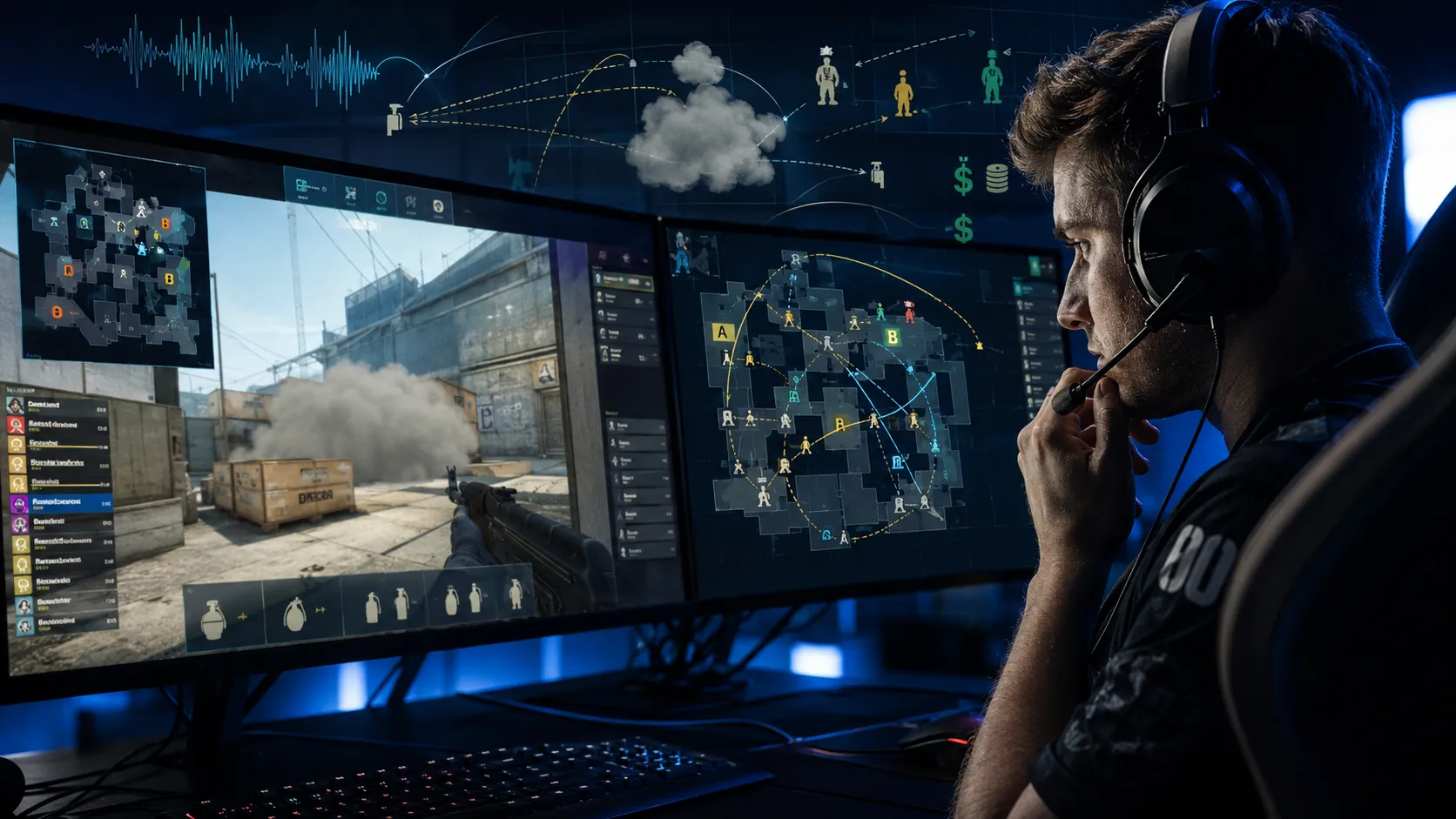
Introduction
You don't need lightning-fast aim to become a better Counter-Strike 2 player.
Watch any professional match, and you'll notice something that rarely gets talked about: the best players seem to know what's about to happen before it actually does. They rotate early, pre-aim the right angles, and rarely look surprised by an enemy's position.
It isn't luck.
It isn't cheating.
And it isn't just experience.
Professional players have developed exceptional CS2 game sense, allowing them to predict enemy decisions by combining dozens of small clues into one complete picture.
This ability—often called reading the round—is one of the biggest differences between average players and elite competitors.
In this guide, you'll learn exactly how professional Counter-Strike 2 players use sound cues, utility usage, economy, timing, and rotations to predict rounds before they unfold. More importantly, you'll learn how to start building those same habits in your own matches.
Sound Cues: Listening Beyond Footsteps
Most players hear sounds.
Professionals interpret them.
Every audio cue in Counter-Strike 2 tells a story. A footstep, reload, scoped AWP, ladder climb, dropped weapon, broken window, or even silence can reveal information about the enemy team's intentions.
Take Mirage as an example.
You hear several Terrorists running through Apartments before everything suddenly goes quiet.
Many players stop thinking there.
Professionals immediately ask questions.
- Why did the footsteps stop?
- Are they setting up utility?
- Did only one player stay behind?
- Are they trying to force a rotation?
- Was the noise intentionally created?
Silence is often just as valuable as sound.
The more matches you play, the more you'll recognize patterns instead of isolated noises.
Pro Tip
Instead of asking "Where did I hear that?" ask "Why did I hear that?"
That single mindset shift dramatically improves your CS2 game sense.
Utility Usage Reveals the Strategy
Grenades are one of the strongest sources of information in Counter-Strike 2.
Professional players memorize hundreds of smoke lineups and understand what each one usually leads to.
For example:
- Early Mid smoke on Inferno often signals map control.
- Multiple flashes into Banana usually indicate a fight for early space.
- Ancient Donut smoke frequently suggests Mid pressure.
- Mirage Window smoke almost always indicates Mid control.
One grenade rarely exists on its own.
Pros immediately start predicting what comes next.
Even more importantly, they recognize when utility doesn't make sense.
Imagine four smokes land on A Site.
Everyone rotates.
Except one experienced player.
Why?
Because the execute is missing flashes.
No players have crossed.
The bomb hasn't been spotted.
The utility looks convincing—but incomplete.
Recognizing fake executes is one of the fastest ways to improve your decision-making.
Practice Exercise
Watch one professional demo without focusing on kills.
Only pay attention to grenades.
Try predicting the next thirty seconds after every smoke or flash.
You'll quickly notice how much information utility provides.
Economy Predicts the Round Before It Starts
One of the most overlooked skills in Counter-Strike 2 is economy tracking.
Professional players don't wait for the action to begin.
They start analyzing the round during freeze time.
Ask yourself:
- Can they afford AWPs?
- Is this a force buy?
- Is it an eco?
- How much utility can they purchase?
- Will they save next round?
These answers immediately eliminate dozens of possible strategies.
Typical Economy Patterns
Full Eco
Expect fast rushes, stacks, or close-range fights.
Force Buy
Expect aggression with limited utility and shorter rounds.
Full Buy
Expect slower defaults, more map control, and coordinated executes.
Understanding economy allows you to prepare before the first bullet is fired.
That's exactly how professional players stay one step ahead.
Timing Creates Invisible Information
Every competitive map follows predictable timing windows.
Professionals memorize them.
If something doesn't happen when expected, that becomes information.
For example:
- No Mid utility on Ancient?
- Nobody contests Banana on Inferno?
- Mirage Window stays smoked longer than usual?
- No B pressure after thirty seconds?
Something unusual is happening.
Instead of reacting, pros begin predicting.
Timing also exposes lurkers.
If four enemies have appeared and one player hasn't shown for over forty seconds, experienced teams immediately begin adjusting their positions.
Understanding timing transforms random events into predictable patterns.
Rotations Are Evidence-Based Decisions
One of the biggest myths in Counter-Strike is that professionals rotate because of instinct.
The reality is much simpler.
They rotate because enough information supports the decision.
Consider this situation:
- Three grenades land on A.
- Bomb carrier spotted in Mid.
- No B pressure all round.
- Economy suggests a full execute.
- Timing matches a standard hit.
Individually, none of those clues prove anything.
Together, they tell a convincing story.
Professional rotations are built from multiple layers of evidence rather than one dramatic moment.
This is why they seem almost psychic.
The Secret Is Pattern Recognition
Elite Counter-Strike players aren't predicting the future.
They're recognizing patterns.
Every round follows a logical structure.
Information leads to decisions.
Decisions lead to positioning.
Positioning leads to executes.
The more Counter-Strike you study, the more familiar these patterns become.
Eventually, you'll stop reacting to the game.
You'll begin anticipating it.
That's what people call game sense.
How to Improve Your CS2 Game Sense
If you want to read rounds like professional players, focus on building better habits rather than simply playing more matches.
Try these methods:
- Watch your own demos and pause before every major fight. Predict what happens next.
- Watch professional matches from the spectator view instead of only following kills.
- Track enemy economy every round.
- Learn common utility lineups on your favorite maps.
- Practice communicating information instead of only enemy positions.
- Ask yourself why every smoke, flash, or rotation happened.
Over time, these habits become automatic.
The result isn't just better predictions.
It's smarter decision-making throughout every match.
Final Thoughts
The biggest difference between average players and professionals isn't aim.
It's information.
The world's best Counter-Strike 2 players constantly collect clues through sound cues, utility usage, economy, timing, and rotations. They combine those clues into accurate predictions long before the action begins.
Fortunately, this isn't a talent you're born with.
It's a skill that improves every time you consciously analyze a round instead of simply reacting to it.
The next time you queue into Premier or Competitive, challenge yourself to predict the enemy's next move before it happens.
You won't always be correct.
But every accurate prediction is another step toward developing professional-level CS2 game sense.
Frequently Asked Questions
How do CS2 pros predict enemy movements?
Professional players combine sound cues, utility usage, economy tracking, map timings, and previous round information to predict where opponents are likely to move.
What is game sense in Counter-Strike 2?
Game sense is a player's ability to understand what is happening—and what is likely to happen—using information gathered throughout the round instead of relying only on mechanical aim.
Does watching professional matches improve game sense?
Yes. Watching professional demos helps players recognize common strategies, utility patterns, rotations, and timing windows that can be applied in their own matches.
Is game sense more important than aim?
Both are important, but game sense often gives players better positioning and decision-making, making gunfights easier before they even begin.