How a Half-Life Mod Became Counter-Strike: The Gooseman and Cliffe Story
One of the biggest esports in history started as a project a university student worked on for about 20 hours a week, between classes. Minh "Gooseman" Le and Jess Cliffe never planned a franchise. Here is how a free Half-Life mod grew too big to stay free.
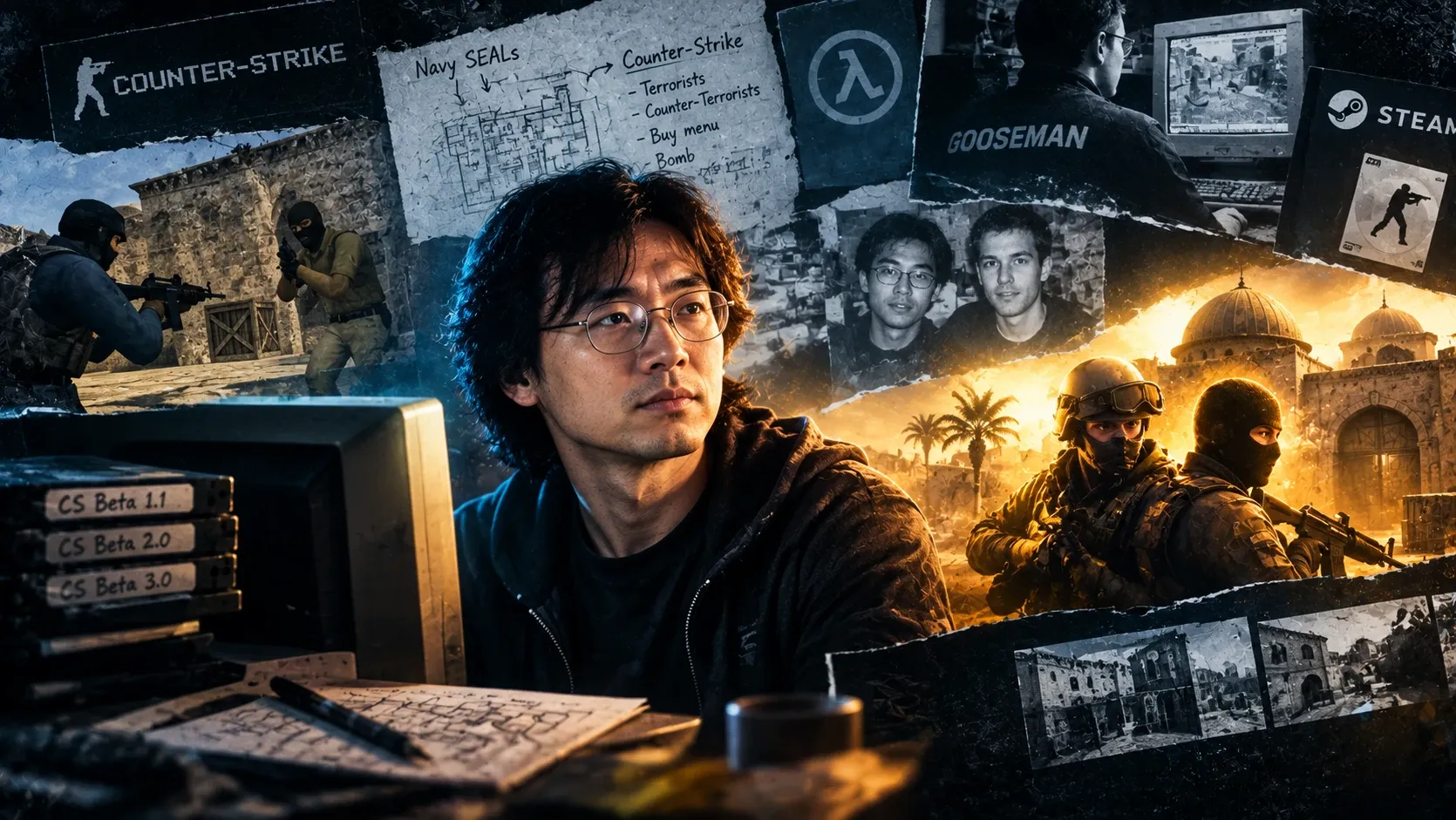
Most great games begin in a studio with a budget and a deadline. Counter-Strike began in the spare hours of a university student who was spending more time on his mod than on his coursework.
A Student With an Unusual Route
Minh Le was born in Vietnam in 1977. His family leaft by boat in 1979 and settled in Canada as refugees. He studied computing science at Simon Fraser University from 1996 to 2001. Online he went by Gooseman, a name borrowed from a character in a 1980s cartoon called The Adventures of the Galaxy Rangers.
Mods Before the Mod
Le picked up id Software's Quake in 1996 and started experimenting with its development kit. About a year later he finished his first mod, Navy SEALs, which is often described as Counter-Strike's spiritual predecessor. While working on another Quake mod, Action Quake 2, he came up with the idea for Counter-Strike and befriended its webmaster, a fellow modder named Jess Cliffe. In later interviews Le dated the idea to 1998 and pointed to his interest in special military units and games like Rainbow Six.
Half-Life Changes the Plan
Half-Life arrived in November 1998, and Le began building his idea as a mod for it while in the middle of his fourth year at university. By his own account he put in about 20 hours a week, which was more effort than he gave his schoolwork. Cliffe joined to help with maps and other parts of the project.
The first public beta came out in June 1999. Its core idea was simple and unusual for the time: two teams, Terrorists and Counter-Terrorists, fighting round after round with one life per round and money to spend on weapons. Nothing else in Half-Life's modding scene felt quite like it.
The Betas That Built a Community
The updates came fast. According to a community-maintained timeline, beta 1.1 arrived on June 27 with new maps, beta 2.0 on August 13 brought night vision and a wave of new maps, and beta 3.0 on September 14 added the knife and the P90. Players kept making their own maps, and the best ones rose to the top, which fed the game's growth.
That timeline comes from fans, so treat the exact dates and contents as approximate. What is well documented is the direction: every few weeks there was something new, and the player base kept growing.
Valve Takes Notice
By the fourth beta, Valve had started helping with development. In 2000 Valve bought the rights to Counter-Strike and hired Le and Cliffe to work with the team in Bellevue, Washington. Sources disagree on the month of the acquisition, with some pointing to April 2000 and others to September, so it is safest to say simply that it happened in 2000. The retail version followed on November 9, 2000.
Years later, Valve's Doug Lombardi said while announcing Counter-Strike: Global Offensive that the mod had become the most played online PC action game in the world almost immediately after release. That is Valve's own telling, but nothing in the game's history contradicts it.
From Mod to Esport
Competition showed up almost at once. A community timeline lists tournaments in Dallas and Cologne in December 2000, and the 2001 CPL Winter Championship is often counted as the first Major. Dust2 shipped with version 1.1 in March 2001. Counter-Strike 1.6 followed in September 2003, alongside the launch of Steam, and it stayed the competitive standard for years.
The Counter-Strike 2 That Never Was
There is a twist that feels almost funny now. After version 1.0, Le reportedly started work on a prototype of a Counter-Strike sequel. After about three years the project was shelved at roughly 25 percent completion. He moved on to Day of Defeat: Source, left Valve in 2006, and later worked on Tactical Intervention, then Rust at Facepunch Studios, then a project at Pearl Abyss. In an interview published in 2026, he said he had thought about returning to help with Counter-Strike 2, especially on weapon animations and maps, and that he believed the game was in a good place.
Why It Still Matters
IGN once ranked Le and Cliffe 14th on its list of the top 100 game creators of all time. The reason is easy to see. Rounds without respawns, the buy menu, the bomb: almost everything you do in CS2 today traces back to a student's project from 1999. A free mod that nobody paid for ended up shaping an industry.
Know the Story Behind the Game
Knowing where this game came from makes everything built on top of it more interesting. The mini games on CS Guess test that kind of knowledge, covering prices, rarity, and the history behind this game, with free perks for playing well.
Head over to CS Guess and see how much of this game's history you know.