Is CS2 Pay to Win? What Skins and Cases Actually Affect
Ask this question in almost any CS2 community and you'll get the same confident one-line answer: no, it's all cosmetic. That answer is mostly true, and also slightly incomplete, because there's one category of paid item where the line between "just cosmetic" and "actually matters" gets genuinely blurry.

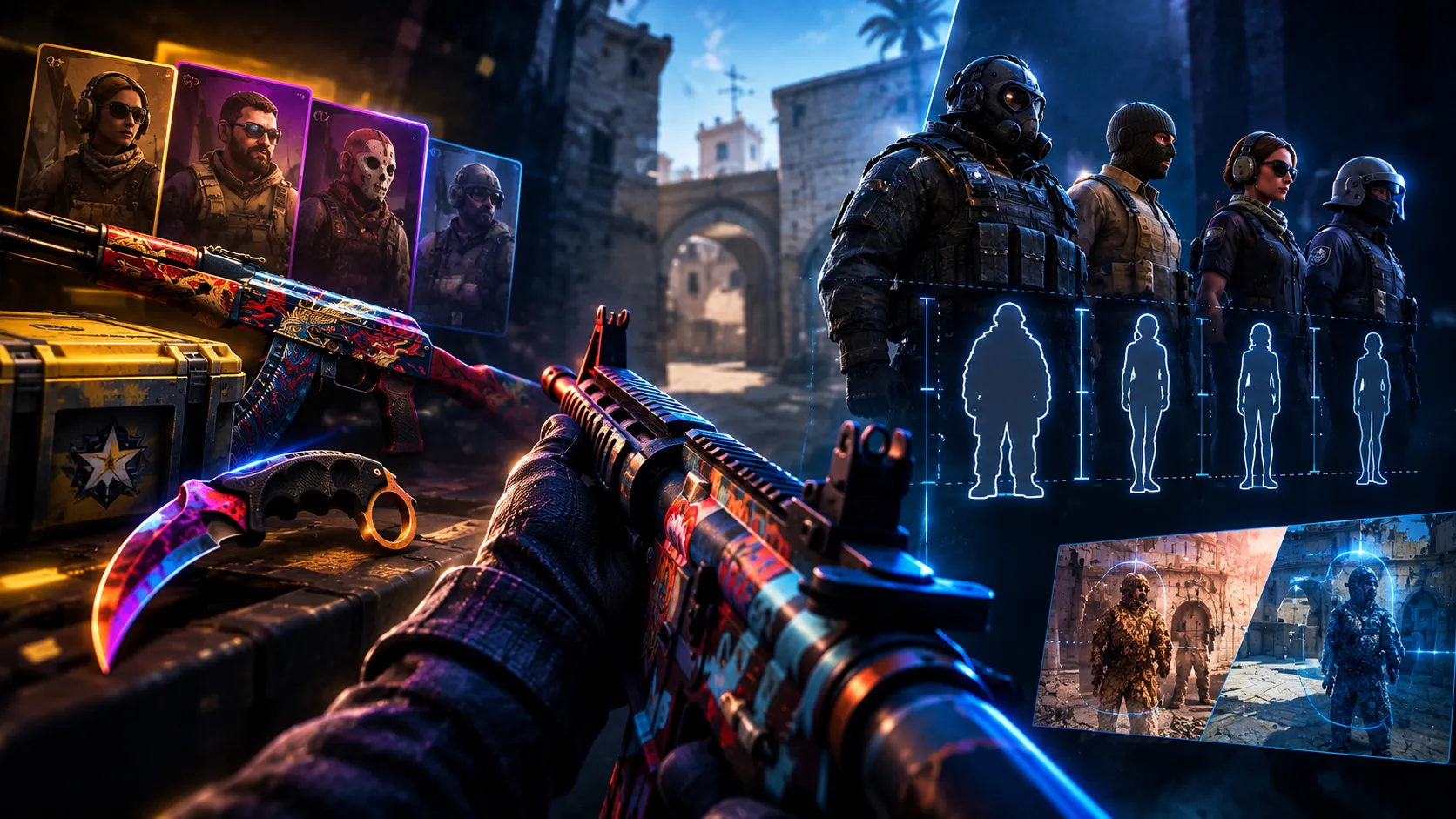
The short version people usually want is simple enough to fit in a sentence, but the honest version has a real asterisk on it, and that asterisk is worth understanding if you're spending real money in this game.
Weapon Skins Really Are Just Paint
Start with the easy part. A weapon skin changes what your gun looks like and nothing else. It doesn't touch your hitbox, your damage output, your recoil pattern, or your accuracy in any way. A thousand dollar Karambit and a stock knife perform identically in combat. This applies to every weapon finish in the game regardless of price, rarity, or how good it looks in your inventory. If someone tells you a specific skin makes your gun shoot better, they're wrong, and it's worth knowing that confidently rather than half believing it.
Cases and keys exist purely to sell you a chance at these cosmetic items, and Valve has been under real regulatory pressure over exactly that random-chance mechanic. Belgium and the Netherlands have already restricted loot box style mechanics, Germany added a mandatory odds display for local players in March 2026, and in February 2026 the New York Attorney General filed a lawsuit against Valve arguing that CS2's cases function as illegal gambling. Valve has denied the claims and moved to dismiss the case, comparing the randomness in cases to other everyday products like trading cards. That litigation is ongoing, so it's worth treating as an open legal question rather than a settled fact either way. None of that changes what's actually true about the cosmetic side, though. Whatever you think about how cases are sold, what comes out of one has zero effect on how your gun performs once a round starts.
Agent Skins Are Where It Gets Genuinely Complicated
This is the part most quick answers skip entirely. Agent skins change your character model rather than your weapon, and that distinction matters more than it might seem. Back in CS:GO, this was a real, documented problem. Different agents had different hitbox sizes, meaning some models were mechanically easier to hit than others, and players who knew this would specifically pick smaller agents for a genuine competitive edge. Valve fixed this directly in CS2 by standardizing the hitbox skeleton across every agent, default or premium, so the invisible box that actually registers your shots is now identical no matter which model you're using.
What didn't go away is the visual side of things. Bulky agents wearing heavy gear, thick helmets, or large backpacks have geometry that extends past their actual hitbox, so a shot that visually appears to land on that gear does nothing, since the hitbox underneath doesn't cover it. Slimmer agents create a smaller silhouette on screen even though their hitbox is the same size as everyone else's, which some players report makes them subjectively harder to track and hit in the middle of a firefight, even if the underlying mechanics are identical. Community estimates place the visual volume difference between the bulkiest and slimmest models somewhere around ten to twelve percent, though that figure comes from player measurement rather than anything Valve has confirmed.
There's also a genuine camouflage factor tied to specific maps. Some agent textures blend into certain environments more than the default models do. An agent with orange and brown tones can genuinely disappear against Dust2's color palette in a way the standard skin doesn't, and that's a real tactical consideration when you're picking what to wear into a match on a specific map, not a myth or a placebo effect.
One piece of evidence that this concern is taken seriously rather than dismissed as paranoia: custom agent skins are disabled entirely in professional matches. Every player competing at the top level uses the same default models specifically so that visibility and silhouette size can't become a variable between teams. That's not something tournament organizers would bother doing if the visual differences genuinely didn't matter at all.
So Is It Actually Pay to Win
If you're asking whether spending money buys you a mechanical advantage the way it would in a genuinely pay to win game, the answer is no. Nothing you can purchase changes your hitbox, your damage, or your gun's performance. If you're asking whether every purchasable cosmetic is functionally identical to every free one, the answer is a little softer than that, because agent visibility and map-specific camouflage are real, if modest, factors that professional play treats seriously enough to eliminate outright. The honest summary sits between the two extremes: CS2 isn't pay to win in the way that term usually gets used, but it's not purely, perfectly cosmetic either, and the gap between those two claims is exactly where agent skins live.
Test Your Knowledge on a Level Playing Field
If you're the type of player who actually cares about the details behind claims like this rather than just accepting the one-line answer, that same curiosity is exactly what the mini games on CS Guess are built to reward. Test your read on prices, rarity, and the game's history, and build up free perks for playing well, with nothing purchasable giving anyone an edge over anyone else.
Head over to CS Guess and put what you actually know to the test.