The $2.5 Million Knife: Inside the Karambit Blue Gem #387 Story
Somewhere out there, sitting in a single Steam inventory, is a knife that people have offered millions of dollars for and still walked away empty-handed. The Karambit | Case Hardened in the legendary Blue Gem pattern, specifically the one carrying seed #387, isn't just the most expensive skin in Counter-Strike history. It's become something closer to a piece of folklore. Here's the full story of how a random number generator created a digital object worth more than most houses.

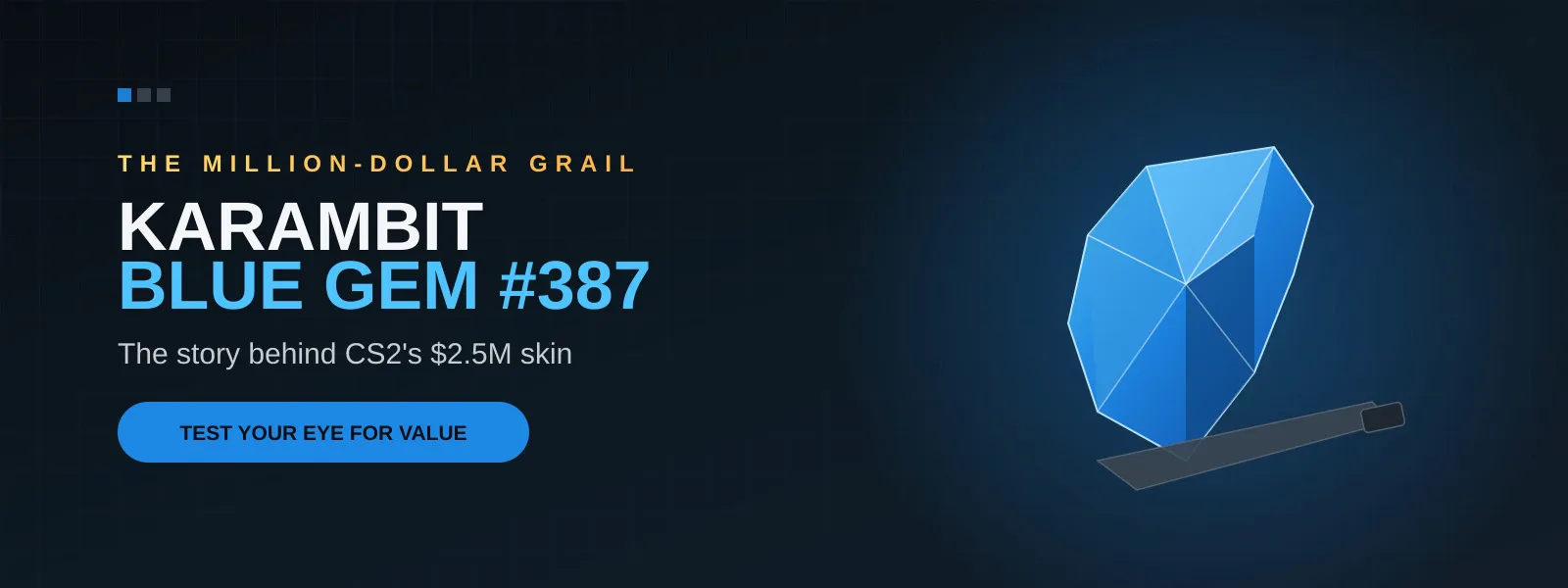
Every community has its white whale. For car collectors, it might be a numbers-matching Ferrari sitting in a barn somewhere in Europe. For sneakerheads, it's some untouched pair from a discontinued run. For the CS2 skins community, it's a single Karambit, and if you've spent any real time around skin trading, you already know its name before you even see a screenshot: the Blue Gem.
If you're newer to the skins side of Counter-Strike, this whole story might sound almost made up. A knife worth more than two million dollars, in a game where you can also just buy a rifle skin for the price of a coffee. But the Blue Gem is real, the offers on it are real, and the story behind why it exists is genuinely one of the wildest things random number generation has ever produced inside a video game.
What Even Is a "Case Hardened" Skin, and Why Do Patterns Matter So Much
Most skins in CS2 look basically the same every time you pull one, aside from wear and float differences. Case Hardened weapons don't work that way. Every single Case Hardened item, whether it's a Karambit, an AK-47, or anything else in that finish, gets a unique pattern seed the moment it's generated. That seed determines exactly how the blue, gold, and purple patina spreads across the metal.
Most of the time, this produces a fairly ordinary mix of colors. But every so often, the seed lines up in a way that produces something almost entirely blue across the visible playside of the weapon, and that's what the community calls a Blue Gem. It's not a separate skin. It's not a rarer drop rate item in the traditional sense. It's the exact same Case Hardened skin everyone else has, except the pattern that got assigned to it happens to be one of the rarest visual outcomes mathematically possible.
On a Karambit specifically, the odds of landing a genuine full Blue Gem playside are frequently cited at somewhere around 1 in 371 million. To put that in perspective, you have a meaningfully better chance of getting struck by lightning at some point in your life than you do of unboxing or trading into a pattern like this by pure luck.
The Story Behind Pattern #387
Out of every Blue Gem Karambit that exists, pattern #387 is the one that's reached genuine legend status. This particular knife checks nearly every box a collector could ask for. It's Factory New, meaning the float is clean enough that the pattern displays as close to perfectly as the skin allows. It shows an almost complete blue coverage across the playside, which is the single most sought-after visual trait on any Case Hardened weapon.
The stories around this specific knife have circulated in the trading community for years at this point. Reported offers north of a million dollars have reportedly been turned down by its owner more than once, and by 2025 and into 2026, collectors and market analysts following high-end CS2 trading have floated valuations as high as $2.5 million if it were ever to actually change hands. Whether that number ever gets tested in a real transaction is genuinely unclear, since deals at this level rarely happen in public and almost never get fully verified. But the fact that a video game cosmetic item has an entire mythology built around whether or not someone will finally sell it tells you everything about how far this economy has come.
Why Nobody Can Just "Make Another One"
This is the part that trips people up the most when they first hear the Blue Gem story. You can't grind for this. You can't save up and craft one through trade-ups, and you can't reliably influence your odds through any strategy at all. The pattern is locked in at the moment the item is generated, and from that point forward it either is a Blue Gem or it isn't.
That's actually part of why this particular category of skin held up so well even during the broader CS2 market turbulence that followed the trade-up contract changes in late 2025. When Valve adjusted how trade-ups worked, a lot of the market saw sudden, sharp corrections, because certain items that used to be craftable through trade-ups suddenly weren't, or vice versa. Blue Gem patterns were completely unaffected by any of that, since there's no trade-up path that can produce one in the first place. Fixed, finite supply tends to be the safest place to sit during exactly this kind of market shakeup, and the Blue Gem is about as fixed and finite as it gets.
The Other Contenders for "Most Expensive Skin in CS2"
The Blue Gem Karambit usually tops these lists, but it's not competing entirely alone. Souvenir AWP Dragon Lores in Factory New, particularly the ones carrying gold Katowice-era stickers, have sold for reported prices well into six figures. High pattern AK-47 Case Hardened crafts, especially ones combined with rare early tournament stickers, have also crossed into serious six-figure territory in reported private sales. And then there's the Howl, the only skin in CS2 history to carry official Contraband status after a copyright dispute forced Valve to pull it from circulation entirely, which keeps its value propped up purely through permanently fixed scarcity.
What sets the Blue Gem apart from all of these is that it isn't really being compared on the basis of a rare event, like winning a tournament sticker capsule or catching a souvenir drop during a Major. It's being compared on pure mathematical improbability. Nobody engineered this outcome. It's just what happens when you roll dice 371 million times and someone, somewhere, actually hits the number.
How to Actually Spot a Real One (Because Fakes Absolutely Exist)
Here's the part that matters if you're anywhere near the trading side of this hobby rather than just reading about it for fun: wherever there's a skin worth this kind of money, there are people trying to scam their way around it. Listings claiming to be "Blue Gem" Case Hardened items pop up constantly on shady third-party sites, often relying on screenshots, inspect links that don't actually resolve, or pattern claims that don't hold up once you actually check them.
A real Blue Gem claim should always be verifiable through the weapon's actual inspect link, not just a picture. The pattern index should be checkable against known databases of confirmed Blue Gem seeds. And any high-value trade like this should go through an established, reputable middleman or platform rather than a direct trade with a stranger, no matter how convincing the screenshots look.
Could You Actually Spot One Yourself?
This is honestly the fun part. Most players have looked at a Case Hardened knife at some point and had no idea whether what they were looking at was worth $15 or $15,000. Pattern recognition on Case Hardened items is a genuinely learnable skill, and it's exactly the kind of thing that turns a random skin sighting in someone's inventory into a "wait, is that actually valuable" moment.
That's the whole idea behind the pattern and pricing rounds on CS Guess. Instead of just reading about the Blue Gem after the fact, you can actually test whether you'd recognize valuable patterns, floats, and finishes yourself, guess real prices on real items, and see how your eye for value stacks up against other players. Playing through the mini games also chips away at daily free perks along the way, so even if you never end up owning a seven-figure knife yourself, you can at least walk away knowing you'd recognize one on sight.
Head over to CS Guess and put your pattern knowledge to the test. Who knows, the next Blue Gem story might start with someone who actually knew what they were looking at.