The Rarest CS2 Skin Patterns Explained: Blue Gems, Fire and Ice, and the Other Grails Collectors Chase
Two players can own the exact same knife - same wear condition, same collection - and one of them is sitting on a weapon worth a few hundred dollars while the other is holding something that could sell for six figures. The difference almost never comes down to luck in the way people assume. It comes down to a single hidden number called the pattern seed, and understanding what that number does is the key to understanding why certain CS2 skins become genuine grails.

Every skin that drops in Counter-Strike carries an invisible passenger. It's a number between one and one thousand, assigned randomly the moment the item is generated, and on most weapons it changes almost nothing you'd ever notice. On a small handful of finishes, that same number is the entire reason a skin becomes legendary.
What a Pattern Seed Does
That hidden number is officially called the paint seed, though most of the community just calls it the pattern index. It controls exactly how a skin's texture gets mapped onto the three dimensional model of the weapon. Picture wrapping a printed sheet of colored paper around an oddly shaped object. Depending on where you start wrapping and at what angle, the pattern on the paper lines up completely differently against the object's curves and edges each time. That's essentially what the paint seed does to a weapon skin. Because every gun and knife has its own unique shape, the same seed number can look completely unremarkable on one weapon while producing something extraordinary on another.
For the vast majority of skins in the game, this barely matters. A seed shift might nudge a scratch or a smudge a few millimeters to the left, and nobody would ever notice or care. But for a specific group of finishes built around bold, sweeping color transitions, the seed becomes the single biggest factor separating a skin worth ordinary market price from one that collectors will pay a fortune to own.
The Case Hardened Blue Gem
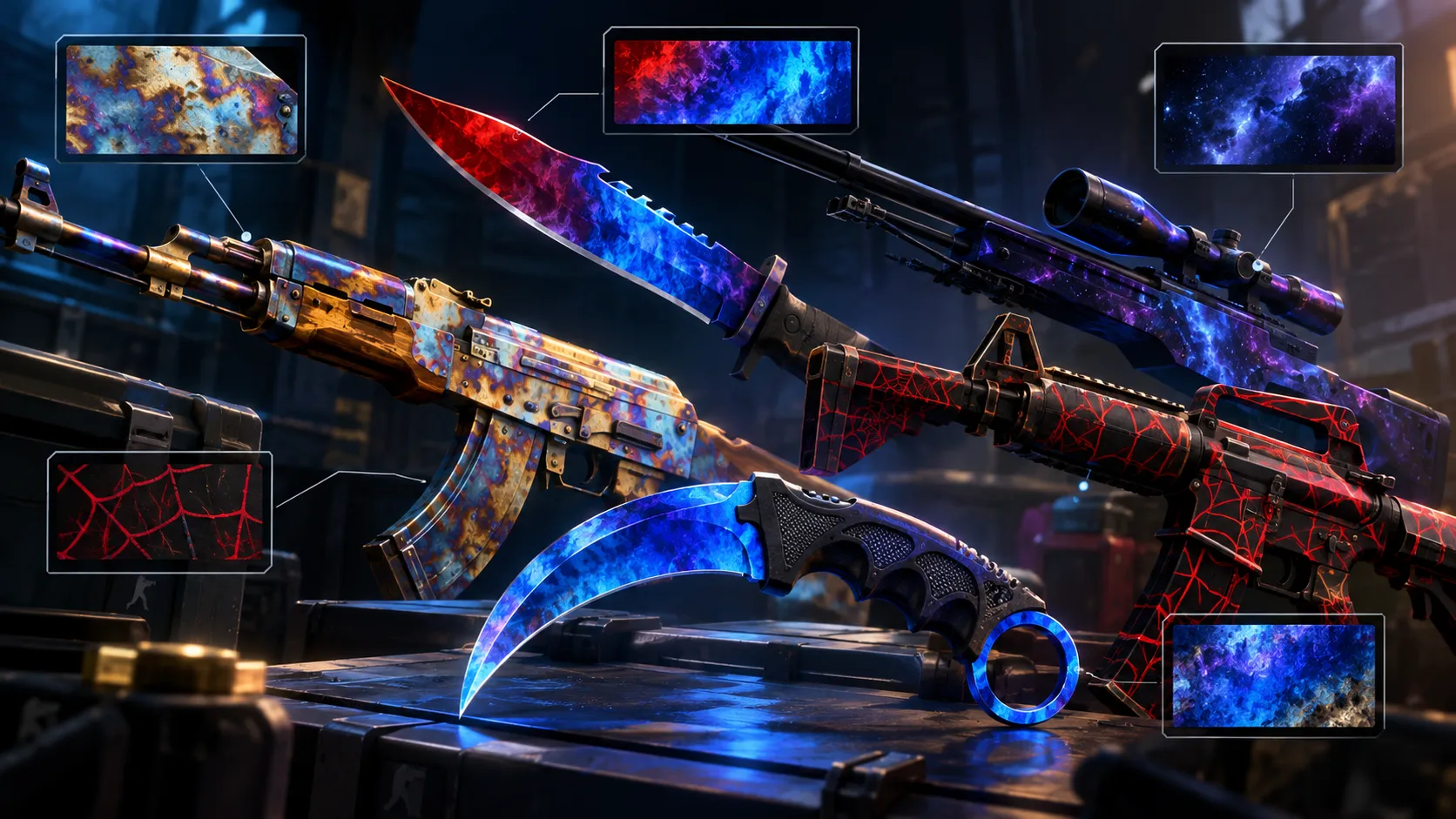
Case Hardened is probably the single most famous example of pattern chasing in the entire game. The finish itself is a mix of blue, purple, and gold coloring meant to resemble the heat treated surface of case hardened steel - and depending on the seed, those colors can land almost anywhere across the weapon. Most copies end up as an unremarkable blend of all three colors. A rare handful of seeds, though, produce something the community calls a Blue Gem, where the visible side of the weapon - the side facing the camera, the one that matters most when you're holding it in game - ends up covered in solid, ocean deep blue with barely a hint of gold or purple breaking it up.
The most famous example in the entire game is a specific pattern on the Karambit. It's widely regarded by collectors as the best Blue Gem ever produced, and Factory New copies of that exact seed have sold for more than one hundred fifty thousand dollars. That's not a typo, and it's not an outlier either: strong Blue Gem patterns on desirable knives routinely trade for ten to a hundred times what an ordinary copy of the same knife would cost, purely because of where a random number happened to land when the item was generated.
Fire and Ice, the Cleanest Cut in Marble Fade
Marble Fade knives blend red, yellow, and blue together in a swirling pattern that shifts entirely based on seed. Most copies show a mix of all three colors, which looks perfectly nice but isn't what collectors are hunting for. What they want is a pattern where the yellow disappears almost entirely, leaving only a clean, sharply divided line between red and blue running across the blade. That specific look has earned its own nickname, Fire and Ice, and the cleanest, most symmetrical examples of that split command serious premiums over an average Marble Fade.
This is also one of the more commonly faked claims in skin trading. Plenty of listings advertise a knife as genuine Fire and Ice when a careful look reveals a thin sliver of yellow still peeking through near the spine of the blade - which technically disqualifies it from the truest version of the pattern, even though it looks similar at a glance. Anyone shopping for one of these is generally better off inspecting the actual weapon through Steam's inspect link rather than trusting a screenshot, since photos can be cropped or angled in ways that hide the exact detail that determines whether a pattern is the real thing.
Crimson Web and the Hunt for a Centered Spread
Crimson Web skins lay a web of thin red lines across a black base, and much like the other finishes on this list, the seed determines exactly where that web ends up. A copy with the web scattered mostly across the handle or the back of the blade, where it's barely visible during actual gameplay, is worth close to nothing special. A copy where the web lands large, unbroken, and dead center on the side of the blade you actually see while playing is a different story entirely. On knives like the Karambit or M9 Bayonet, a pattern with multiple big webs centered on the playside can sell for two to five times what a normal copy commands - occasionally climbing into five figure territory for the cleanest examples anyone has documented.
Doppler Phases, Where the Seed Decides the Whole Identity
Doppler knives take this concept even further than the others. Rather than just shifting where a color lands, the seed on a Doppler determines which phase the knife becomes entirely, and those phases carry completely different names and price tags despite all selling under the same general Doppler label on the market. Ruby and Sapphire, which show deep solid red or blue coloring respectively, sit well above the more common phases in value, while Black Pearl - a rarer, dark, almost galaxy like finish - can command a premium all its own. Two knives can both say Doppler in their name and be separated by an enormous price gap purely because of which phase the seed happened to produce.
Why Chasing These Patterns Got More Complicated Recently
The knife and glove market went through real turbulence following an October 2025 update that let players craft a guaranteed knife or pair of gloves directly from Covert skins. Prices across ordinary copies of many knives dropped significantly in the aftermath, as that scarcity evaporated. What's interesting is that top tier pattern seeds held their value noticeably better than generic copies of the same knives throughout that entire correction. That makes sense once you think about why: a generic knife can now effectively be manufactured on demand through the new system, but a specific, documented, top ranked pattern seed can't be crafted into existence no matter how many skins someone feeds into a contract. The supply of a true grail pattern is exactly as limited as it's always been, seed number and all - and that scarcity is precisely why these patterns held their ground while the broader market corrected around them.
Hunting for Your Own Grail
If any of this has you wanting to check what you're actually holding, community pattern databases and checker tools let you look up a specific seed number against known rankings for finishes like Case Hardened, Marble Fade, and Crimson Web. It's worth remembering that the vast majority of seeds on any given skin are perfectly ordinary, and finding a genuine top tier pattern by chance is exactly as rare as the prices suggest. That rarity is the entire point, and it's exactly why a community has grown up around hunting for these specific numbers in the first place.
Sharpen Your Eye for What Makes a Skin Valuable
Understanding why one pattern commands a fortune while an identical skin sells for a fraction of the price is exactly the kind of knowledge the mini games on CS Guess are built to test. You'll sharpen your read on prices, rarity, and the details that separate an ordinary item from something collectors genuinely chase, with free perks for playing well along the way.
Head over to CS Guess, put your knowledge of this economy to the test, and see how sharp your eye for a real grail actually is.