Why Dust2 Never Dies: The Story Behind Counter-Strike's Most Famous Map
Counter-Strike has changed engines, graphics, and rules more than once, yet one map from 2001 is still the first thing most players picture when they hear the name. Valve has removed it from competitive play twice and it keeps finding its way back. Here is where Dust2 came from and why it refuses to die.

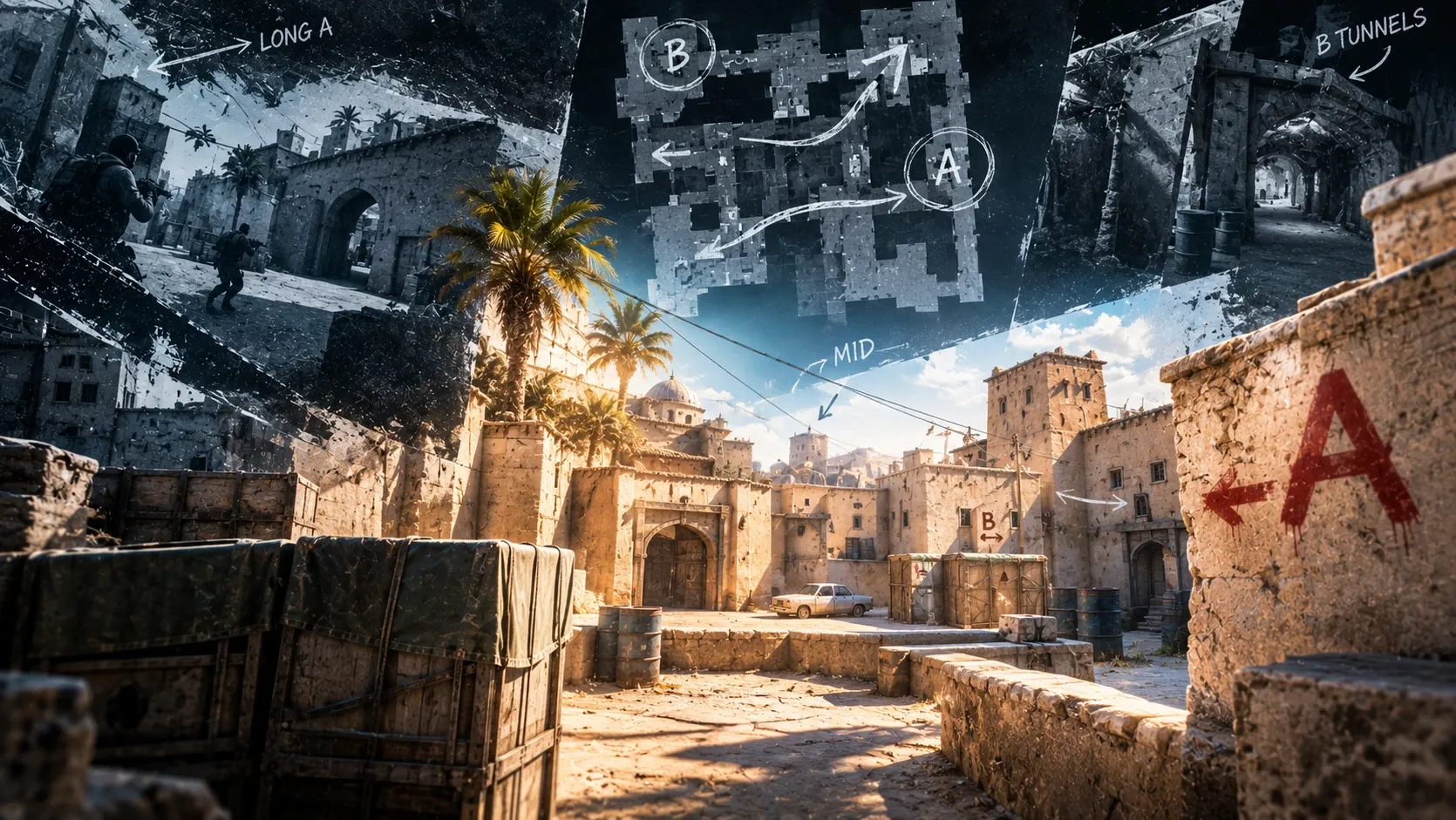
Some maps are played. Dust2 is something closer to a shared language. Players who have never met can describe a lineup, a fake, or a mistake using nothing but its callouts, and everyone knows exactly what they mean. That does not happen by accident.
A Sequel Nobody Planned to Love
Dust2 was built by a mapmaker named David Johnston, who had already made the original Dust, a map that became hugely popular during Counter-Strike's early days. Players kept asking for more of it, and Johnston set out to make a proper follow-up. He reportedly doubted it was good enough to carry the name. His working title was "Dust 3", a strange choice for a sequel, and it only became Dust II before the game shipped.
The finished map arrived on March 13, 2001, as part of Counter-Strike 1.1. Chris "MacMan" Ashton helped with the textures. Johnston stepped away from the map around that same version, when ownership passed to Valve, and it has been in Valve's hands ever since.
Why the Design Holds Up
The layout is almost aggressively simple. Two bomb sites, a symmetrical structure, and three main routes in the form of Mid, Long A, and B Tunnels. Johnston wanted one area built for close fights and one for long range duels, and those became B Tunnels and Long A. One of the map's most famous features has a plain origin. By his own account, Long A exists because he ran out of world space and could not build outward, so he built long instead.
Looking back, Johnston has said he thinks the map stays popular simply because it is familiar and constant. Everyone knows it in such detail that skill, rather than surprise, decides most rounds. That is a quiet but powerful point. A map nobody has to learn is a map where the better team usually wins.
A Map That Barely Changes
Very few things in Counter-Strike have stayed this stable. After the 2001 release, Dust2 got graphical touch-ups in Condition Zero and on Xbox, a handful of physics and object changes in Counter-Strike: Source, and metal doors in place of wooden ones in Global Offensive. The biggest change came in October 2017, when Valve released a visual remake as a beta and made it public about a week later. The layout stayed.
Counter-Strike 2 followed the same approach. Valve labeled Dust2 a "touchstone" map, meaning it got new graphics and lighting while keeping essentially the same layout. For a game that rebuilt nearly everything else, that was a deliberate choice to leave it alone.
Removed Again and Again, Never for Long
You might assume a map this beloved would be untouchable. It has actually been pulled from competitive play several times.
On February 3, 2017, Valve removed Dust2 from the Active Duty pool, the group of maps used in competitive matches and pro play, and replaced it with a revamped Inferno. Dust2 got its own separate map group in Casual and Deathmatch. Pro players pushed back hard, with some arguing Valve had cut a balanced map to make room for one with problems. It returned in April 2018, replacing Cobblestone. In November 2022 it was swapped out again, this time for Anubis ahead of the 2023 Paris Major. In April 2024, during Counter-Strike 2's first year, it came back in place of Overpass, and reactions were mixed.
Mapmaker Shawn "FMPONE" Snelling once argued in a Kotaku feature that Dust2 could never really leave Active Duty because it could never leave matchmaking. Valve proved it could be removed from the pool, but the pattern since then backs up the spirit of his point. Every removal has turned out to be temporary.
A Map Bigger Than the Game
Dust2 has appeared in every Counter-Strike game released so far, and it has spread well beyond them. Versions of it show up in Far Cry 3, Far Cry 5, Crossfire, and Minecraft. Reports in 2014 claimed fans had built a life size replica, though the location was never identified. In 2023 a fan rebuilt the whole map from scratch in Unreal Engine 5 with realistic graphics. An indie game called Dustnet is set entirely inside what it calls the last copy of de_dust2 in the world.
According to the community wiki, there is even a hidden developer note near the Counter-Terrorist spawn that you can only see with noclip or free look. Treat that one as community lore rather than something Valve has confirmed.
Why It Still Matters
The Active Duty pool keeps turning. When Cache came back in July 2026, Overpass was the map that rotated out. Dust2 keeps surviving those reshuffles.
It also keeps producing big moments. In April 2026, Vitality clinched the final of IEM Rio, and with it a record second ESL Grand Slam, by winning the deciding map on Dust2 13-5. Twenty-five years after its release, the map is still where championships get decided.
Prove You Know Your Maps
Knowing a map's history is a different skill from knowing its callouts, and the best fans have both. The mini games on CS Guess test your knowledge of this game's prices, rarity, and the stories behind it, with free perks for playing well.
Head over to CS Guess and see how much of this game's history you can recall.