CS2 Grenade Lineups: How to Actually Learn Utility Instead of Copying Videos
Search for any CS2 lineup guide and you'll find the same format everywhere: a giant list of smokes and flashes for every map, each one demonstrated in a clip that makes it look easy. Most players watch a dozen of these videos, try to remember all of it, and then throw the same three grenades they always throw once a real match actually starts. The problem was never a lack of lineups. It's how most players try to learn them.

There's a very specific failure mode that shows up in almost every rank below the top tier. A player watches a lineup video, nails the smoke twice in an empty server, feels confident, and then completely blanks on it three days later during a real Premier match. That gap between "I saw it work" and "I can throw it under pressure" is the entire problem this article is about.
Fewer Lineups, Thrown Better
The instinct when you're trying to improve is to learn as much as possible, so a lot of players try to absorb thirty or more lineups per map in one sitting. That approach tends to backfire. A smaller set of five or six lineups you can hit consistently, ideally something close to nine times out of ten, wins you more rounds than thirty lineups you're only reliable with once in a while. Under actual round pressure, your hand goes to what's automatic, not to whatever you technically know is possible. A lineup you can only land six times out of ten in a private server isn't something you should be relying on in a competitive match, because that failure rate gets worse, not better, once nerves and time pressure show up.
The practical version of this is picking one map, learning a genuinely small core kit for it, and only moving to a second map once the first one feels automatic. Most guides suggest around three to five essential lineups per map as a starting point rather than an exhaustive list. You can always add more later. Rushing to cover every map at once is usually what causes players to retain almost none of it.
Setting Up a Real Practice Session
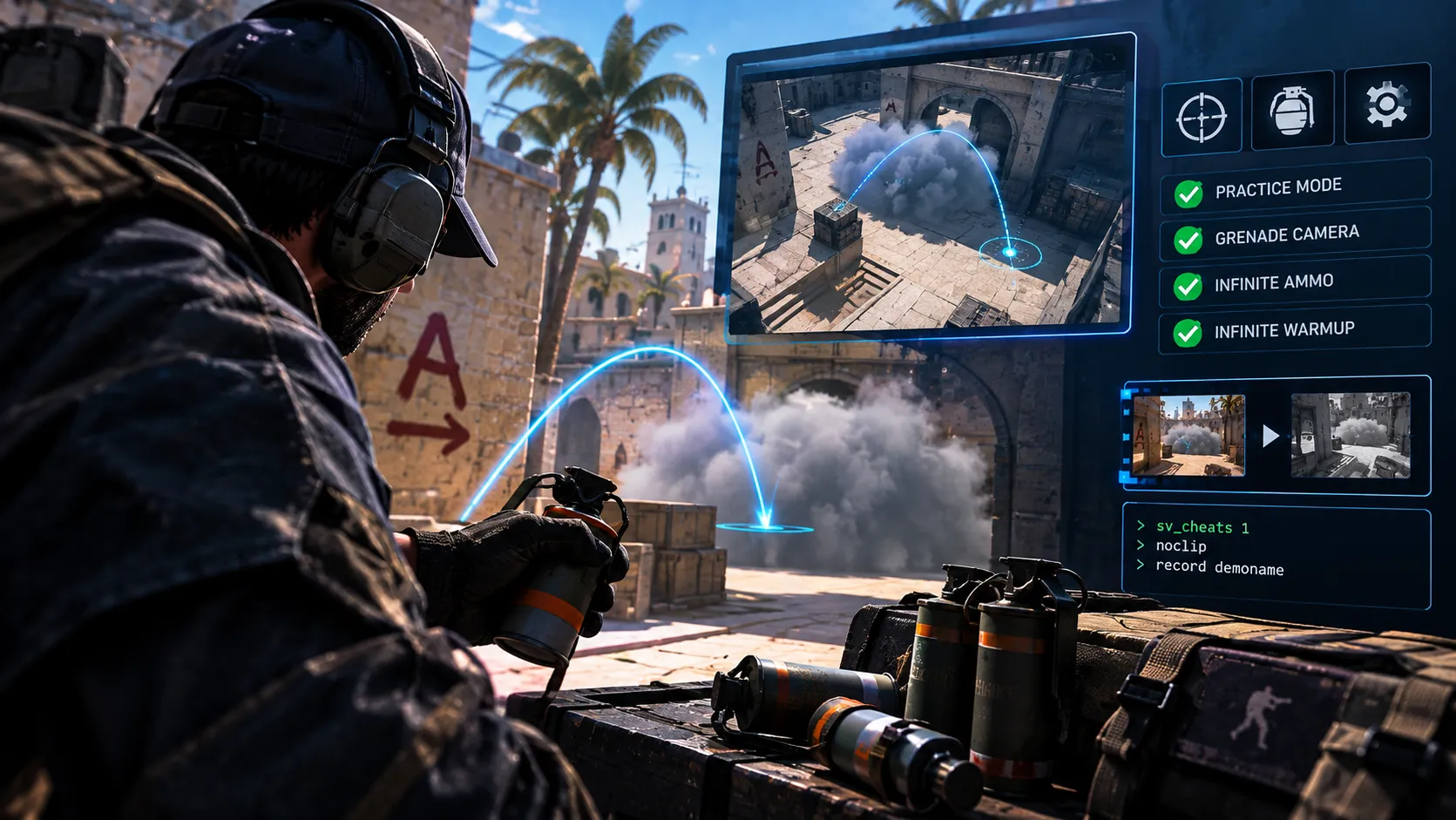
CS2's practice mode makes this genuinely easier than it used to be in CS:GO. From the main menu, go to Play, then Practice, and pick the map you want to drill. Once you're in, turn on Grenade Camera, Infinite Ammo, and Infinite Warmup from the practice settings. Grenade Camera specifically is the one that matters most here, since it shows you the actual arc and landing point of your throw in real time instead of making you guess whether you got the angle right.
If you want more control than the menu gives you, the console offers additional options once sv_cheats is enabled on your local server. Commands like noclip let you fly around a smoke to check exactly where it landed relative to the site, and recording your practice session with record demoname lets you go back and review a missed throw at quarter speed afterward, which is often the fastest way to spot exactly where your aim or run-up went wrong.
The Repetition Number That Actually Matters
There's a rough benchmark worth knowing here: getting a lineup to genuinely reliable, match-ready status tends to take somewhere in the range of fifty to a hundred repetitions in a private server. That number sounds like a lot until you realize most players quit practicing a lineup after five or six successful throws and assume it's locked in. It isn't. Muscle memory that holds up under the stress of an actual round needs a lot more reinforcement than muscle memory that just holds up in an empty lobby with nobody shooting at you.
Why Copying a Pro's Utility Isn't the Whole Lesson
Watching how a professional team uses utility is genuinely useful, but only if you're paying attention to the right part of it. Copying where a pro throws a specific smoke teaches you one lineup. Paying attention to when they throw it, what triggered that decision, and how their teammates moved in response teaches you something that transfers to situations you haven't specifically practiced. That distinction matters more than it sounds like it should. A flash thrown a half second too early or too late is often worse than not throwing it at all, and that timing sense doesn't come from a lineup video, it comes from watching the decision-making around the throw.
This is also where in-game communication earns its keep. A single callout like "smoking cross" or "flash over, wait for pop" does more for your team's coordination than the grenade itself in a lot of situations, because it tells four other people what to expect and when to move. Good utility usage is a team skill wearing a mechanical skill's clothing.
Building a Routine That Actually Sticks
Fifteen to thirty minutes of focused practice before you queue tends to be enough if you're doing it consistently rather than occasionally. Add one new map per week instead of trying to overhaul your entire pool at once, and treat your private server reps as seriously as you'd treat aim training, since the two skills genuinely compound each other. A player who can hold an angle and also knows exactly when to smoke it off is a considerably harder problem for the other team than either skill on its own.
Sharpen a Different Kind of Game Sense
Learning utility well is about pattern recognition and repetition just as much as it's about raw mechanics, and that same instinct for spotting patterns is exactly what gets tested in a completely different way by the mini games on CS Guess. You'll get to test your read on prices, rarity, and the game's history, with free perks for playing well along the way.
Head over to CS Guess and see how sharp your instincts are once the guns get put away.