The ESL Grand Slam Explained: Counter-Strike's $1 Million Prize and the Team That Won It Twice
Majors get most of the attention, but ESL runs a prize that may be even harder to win. In April 2026 Vitality collected it for the second time in a year, and ropz became the first player ever to hold three. Here is how the Grand Slam works and why so few teams have pulled it off.
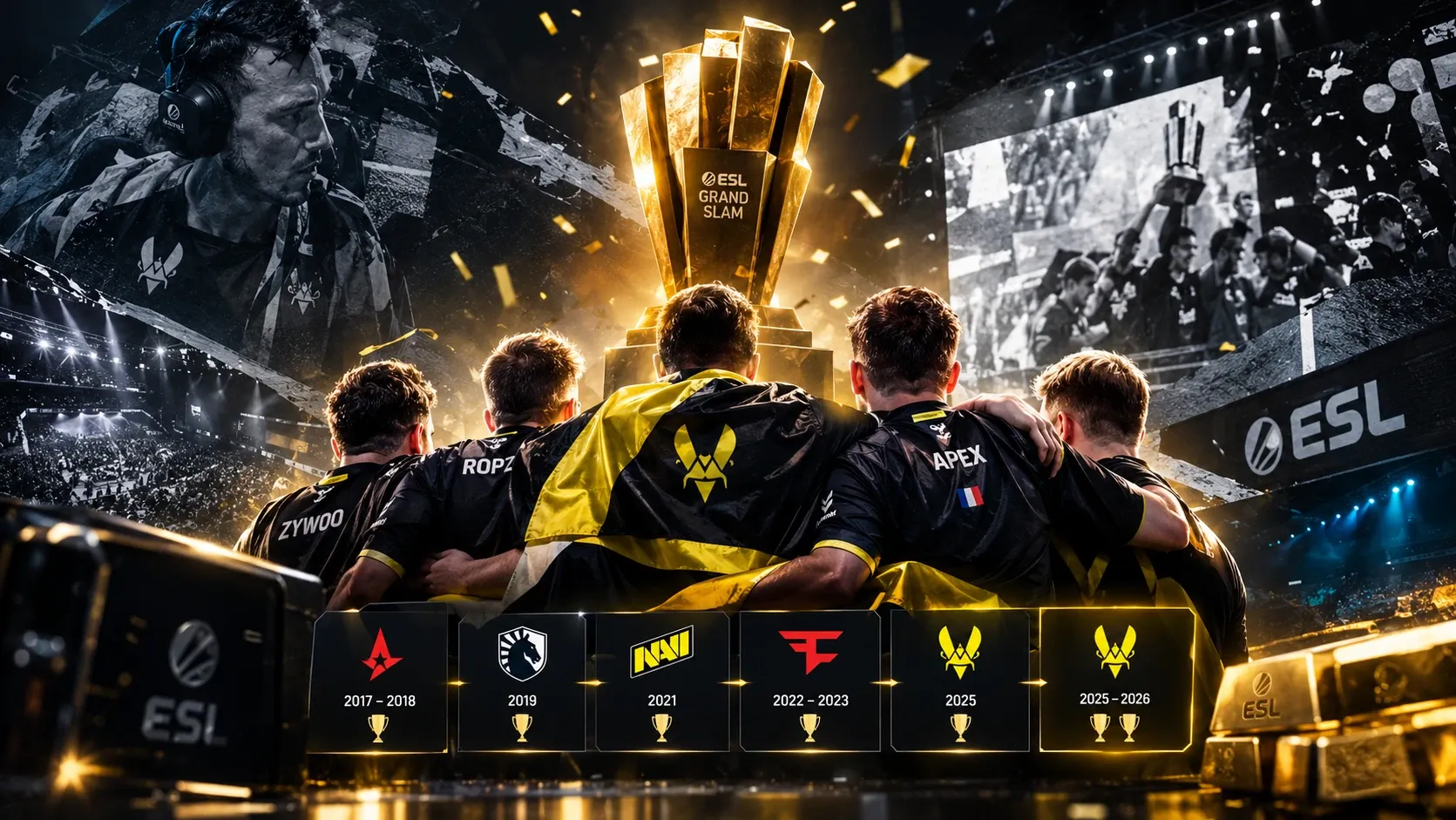
Ask a Counter-Strike fan what the biggest prize in the sport is and the answer is almost always a Major. Ask someone who has won both and you may hear something different. After IEM Rio 2026, Vitality's in-game leader apEX said the ESL Grand Slam is harder to win than a Major. Once you see the rules, it is easy to understand why.
How the Grand Slam Works
The idea is simple to state and brutal to execute. A team has to win three ESL Pro Tour Masters events and one ESL Pro Tour Championship event, which means IEM Kraków (the event formerly held in Katowice), IEM Cologne, or a Major run by ESL. All four wins have to land inside a window of ten consecutive events. The prize is $1,000,000, and according to Liquipedia it goes straight to the players. The trophy is a set of gold bars.
A few extra rules make it tougher than it sounds. The same core of three players has to be on the roster for all four winning finals, though teams can swap the other spots between tournaments. A player who leaves and competes in a Grand Slam event for another team gives up any claim to his old team's prize. Results from a finished Grand Slam never carry over, so every new race starts from zero. There is also a $100,000 spoiler bonus for any team that beats a contender in a grand final and stops the Slam from being completed. Reporting in late 2025 noted that nobody had collected it yet.
These rules have been adjusted more than once over the years, so ESL's own Grand Slam page is the place to check the current version.
Where It Came From
ESL launched the prize in 2017 as the Intel Grand Slam, a partnership between the organizer and the chipmaker. The name stuck for years. In 2025 it became the ESL Grand Slam, after ESL clarified that the prize was no longer part of its renewed Intel partnership.
Every Winner So Far
Astralis took the first one. Their season ran from July 2017 to December 9, 2018, when they beat Liquid 3-1 in the EPL Season 8 final in Odense.
Liquid won season two, and they did it faster than anyone since. They took four qualifying events back to back between February and July 2019, a run of just 143 days, and clinched it at ESL One Cologne 2019 with a 3-1 win over Vitality.
NAVI's season three stretched across the pandemic years, with cancelled events scrambling the calendar. They finished it at EPL Season 14 on September 12, 2021, beating Vitality 3-2 in the final.
FaZe won season four. They opened with a 3-0 sweep of G2 at IEM Katowice in February 2022 and clinched in Malta on March 26, 2023, beating Cloud9 3-1 in the EPL Season 17 final. That roster included both ropz and Twistzz.
Vitality finished season five at IEM Melbourne on April 27, 2025. They beat Falcons 3-2 in a final that needed triple overtime on the deciding map.
Notice who keeps showing up on the wrong end of those clinchers. Vitality lost the final that completed Liquid's Slam in 2019 and the one that completed NAVI's in 2021, then came back to win two of their own.
Vitality's Record Double
Season six began at IEM Dallas in May 2025. Less than a year later, on April 19, 2026, Vitality walked into the final of IEM Rio needing one more win. They beat Spirit 3-0, taking Mirage 16-13 in overtime, Nuke 13-10, and Dust2 13-5. ESL called it the first back-to-back Grand Slam in Counter-Strike history, worth a second $1,000,000 bonus. The final drew 26,000 fans to the Farmasi Arena in Rio de Janeiro and a peak online audience of more than 1.1 million, according to ESL.
The result also made history for one player. ropz now has three Grand Slams, with FaZe in season four and Vitality in seasons five and six. He had been tied at two with Twistzz, who won with Liquid in season two and FaZe in season four. apEX also holds two, both with Vitality.
Why It Is So Hard to Win
A Major is one tournament. A team can catch fire for two weeks, lift the trophy, and be remembered forever. The Grand Slam asks for something different: sustained excellence across ten events, usually spread over a year or more, through injuries, roster changes, and travel.
It also only counts ESL events. Vitality won PGL Cluj-Napoca and BLAST Open Rotterdam in 2026, two big titles, but neither moved the Grand Slam clock because neither is an ESL tournament. A team can look unbeatable for months and still be nowhere near the finish line if the wins come at the wrong events.
The numbers show how rare it is. Six seasons have been completed in under nine years, and only one organization has finished more than one.
What Comes Next
Season seven started at IEM Atlanta in May 2026 with the slate wiped clean. Every team, Vitality included, has to build the same combination of ESL wins inside a fresh ten event window, with a three player core that stays intact. Whether anyone can do it, and how fast, is one of the quieter storylines of the season.
Test Your Knowledge of the Scene
Knowing how the sport's biggest prizes actually work, and who has won them, is the kind of detail that separates casual viewers from people who really follow this game. The mini games on CS Guess test that same kind of knowledge, covering prices, rarity, and the history behind this game, with free perks for playing well.
Head over to CS Guess and see how much of this scene you really know.