Why the M4A4 Howl Is the Only "Contraband" Skin in CS2 (And Why It'll Never Happen Again)
There's exactly one skin in the entire history of Counter-Strike that carries the rarity tier "Contraband." It's not the rarest pattern, it's not a tournament exclusive, and it wasn't handed out during some legendary in-game event. It exists because of a copyright scandal, a DMCA notice, and a decision by Valve that they have never repeated since. This is the story of the M4A4 Howl, and why nothing will ever join it in that tier again.

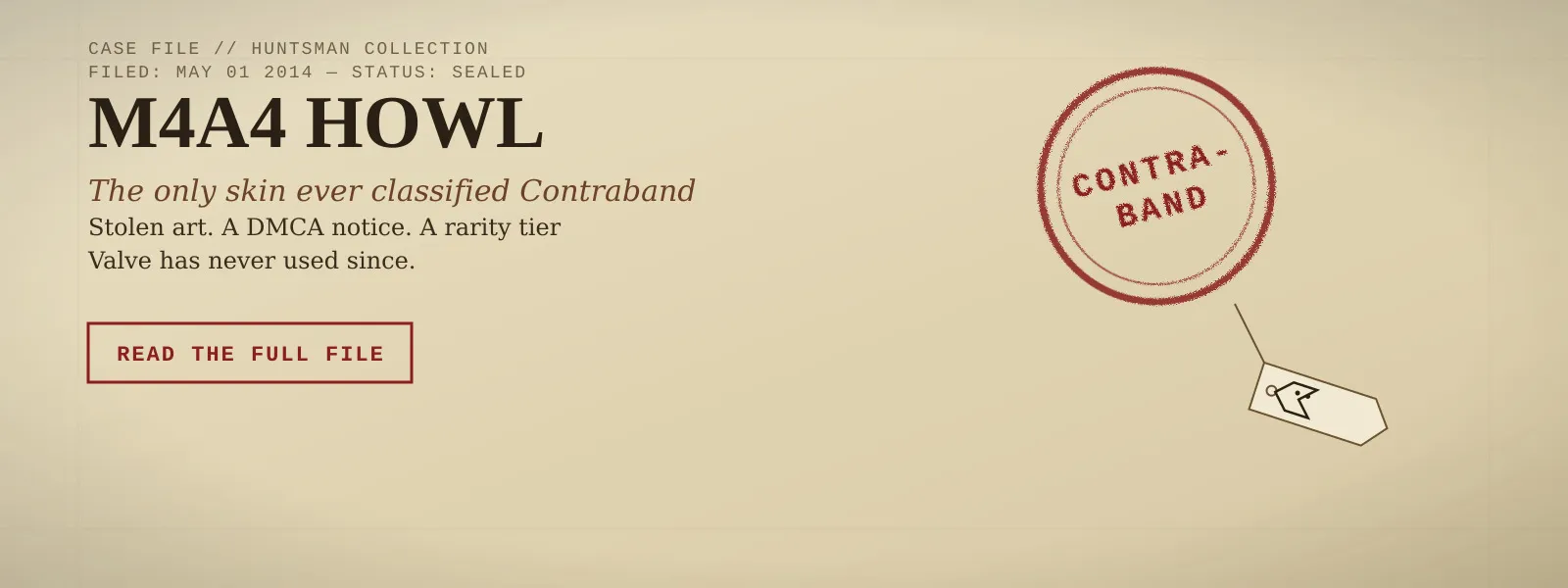
Open up the rarity filter on any CS2 marketplace and you'll see the usual tiers stacked in order: Consumer, Industrial, Mil-Spec, Restricted, Classified, Covert. Then, sitting by itself above all of them, there's one more category with exactly one item in it. Contraband. Just the M4A4 Howl, and nothing else, ever.
That alone is enough to make it one of the most talked-about skins in the game. But the reason it sits there completely alone isn't some clever rarity design from Valve. It's the result of a genuine copyright dispute that turned a community-made skin into the only item of its kind in Counter-Strike history, and understanding that story is the only way to really understand why the Howl commands the kind of money it does.
How a Community Skin Almost Wasn't a Big Deal at All
Back in 2014, Counter-Strike still relied heavily on the Steam Workshop for new skin designs, where community artists could submit their own weapon finishes and hope Valve would pick theirs for an official case. Two workshop contributors going by the names Auzzii and sic submitted a design called "Howling Dawn," featuring a stylized wolf's head wrapped in flame across the M4A4. It was a striking piece of art, and the community responded to it immediately, racking up thousands of positive votes on the Workshop page.
Valve noticed the popularity and added it to the game as a Covert-tier skin in the Huntsman Collection, released as part of "The Hunt Begins" update on May 1, 2014. For a little while, it was just another new skin players were excited to unbox, no different from dozens of other community designs that had made it into cases before it.
The Copyright Problem Nobody Saw Coming
Not long after release, an artist on DeviantArt using the handle CanisAlbus noticed something uncomfortably familiar about the new skin. The wolf design bore an extremely close resemblance to their own artwork, which had been published online well before the Workshop submission ever existed. According to accounts from that time, no permission had been sought and no credit had been given.
CanisAlbus filed a DMCA takedown notice, and Valve, facing a legitimate copyright infringement claim, had to act fast. The skin was pulled from circulation, the artists behind the submission faced community bans over the incident, and Valve set about replacing the underlying artwork with a redesigned version to resolve the legal issue entirely.
Why Valve Created an Entirely New Rarity Tier Just for This
Here's where the story goes from "skin got pulled for copyright reasons" to "skin becomes the single most unique item in Counter-Strike history." Rather than simply deleting every existing Howl from player inventories, which would have effectively stolen the item from people who'd legitimately unboxed it before the dispute, Valve chose a different path. They updated the artwork to resolve the legal issue, then created a brand new rarity classification that has never been used before or since: Contraband.
Every Howl that existed at that point in time kept the skin, just permanently frozen in supply. No new Howls can ever enter circulation through drops, cases, or trade-ups, because the item that originally generated them no longer exists in an obtainable form. What's out there right now is genuinely all that will ever exist.
Valve has never repeated this. Other skins have run into copyright or trademark disputes over the years since, and in every one of those cases, Valve handled it quietly through removal or replacement rather than creating another one-of-a-kind rarity tier. The reasoning tends to get discussed a lot in the community, and it makes sense when you think about incentives: if using stolen or disputed artwork could result in your skin becoming permanently frozen and insanely valuable, you'd be handing bad actors an actual reason to manufacture copyright disputes on purpose. Contraband exists exactly once, specifically so nobody has a financial incentive to try to make it happen again.
What the Howl Actually Costs Today
Because supply is permanently capped and demand has only grown as the game's playerbase has expanded, Howl prices have climbed steadily for over a decade. Battle-Scarred copies sit at the more accessible end, generally in the low thousands of dollars. Clean, low-float Factory New copies push into the tens of thousands. StatTrak Factory New examples, especially ones carrying rare early tournament stickers like the 2014 Katowice holo capsules, have been reported selling for well over $200,000 in private trades.
Even the discontinued "Howling Dawn" sticker connected to the original controversy still trades on its own, since it was pulled from cases alongside the weapon skin itself and carries its own piece of the story.
How the Howl Stacks Up Against Other Grails
If you've read our breakdown of the Karambit Blue Gem, you already know that CS2's most valuable items tend to earn their price through one of two paths: pure mathematical improbability, like a Blue Gem pattern nobody could ever force to happen, or absolute fixed scarcity created by outside circumstances, like a permanently frozen supply. The Howl is the clearest possible example of that second path. Nobody is chasing a lucky roll on this one. Every single copy that will ever exist already exists, and that number only ever goes down as accounts get banned, items get lost, or long-term holders simply never sell.
That distinction matters if you're trying to understand CS2's high-end market as a whole. Pattern-based grails like the Blue Gem depend on odds. Scarcity-based grails like the Howl depend entirely on the fact that the door behind them has been permanently welded shut.
Watch Out for Fake Listings
Wherever there's a five- or six-figure skin, there are people trying to scam their way around it, and the Howl gets targeted constantly because its story is so widely known. Be especially careful of listings claiming to be a Howl at a price that seems too good given current market rates, screenshots without a working inspect link, or sellers pushing you toward a direct trade instead of a reputable middleman or established trading platform. If someone's offering you a deal on a Contraband skin that sounds unusually generous, that's exactly the moment to slow down and verify everything before you commit to anything.
Would You Have Recognized It Back Then?
Part of what makes the Howl's story so fun to look back on is that, for a brief window in 2014, it was just a new skin in a case like any other. Nobody unboxing it that week knew they were holding onto what would eventually become the single rarest classification in the entire game.
That's honestly the appeal behind testing yourself on skin history and pricing over on CS Guess. You get thrown real items, real prices, and real rarity questions, and you find out pretty quickly whether you'd have clocked the Howl's future value back when it was still just another wolf-themed rifle skin, or whether you'd have skinned right past it without a second glance. Playing through the rounds also earns you free daily perks along the way, so even a wrong guess on a seven-figure grail still gets you something out of it.
Head over to CS Guess and see if your eye for skin history holds up. The next Contraband-level story might already be sitting in someone's inventory right now, completely unnoticed.