Why CS2 Community Servers Basically Disappeared (And What Replaced Them)
Ask anyone who played CS:GO for years outside of ranked matches what they miss most, and a huge number will say the same thing: the community servers. Surf, KZ, jailbreak, zombie escape, entire subcultures with their own maps, their own communities, and their own regulars. Almost none of that carried over cleanly into CS2, and the reasons why involve a genuine engine problem, not just neglect.

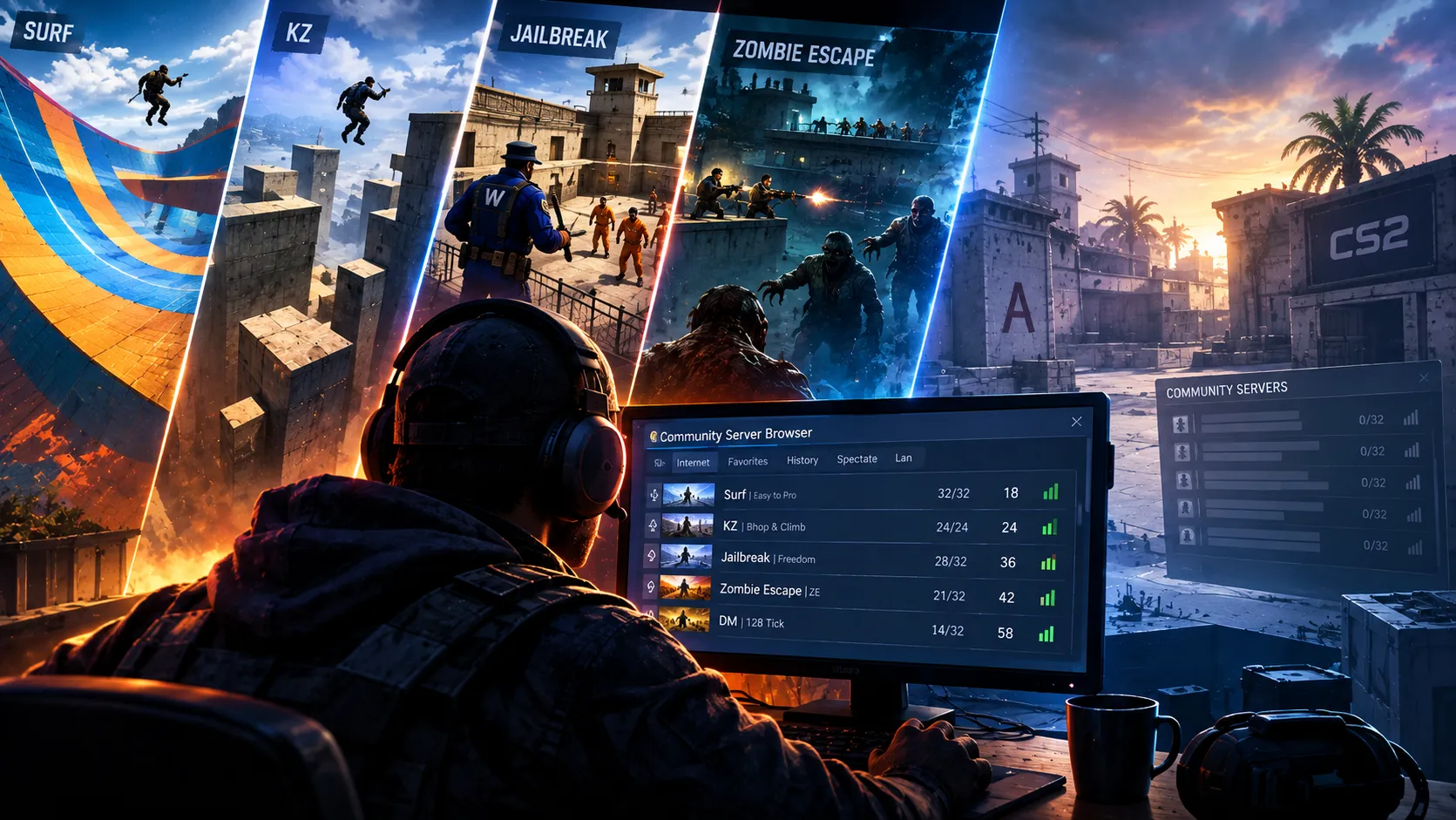
For a huge slice of the CS:GO playerbase, competitive matchmaking wasn't even the main event. It was community servers, and when CS2 arrived, that entire world mostly didn't come with it.
What Actually Existed Before
Across roughly a decade of CS:GO, an enormous, self-sustaining ecosystem of player-run servers grew up around the base game. Surf servers let players fly across sprawling, physics-based maps with no shooting involved at all. KZ and bunnyhop servers turned movement itself into the entire game. Jailbreak servers built out entire role-play style scenarios with wardens and prisoners. Zombie escape servers pitted a handful of infected players against dozens of survivors on massive custom maps. None of this came from Valve directly. It came from community mapmakers and server operators refining these formats for years on top of Source engine tools, often running on tick rates and configurations the community had tuned well past anything Valve shipped by default.
Why the Transition to CS2 Broke Almost Everything
CS2 moved the game onto Source 2, and that engine change is the actual root of the problem, not simple neglect. The custom maps, scripts, and server-side plugins that powered surf, KZ, jailbreak, and zombie escape were all built for Source 1's tools and architecture. Moving that work to Source 2 wasn't a copy-paste job, and in a lot of cases it meant rebuilding core systems from scratch, which most community developers either haven't done or couldn't easily justify doing for a hobby project. CS2 also launched without community servers functioning in any real sense, and even after Valve brought back a server browser, the population and quality of what's actually running has never come close to matching what CS:GO had built up.
The surf and KZ communities were hit especially hard by this. Those formats depended entirely on precisely tuned server configurations that had been refined through years of community feedback, and CS2's different movement feel combined with the missing infrastructure left very little of that foundation intact. Valve did eventually ship its own official versions of some casual modes, including deathmatch and, more recently, an official Retakes mode. Longtime community members have generally described these as noticeably rougher than the community-built versions that came before them, which is part of why a lot of players didn't simply migrate over to Valve's native alternatives once they existed.
What's Actually in the Community Server Browser Today
If you open CS2's community server browser now, servers do technically exist, but the experience is a shadow of the CS:GO version. Population counts are frequently misleading, with a number of servers showing suspiciously full lobbies that turn out to be filled largely with bots rather than real players. English-language, populated servers running specifically the classic formats, surf, KZ, jailbreak, zombie maps, are genuinely hard to find compared to how common they were during CS:GO's peak. Some players have turned to third-party, community-run server browser websites instead of CS2's built-in one, specifically because Valve's own browser has been widely described as unreliable at actually surfacing active, populated servers.
Adding to the frustration, CS:GO itself was not preserved as an independently playable game the way older Counter-Strike versions were. Counter-Strike: Source, for example, is still fully accessible and still gets the occasional patch. CS:GO's own community server browser was deliberately disabled once CS2 launched, though a legacy branch of CS:GO can still technically be accessed through Steam's beta options, and some old server IPs still connect if you know where to look.
The Theory That Keeps Coming Up
A specific belief shows up constantly in community discussions about this topic: that Valve deliberately let the CS:GO community server ecosystem wither, and didn't prioritize rebuilding it in CS2, specifically to push the entire playerbase toward competitive matchmaking and Premier, where the game's economic and esports interests are concentrated. It's worth being clear that this is a community theory rather than anything Valve has confirmed, and there's no public statement from Valve explaining a deliberate strategy along these lines. What's not in dispute is the outcome. Whatever the intent actually was, the practical result has been a CS2 experience heavily centered on ranked and casual matchmaking, with the sprawling, informal server culture that used to sit alongside it reduced to a fraction of its former scale.
What This Actually Means for Players Now
If you're new to the series through CS2 specifically, you likely never experienced what's actually being mourned here, and that's a genuinely different starting point than the one longtime players are working from. If you did grow up on CS:GO's surf and jailbreak scene, the honest picture is that a smaller version of that culture survives in CS2, but finding an active, well-populated server running the specific format you're looking for takes real effort compared to how it used to work, and Valve's own official replacements have generally been seen as a downgrade rather than an even trade.
Keep the Culture Alive a Different Way
Community servers were never just about the gameplay itself, they were about a shared culture built up over years by people who cared enough to keep refining it. That same kind of deep, genuine engagement with this game's culture is exactly what the mini games on CS Guess are built around, testing your knowledge of prices, rarity, and history, with free perks for playing well.
Head over to CS Guess and put your knowledge of this game's history to the test.