Some moments in Counter-Strike never fade, and not all of them are good ones. Olofboost is one of the most discussed controversies the game has ever produced, and it began with a comeback nobody had seen coming.
This article tells what happened and what changed. It does not explain how any boost worked, and nothing here should be read as a guide.
The Setting
DreamHack Winter 2014 was the fourth Major in Counter-Strike: Global Offensive history. Fnatic arrived as favorites, having won the three LANs before it. Their quarterfinal opponent was Team LDLC, a French lineup, and the deciding map was Overpass, which had only joined the Active Duty pool in July 2014, so no team had much experience on it.
The Comeback
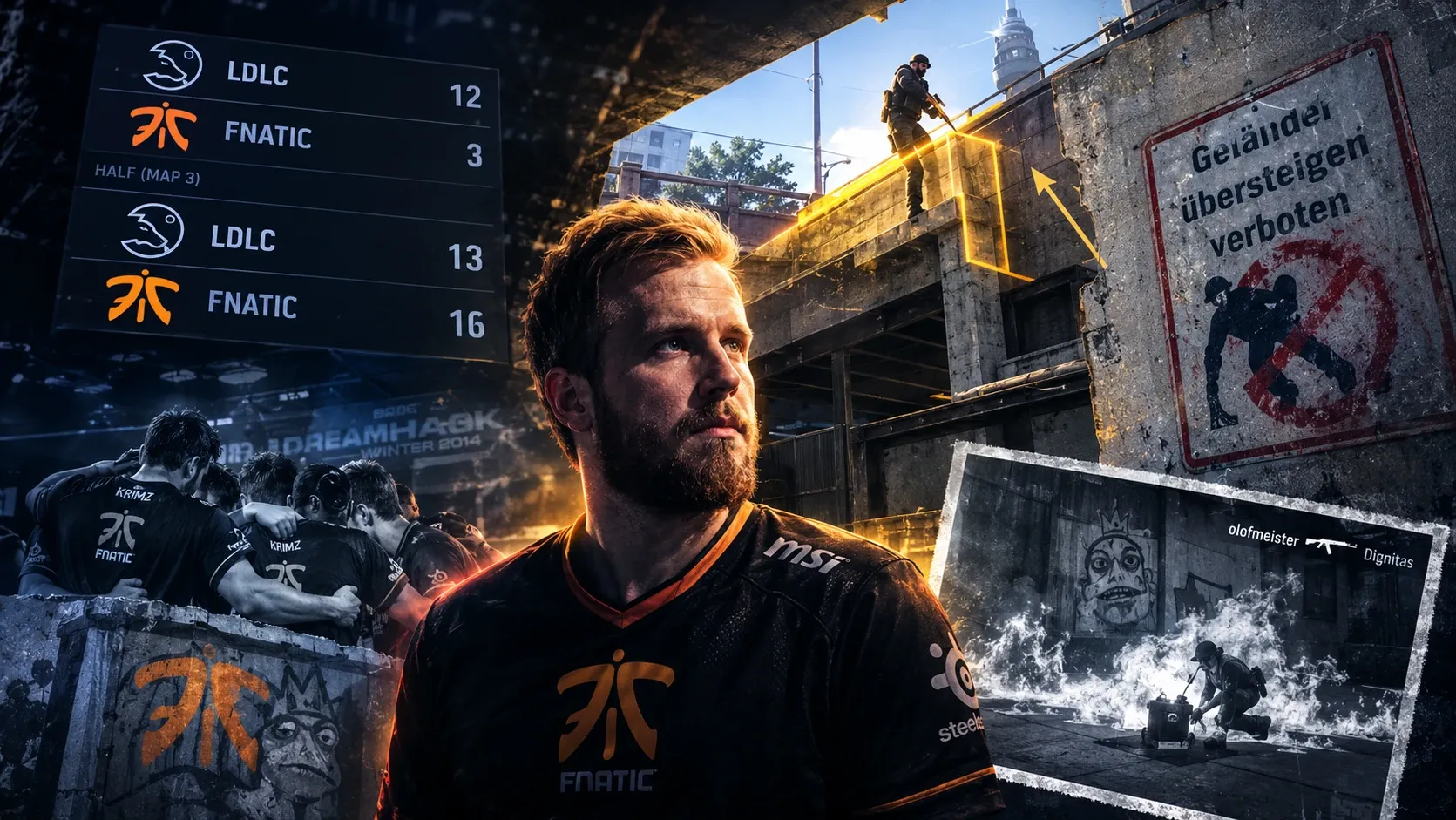
LDLC took control. According to one account, they led 12-3 at the half of the deciding map. Fnatic switched to the Counter-Terrorist side, and Olof "olofmeister" Kajbjer Gustafsson used a boost that gave his side a view of much of the map from a spot players were never meant to reach.
Fnatic won 13 rounds in a row and took the map 16-13, completing a comeback from a position that had looked hopeless. Liquipedia notes the boost was used in 13 of their 14 Counter-Terrorist rounds. Sources differ slightly on the score at the half, with Wikipedia describing a 13-3 deficit, so treat the exact figure as approximate.
The Ruling
LDLC filed a complaint, and DreamHack reviewed the match. Because the boost put a player somewhere the map did not intend, it was treated as an exploit under the tournament's rules. Further investigation also showed that LDLC had used a similar boost earlier in the match, so DreamHack decided the entire game would be replayed.
Fnatic did not replay it. They forfeited the match, becoming the first team in Major history to do so, and were eliminated. Why they made that choice became a long running debate. Rumors circulated about the reasons, but none was confirmed, so I will not repeat them.
The Patch
Valve moved quickly. In a patch on December 4, 2014, it removed some overpowered boosts from Overpass. It also added a sign near the spot in German, "Geländer übersteigen verboten", which means "climbing over railings prohibited". It was a rare moment of Valve acknowledging a community controversy with a joke written into the map.
The Aftermath
For a while, Fnatic were isolated. Their former teammate Devilwalk later said they were cut off from the professional scene after the controversy. The community gave the incident several nicknames, including BoostGate, olofboost, and de_olofpass.
It did not break the team. Through 2015, Fnatic kept winning, taking events like DreamHack Open Tours, DreamHack Open Summer, and the first ESL Pro League finals. They then won ESL One Katowice 2015 and ESL One Cologne 2015, becoming the first organization to win two Majors in a row.
A Footnote on the Same Map
There is a small irony here. Months earlier, at ESL One Cologne 2014, olofmeister had a very different moment on Overpass: a defuse at 14-14 against Dignitas while burning from an incendiary, which killed him just after the bomb was defused. That play was immortalized as a graffiti on the map, and according to Hotspawn it remains in the CS2 version of Overpass.
Overpass itself left the Active Duty pool in July 2026, when Cache returned. The map that gave Counter-Strike one of its most famous controversies, and one of its most beloved clutches, is now outside competitive play.
What It Left Behind
Olofboost changed how the community thinks about exploits. Pixel walks and similar tricks are barred at leagues like ESEA and FACEIT, and Valve treats them as exploits in matchmaking. More than anything, it became a reference point: the story people tell whenever a team wins in a way that feels like it should not count.
Test Your Knowledge of the Scene's History
Knowing the incidents that shaped this game helps you read the news around it. The mini games on CS Guess test that kind of knowledge, covering prices, rarity, and the history behind this game, with free perks for playing well.
Head over to CS Guess and see how much of this game's history you know.